https://planktonvalhalla.com/Plankton Valhalla2026-10-22T06:21:38.011Zhttps://github.com/jpmonette/feedLong essays by Marco Giancotti, published on Aether Mug.https://aethermug.com/favicon/favicon.icohttps://aethermug.com/favicon/favicon.icoCreative Commons CC BY-SA 4.0<![CDATA[Carving Nature at Your Joints]]>https://planktonvalhalla.com/20251219-carving-nature-at-your-joints/2025-12-19T07:11:15.000ZThese are the conclusions—or maybe a sort of capstone—for what you might call the Plankton Valhalla Purpose Series of essays, which you can find here:
We delved quite deep for just three essays. In this fourth and final piece, let me briefly retrace the path of our rabbit-hole exploration.
It all began with an observation: the "boundaries" we see in reality—the distinction between discrete "things" in the world around us, concrete or abstract—are figments of our imagination. The fundamental laws of physics do not account for any of them: boundaries shouldn't exist!
This is how we left the surface for our downward exploration. How can discernible patterns even exist? How can anything be stable and coherent in a universe that started as a giant explosion of randomness and unrelenting forces?
The second essay took us deeper. We found that recursion, the simple situation of something affecting its own future state, is all you need to turn randomness into patterns. The details of the exact processes don't matter here: if there is recursion, the differences concerned—however random, however small initially—can reinforce, erase, and clone themselves, creating repeating or otherwise predictable structures.
But patterns are not just the product of recursion: they can support still more recursion, with the same probability-amplifying effects. Thus patterns can form out of nothingness and build on top of themselves and each other, even mass-producing effects that would otherwise be almost impossible in a soup of erratic non-recursive interactions.
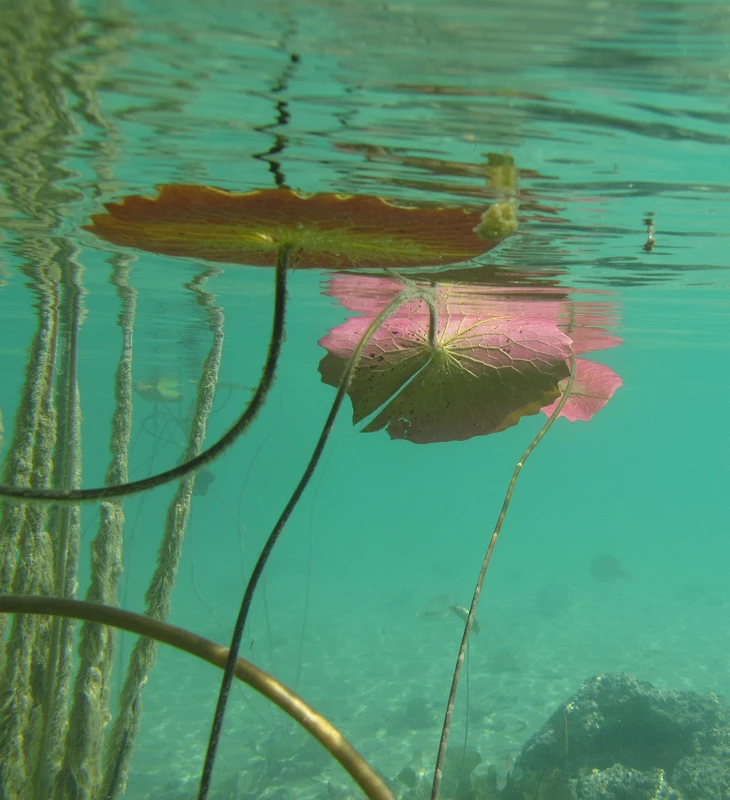
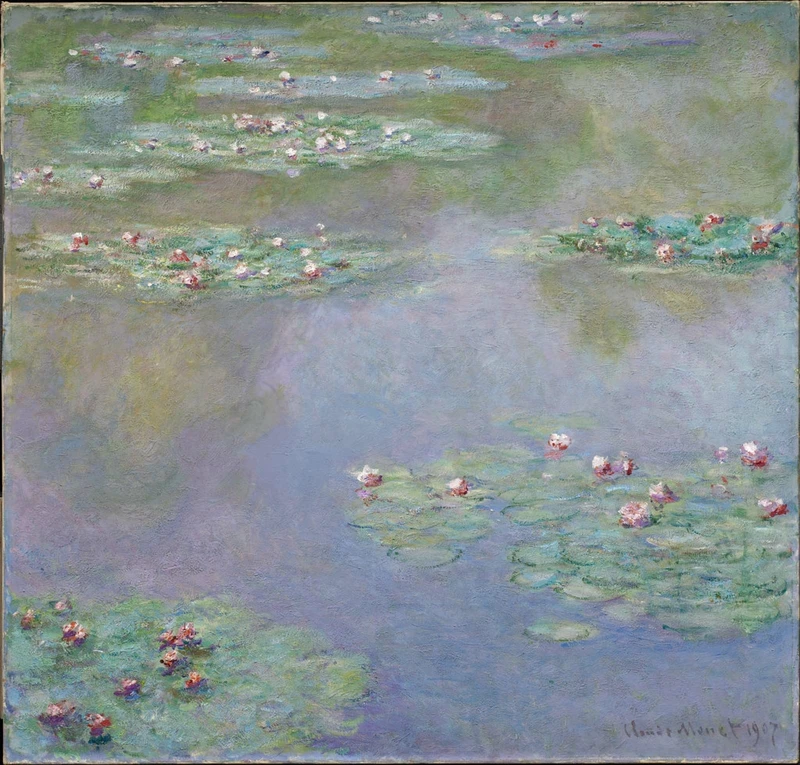
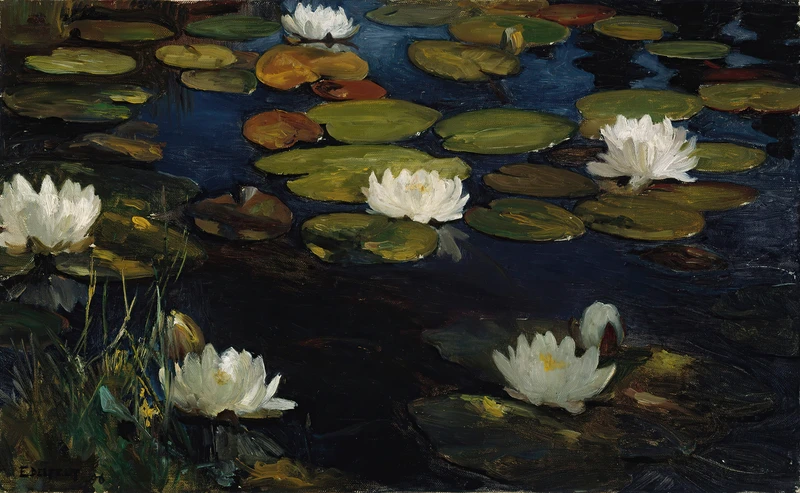
I call these unlikely-made-likely results of recursion Water Lilies. They constitute almost everything remotely stable and predictable in our Universe. But a fundamental problem still remained unsolved at this stage: where do boundaries come from? Why do Water Lilies feel not only distinct from each other, but also inevitable to us?
In the third essay, we reached the deepest point by partially answering that question:
human beings use imagined Water Lilies, called "goals", to design action plans in order to make useful things happen in reality, and
we're not very good at distinguishing between these Intentional Water Lilies and the more numerous Wild Water Lilies that happen by chance.
We constantly downplay how many non-intentional feedback loops there are, and how stupendously complex their outcomes can be. This bias towards seeing purpose in everything is understandable but, like all biases, it often leads to spectacular failures. It is often useful, but not always justified.
It's now time to return to the surface: how do all those boundaries come about, really? On the way back out of the depths and towards the answer, I will briefly touch on two major concepts: information and meaning. They might sound daunting, but with the thinking toolkit of recursion and Water Lilies they'll be a picnic for you.
What Information Really Is
(Photo by Ilse Orsel, Unsplash)
In this series (as in several other Plankton Valhalla essays) you've seen me throw the word "difference" around a lot. This term is not commonly used in the sciences, at least not with the technical connotation I use here. That's a pity, because it is a fantastic tool to understand the world. It's intuitive, because everyone knows what a difference is. There's no trick or mystery: a difference is simply something that distinguishes two things.
Yet, easy as it is, "difference" is a universal idea, perhaps the most universal possible, because nothing can exist without differences—no people, no planets or stars, no atoms or elementary particles, no time, no space. Everything exists as differences.
This concept is particularly useful because it affords us a straightforward, no-nonsense way to define information:
Information is those differences which make a difference.
This is a direct quote from Gregory Bateson, a renowned 20th-century anthropologist-cyberneticist and, as far as I know, the first to use the idea of differences as something more fundamental than information itself: there must be differences that don't make a difference, too, and those differences are not information.
To understand Bateson's reasoning behind his terse (and a little cryptic) definition, let us see how he applied it.
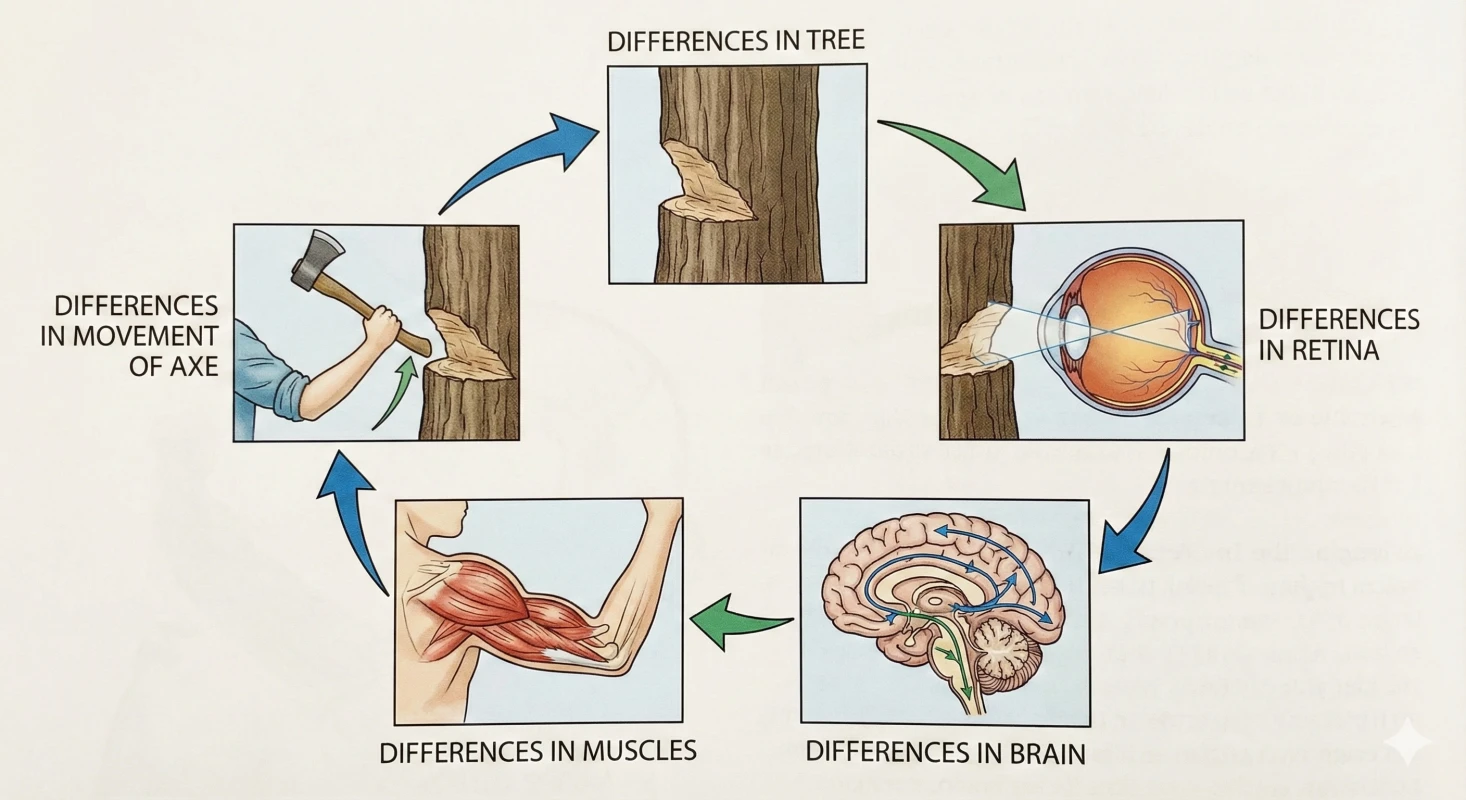
Consider a man felling a tree with an axe. Each stroke of the axe is modified or corrected, according to the shape of the cut face of the tree left by the previous stroke. This self-corrective ... process is brought about by a total system, tree-eyes-brain-muscles-axe-stroke-tree ...
More correctly, we should spell the matter out as: (differences in tree) - (differences in retina) - (differences in brain) - (differences in muscles) - (differences in movement of axe) - (differences in tree), etc. What is transmitted around the circuit is transforms of differences. And, as noted above, a difference which makes a difference is an idea or unit of information.
— Gregory Bateson, Steps to an Ecology of Mind (emphasis mine)
See all the familiar elements? He's talking about a recursive process—a self-correcting feedback loop—and the things going around this loop are differences. Not energy, not matter, just differences.
Each difference depends on the differences in the previous step: brain to muscles, muscles to axe, etc.
(Image by Nano Banana Pro—don't use it as an anatomy reference!)
This quote also demonstrates the relativity of boundaries, showing that we're actually talking about a single thing, the "total system, tree-eyes-brain-muscles-axe-stroke-tree". Bateson continues immediately after the above quote with a complaint about our tendency to consider our boundaries as absolute and fixed:
But this is not how the average Occidental sees the event sequence of tree felling. He says, "I cut down the tree" and he even believes that there is a delimited agent, the "self," which performed a delimited "purposive" action upon a delimited object.
— ibid.
Seeing things through the lens of recursion helps you break out of this ossification of mental boundaries, and it makes it clear how information flows: always in loops.
All that is left to clarify is this difference-making business. What for, and how?
Difference for What?
The raison d'être of all information's difference-making is, of course, purpose. Remove all goals and purposes, and randomness would reign supreme. Differences would still form loops (mindless recursion), but none of them would "make a difference".
Without purpose, you wouldn't bother learning new things and investing in your future, because why would you (the what-for kind of "why")? You would have no reason to obtain tools or stock food, nor to pay attention to anything beyond your immediate surroundings. Instinctive impulses may keep you alive for a while, but you're bound to ruin and starve yourself very soon—you wouldn't be aiming to stay alive, after all.
As soon as purpose comes into play, though, it automatically implies the existence of a plan. Suddenly every difference can be classified: is this difference important for the success of the plan or not? Does it further your sub-goals and increase the probability of realizing your final goal? Does it hinder, alter, or disrupt the plan? Or does it remain completely neutral with respect to that specific purpose?
The lumberjack felling the tree is a purposeful process—ready-to-burn lumber is not likely to arise unless the man's brain initiates the loop with that specific outcome in mind. He is undoubtedly the starting point of the feedback loop, but, as soon as it gets started, the boundary of what is significant expands to include all involved elements, his brain only a member among many. The "transforms of differences" that Bateson described—(differences in tree) - (differences in retina) - (differences in brain)...—count as information as long as they contribute to the execution of the lumberjack's plan.
To put it another way, the differences that don't make a difference for his plan are not information: the subtle creases in the bark of the tree, the unlucky worm that finds itself on the axe's path, the soft breeze caressing the man's brawny arms, the image of nearby birds impressing themselves on his retinas, and so on. None of this is relevant to the tree-felling plan.
The technical term for differences that don't make a difference is "noise". Noise is what we want to ignore in order to focus on the things that do matter.
To recap:
no purpose → no plan;
no plan → no difference-making;
no difference-making → no information.
[!aside] Aside: "Information" in Physics ⚛️
You'll often hear physicists talk about "information" in contexts where there clearly isn't an intrinsic purpose, like black holes and quantum interactions. This is a case of tolerated King-Midas effect.
Although they know that those systems have nothing to do with purposes and intentions, they find it convenient to imbue them with their own "observer goal". Since their purpose is to understand a certain physical phenomenon, automatically all differences that affect that phenomenon "make a difference", hence their use of "information".
I think this custom is ill-advised, because it introduces subjectivity, after the fact, into impersonal phenomena. Use "differences" instead!
Anyway, until my proposed terminology spreads to the whole field (it's just a matter of time now, I know it), remember that some scientists use the term in a confusing and misleading way. They really mean "differences".
What Does It Mean to "Make" a Difference?
The "difference made" by a piece of information is what we call meaning.
If information is about making some—any—difference, meaning is the specific difference being made in a given case. (A fancier way to say it is that meaning is the correlation of a piece of information with the successful execution of a plan.)
When you say that something is meaningful, you mean that it has a bearing on the achievement of one or more of your goals.
The position of the dent in the tree is meaningful to the lumberjack, because he uses that information to direct his next swing of the axe, pushing the world closer to his desired state of "tree is felled". The meaning of the dent, then, is the set of changes in brain patterns following its observation, as well as all the fine muscular adjustments in the man's arms as he swings the axe the next time, but also the new shape of the dent as a consequence of that new stroke... and so on, encompassing the whole cascade of consequences up to the final achievement of the goal.
The fact that the dent, at that particular time, is just so, and not otherwise, has an impact—however small—on the mode and timing with which the tree is felled and the purpose fulfilled. This impact is meaning.
(Photo by Jan Meeus, Unsplash)
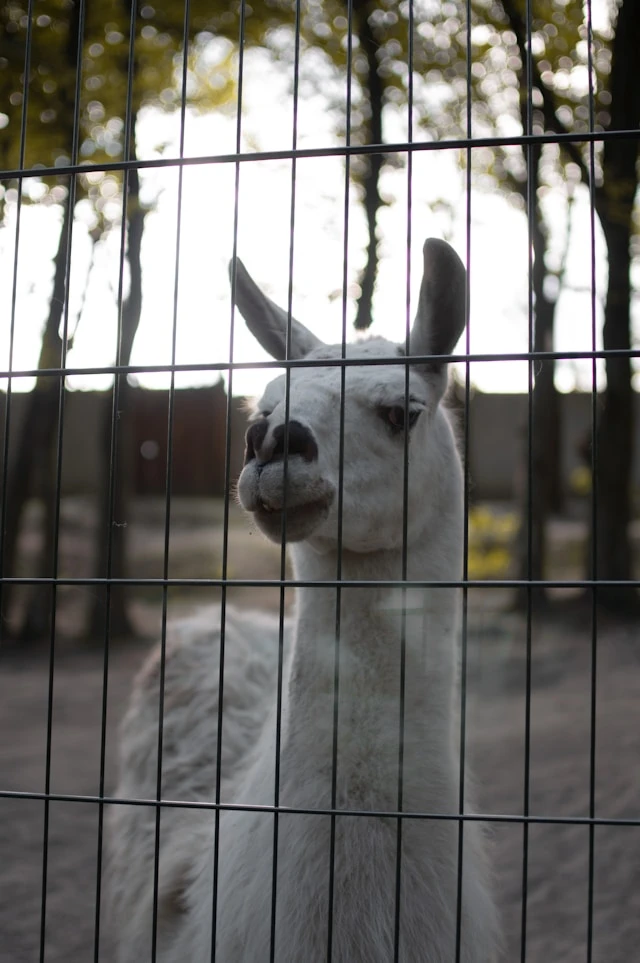
On the other hand, the chirp of a bird perched on a branch nearby is meaningless to the lumberjack in the context of his tree-felling plan. Of course, that same dent is meaningless to the bird (if it is not too close), who instead finds meaning in the calls of other birds. It may be hard to state exactly what that meaning is, but you can sum it up as "the differences in the bird's behavior compared to the case in which it had not heard those calls."
The implication is that it makes no sense to talk about the meaning of something if you don't know what purpose is involved.
All too often, people leave the purpose implicit when they communicate, assuming that other people will share the same goals as they do, only to be surprised when they find that those people see very different meanings in the same things. For example, the difference "it is raining" is "information" for both the bride on her wedding day and the farmer worried about the recent drought, but the meaning is very different for each of them. Since they have dissimilar goals, "it is raining" affects their respective plans in completely different ways.
Carving Nature at Your Joints
Something interesting is beginning to emerge. The presence of purpose creates this rather clean distinction between information and noise, between meaningful and meaningless. This distinction is a little blurry in practice, because information can have different "degrees of meaning", from "barely impactful" to "revolutionary" for your plans. But it is still clear in principle: if it has a detectable influence on the feedback loops of a purposeful process, it is meaningful, otherwise it isn't.
The late and great philosopher Daniel Dennett gave a good example of how this affects thought:
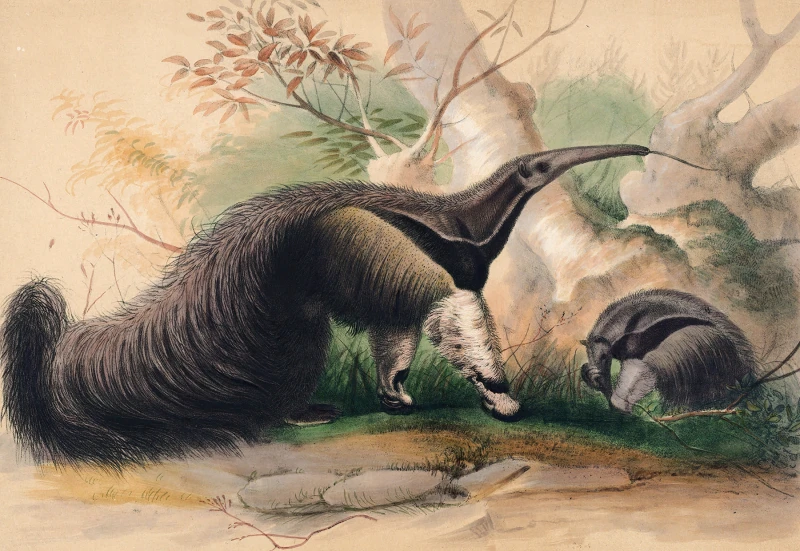
The anteater, unlike the insectivorous bird, does not devote its cognitive energies to tracking individual insects, sampling their trajectories, and making a fine-grained prediction of their future locations; it just averages over the ant-infested area, and lets its tongue take up the slack. A philosopher might say that "ant" is a mass noun in the anteater's language of thought; some regions have more ant in them than others.
— Daniel Dennett, Elbow Room
The Great Anteater, Joseph Wolf
A mass noun is a noun of which you can have amounts, but not individual units. "Jam" and "heat" are mass nouns because you can ask how much there is, but not how many. The opposite is true for count nouns like "fork" and "country". What Dennett is saying is that, for a bird, "ant" is a count noun, because it needs to hunt them one by one. The anteater, however, doesn't even have to look at the ants to eat them: it pours its incredibly long and sticky tongue into a hole in the ground, and collects a large amount of "ant" in a matter of seconds. The insects stick to the tongue in clusters, and are promptly sucked out of their nest and swallowed. When the beast finds that a place has little "ant" left, all it needs to do is to move on to another place where there's more of it.
For the anteater, the number of ants has no meaning. The difference between "this ant" and "that ant" plays essentially no role in achieving its caloric needs. Thus, no boundaries need exist in its mind between individual ants.
The "mental boundaries" of an animal like an anteater are probably hard-coded by evolution, dictated by their particular anatomy and pre-established foraging "plans". Humans make up for the shortness of their tongues with the nimble flexibility of their minds, but the effect is the same. We juggle multiple goals at once, accomplish some, give up on others, and adopt new ones all the time. The dense hierarchical web of our plans creates a legion of criteria for determining what is meaningful and what isn't—what warrants the drawing of a boundary and what doesn't. (Stalin might have had an anteater-like mindset when he allegedly said "one death is a tragedy; a million deaths is a statistic".)
Back to the Surface
The original, strange question that kicked off this series was this: if boundaries are in the eye of the beholder, why do you keep seeing them everywhere, and tend to believe them necessary, objective truths?
I can finally answer that question for you in one sentence: we see boundaries because we have goals; we have goals in order to stay alive.
To survive in a mutable world, we need to predict the future as well as possible. We need to make mental simulations of what would happen in hypothetical scenarios ahead of time. We set up goals and craft intricate webs of plans to make certain favorable states of the world much more probable than they would be otherwise. For any input of our senses, we feel the irresistible urge to assess its relevance to our goals—to know what difference, if any, it makes for our plans.
The search for meaning is built into how we work as organisms. Processing information is living.
But—guess what—our brains are smaller than the Universe. We need to use a few tricks to enormously simplify our inner simulations while retaining a modicum of useful foresight. We do that by only focusing on the few differences that make a significant difference for a given purpose, and ignoring all the rest. That is to say, in our minds we sever the countless ties and interactions that exist between things, retaining only the handful that we care most about.
Severing those ties has the effect of turning what is really a seamless network of connections into a set of discrete "things": the delimited agent called "lumberjack" acting on the delimited object called "tree"; the thing called "anteater" acting on the mass noun "ant".
In this manner—in the gaps left by this rough and subjective severing of links—boundaries arise in our perception of the world.
This is a dangerous gamble. It means that, if you make the mistake of hallucinating non-existent purposes, or of dismissing some feedback loops as meaningless "side effects", this mistake won't just lead to poor outcomes but warp your whole understanding and perception of reality at its very roots. Failing to assign purpose its proper, modest role means erecting mental walls where none exist and walking right into pits you just can't perceive. It means venturing into a world that fights against you from inside your own head.
But the same trick is also why you're able to say fancy things like “pass me the ketchup” and “the projections for our year-close budget ain’t pretty, folks.” This method of simplifying our simulations provides nothing less than the basis for all thought and communication. 💠
Notes
Cover picture: Buste De Jeune Fille Avec Un Couronne De Laurier, Henri Martin
]]>Marco Giancotti<![CDATA[Purpose from First Principles]]>https://planktonvalhalla.com/20251204-purpose-from-first-principles/2025-12-04T05:52:46.000ZThis is the third of four essays in a series. A summary of the previous two is in the text below, but I recommend you read them in full here:
It is the urgent and greedy desire of all wastes to expand and eat up more-fertile lands: this extension of their agonised peripheries lends them a semblance of the movement and life they once possessed.
— The Pastel City, John M. Harrison
The purpose of this last essay is to make sense of purpose.
This is one of the most important things to understand about how people work: purposes drive our actions, allow us to achieve things big and small, and mystify us without end. It is the life force of our unstoppable passion for telling stories. It keeps us alive and sometimes makes us accept or even seek death. So what in the world is it?
The first impulse is to reach out for the dictionary. Head over to Merriam-Webster's American English dictionary and look the word up, focusing only on its most relevant acceptation.
A grid of white, black, and green rectangles squeezing against each other. (Photo by Oli Bekh, Unsplash)
purpose (noun)
1a: something set up as an object or end to be attained : intention
Alright, but what is an "end", then? The dictionary has an answer ready.
end (noun)
4a: an outcome worked toward : purpose
This feels a little circular, but putting the two definitions together carefully we get: "a purpose is something set up as an object or outcome to be attained." This makes sense and matches our intuition, but it doesn't say much at all. We would like to know where those objects and outcomes come from, what it means to "set them up" and "attain" them. The definition doesn't give us any of that.
The Cambridge Dictionary to the rescue:
purpose (noun)
why you do something or why something exists
Yes, Cambridge. That is the question.
Having one or more purposes—chasing goals near and far—is an integral part of our lives. There is hardly a waking moment when you and I are not thinking about something to be achieved, or about the ways to achieve various things. I will go as far as saying that purposefulness is one of the most fundamental properties of human beings, and of many non-human beings too. Yet this same topic is the source of endless confusion, conflict—sometimes even angst. How does purpose work? Understanding that sounds like a good way to solve some of our thorniest problems.
The previous essay in this series prepared us to answer this question. In fact, we already began answering it a little. But let's go in order.
In the first installment, Boundaries Are in the Eye of the Beholder, we saw how the way we think about the world—made of separate, clearly labeled "things" that you can depend on to "be themselves"—is an illusion. The universe is governed by physical laws that are all about movement, forces, warping, and never about peacefully existing in a room in the shape of a sofa (as sofas do), or revolving around the sun in highly predictable ellipses (as you and I do). We see recurrent patterns all around us, patterns we label with names like "dog", "Africa", and "inflation", but they are not at all the obvious result of applying those physical laws. If you look at the physicist's equations, you'd expect the universe to be a big, homogeneous mess of random, indistinguishable fluctuations. Why all these seemingly predictable "things", then, and why such neat distinctions between them?
The second essay, Recursion, Tidy Stars, and Water Lilies, was all about answering that question. The answer was perhaps a bit surprising: at the most general level, what enables the formation of non-random patterns is recursion, i.e. when some phenomenon or interaction—including random ones—happens to affect its own future reoccurrence in any way.
I dedicated a good part of that essay to showing that recursion is responsible for almost everything we know and understand: inanimate things like all solid matter, the structure of stars, and the shapes of pebbles, as well as every directed act and function of living things, humans included. In short, through the action of feedback loops, recursion makes things happen that would otherwise be very unlikely to happen by chance alone.
These "unlikely patterns made likely by recursion" need a name, and I'm calling them "Water Lilies".
[!aside] Aside: Why "Water Lilies"? 🪷
Previously, I wrote about a few of the countless feedback loops that allow a water lily plant to become what it is and do what it does. My conclusions were:
The plant’s DNA isn’t a script to be executed, then, but a survival kit. It sets up the feedback mechanisms, and the plant uses those to improvise.
This means that the plant is the collection of its self-reinforcing and self-regulating processes. There is no separate architect or builder, only a thing blindly constructing itself with inputs from its environment.
I chose the image of this aquatic plant to represent the much broader category of all phenomena that "blindly construct themselves" like that—not only a flower blooming but also a star stratifying, a population revolutionizing its government, and almost every other phenomenon you can think of, from the very simple to those too complex to wrap your head around. They are all Water Lilies in this sense.
I always write the name of this new concept, "Water Lily", capitalized to distinguish it from its namesake plant, "water lily".
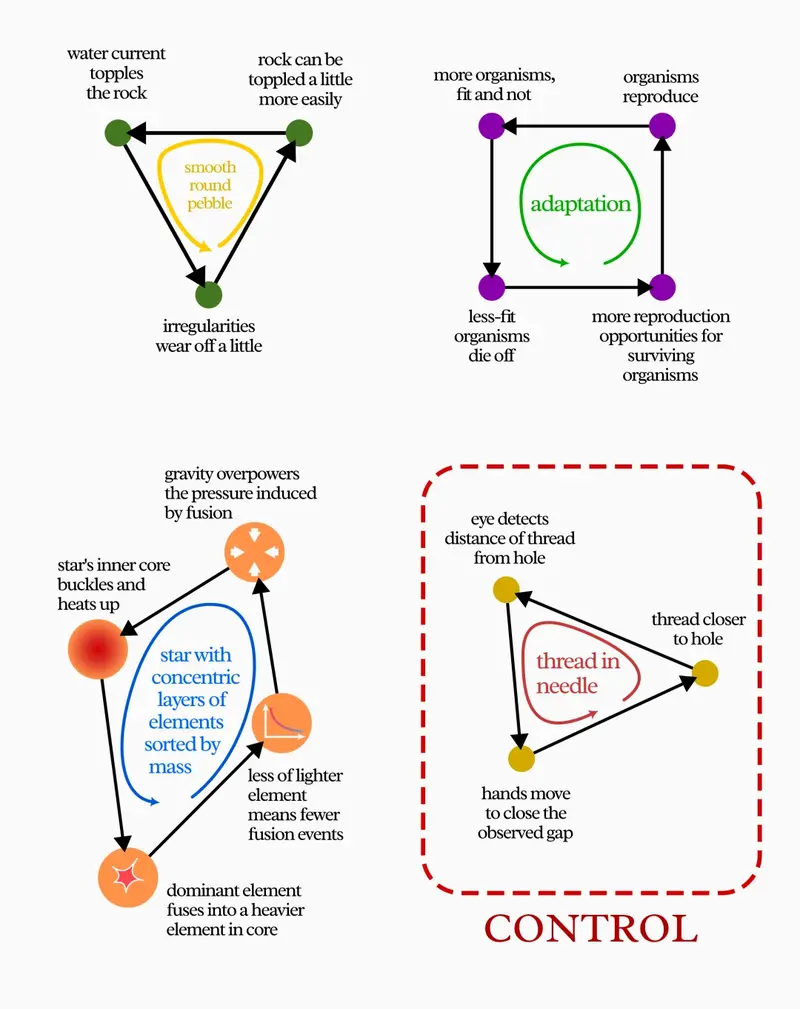
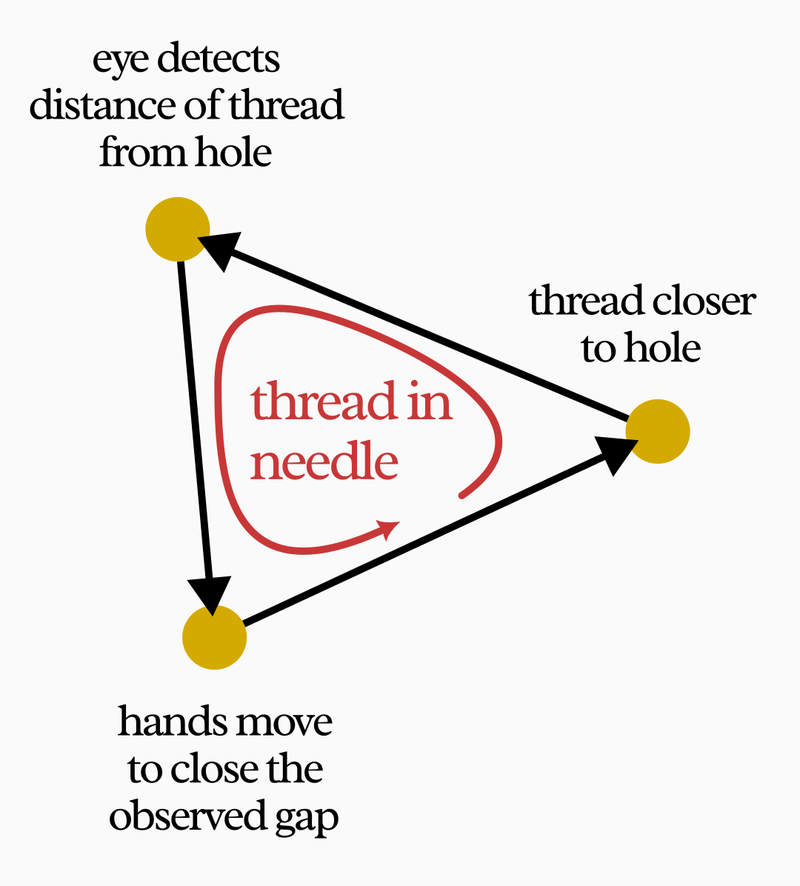
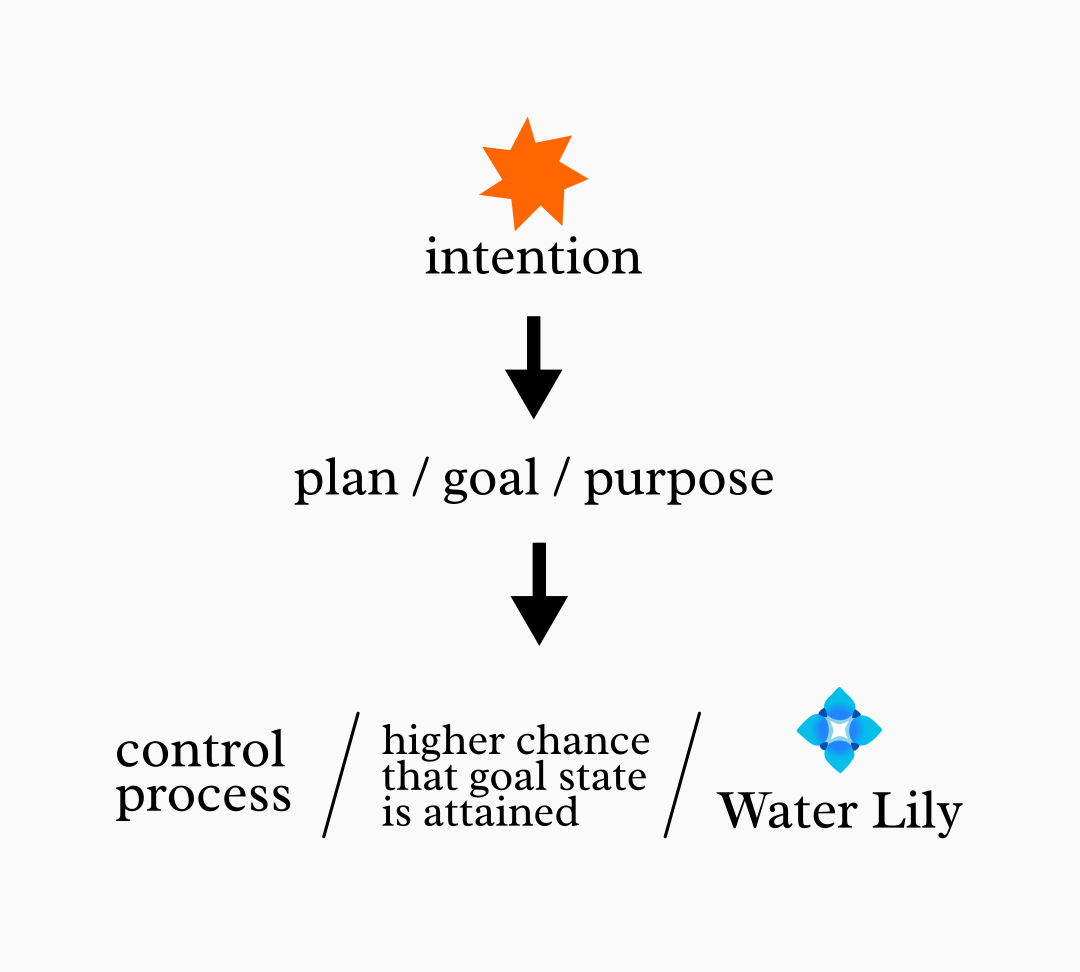
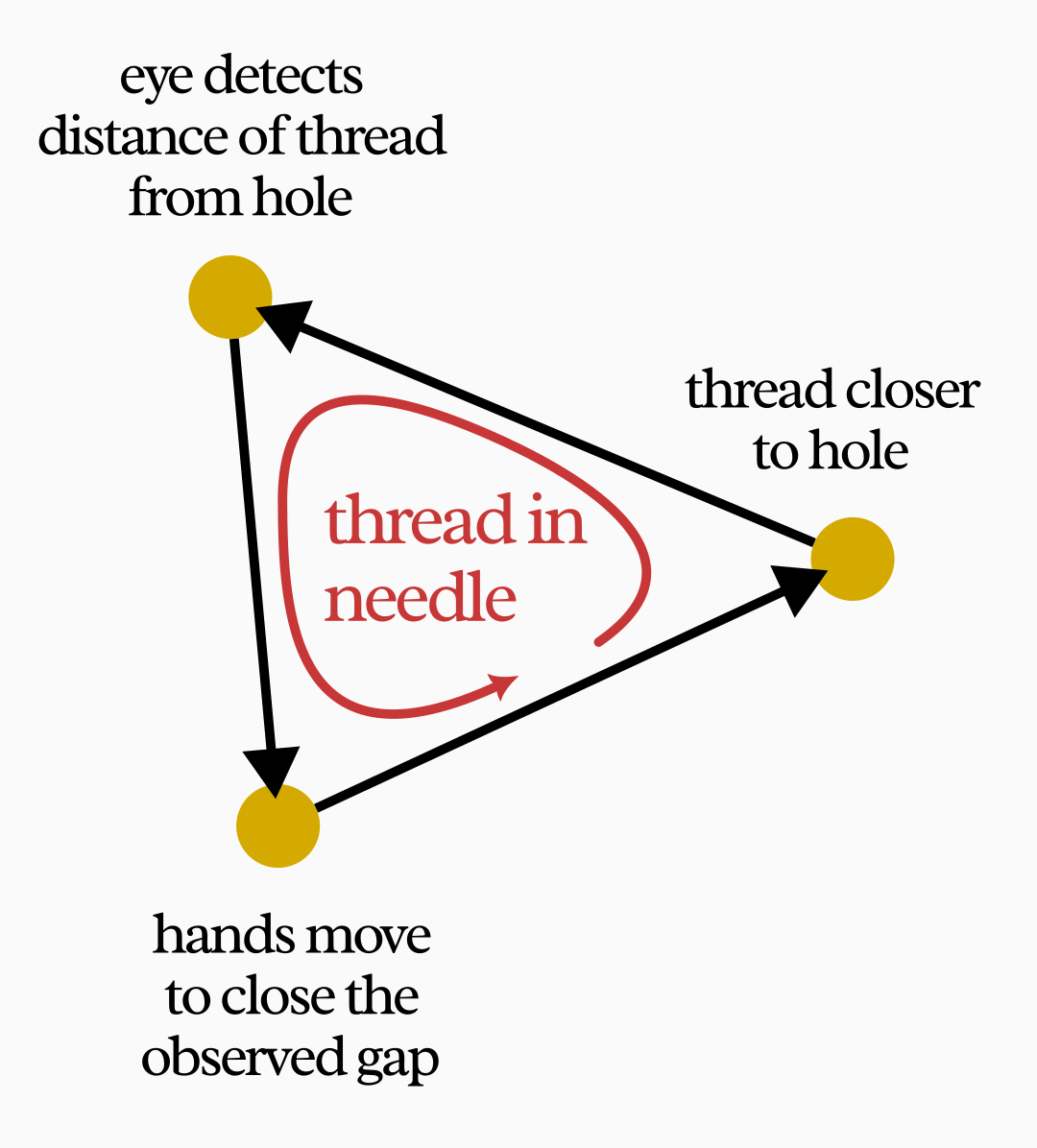
Here we are finally at the core of the matter. The feedback loops that enable recursion are exactly the same kind of process that happens in "control mechanisms"—both the engineered kind, like thermostats and cruise control, and the biological ones, like the hand-eye coordination needed to manually thread a needle. "Control & goals" are merely a special case of "feedback & Water Lilies".
In what follows I will show you the ways in which they are special. The distinction between purposeful behavior and purposeless phenomena is not in whether recursion happens (it does in both), but in how recursion affects us. We'll see that some objective properties of those recursive processes matter a great deal when goals are involved, and not at all when they aren't. Even the way we humans must engage with those purposeful loops is entirely different.
Once that is cleared up, the contours of purpose will be clearer, and the surrounding confusion much reduced. Not only that: we will get, almost for free, new clarity on other important-but-murky concepts like "meaning" and "information".
All this will finally lead us back to our first doubts from more innocent times: where do those boundaries come from? This is the topic of the fourth essay, Carving Nature at Your Joints, published separately.
We humans live and breathe purpose, but we often interpret it very wrong. A little more lucidity can only help. But first, how do we know that we misunderstand purpose despite ourselves?
Part 1: The Ills and Woes of Seeing Purpose Where Purpose Is Not
I'm not sure what this is all about, but apparently it's God's will that you leave this world.
— Mormon fundamentalist Dan Lafferty's words to his 24-year-old sister-in-law before slitting her throat and her baby's. (From Under the Banner of Heaven: A Story of Violent Faith, by Jon Krakauer)
A Civilization of Purpose-Dreamers
Humans seem to really, really want to find the purpose of things. This has the nice effect of making us "storytelling animals", because every story is the chronicle of intents fulfilled or thwarted. But the same tendency is also the cause of many of our self-inflicted torments. This has been going on for a very long time.
For the ancients, everything was imbued with intention—everything and everyone had a specific role and a reason to behave in a certain way. The Sumerians believed that people were built to support gods grown tired of working. They were a civilization of self-proclaimed slaves, and their social organization reflected that belief, with mandatory unpaid work in temples and in public projects. The Ancient Greeks, one or two millennia later, believed that earthquakes were caused by an angered Poseidon. After each disaster, they performed animal sacrifices, offerings and appeasement rituals—wasting resources precisely when they needed them the most.
Faith in deities was clearly a major factor. How many holy wars, following the presumed will of one god or another, have been waged throughout history? How many major life decisions have been taken based only on the belief that God wants it, or that God is there to make things right?
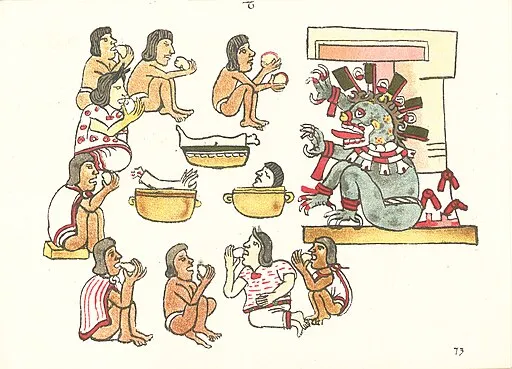
Human sacrifice was intended to pay back the debt that was formed when the gods used their own blood to create the world. The Aztecs believed that if they didn’t sustain the sun with blood, the world would come to an end.
But religions shouldn't get all the blame, because this human tendency to dream up purposes has always been a vice of scientific minds, too. When Kepler first proposed his new theory of elliptical planetary motion in 1609, he faced resistance by his peers, who preferred to believe long-dead Aristotle: celestial objects seek perfection, the Philosopher said, thus their goal must be to draw perfect circles in the sky.
Similar resistance to new discoveries continued through the nineteenth and twentieth centuries, and even into the twenty-first. At every step, scientific progress was hindered by this strange human desire to find and participate in plans that never existed.
Politicians and militants don't fare much better than religions and intellectual circles when it comes to attributing purposes accurately. Social Darwinists justify their ideology with the purported moral imperative of "biological progress", which has gifted the world with atrocious practices like eugenics, racism, and fascism.
Outside biology, this idea of "progress as a goal" has brought enormous harms on society by justifying colonialism and imperialism. The European conquerors believed they were on a benevolent civilizing mission, bringing the "advancements" of Western societies to the "stagnant" and "retrograde" cultures of their victims—whether those cultures asked for it or not.
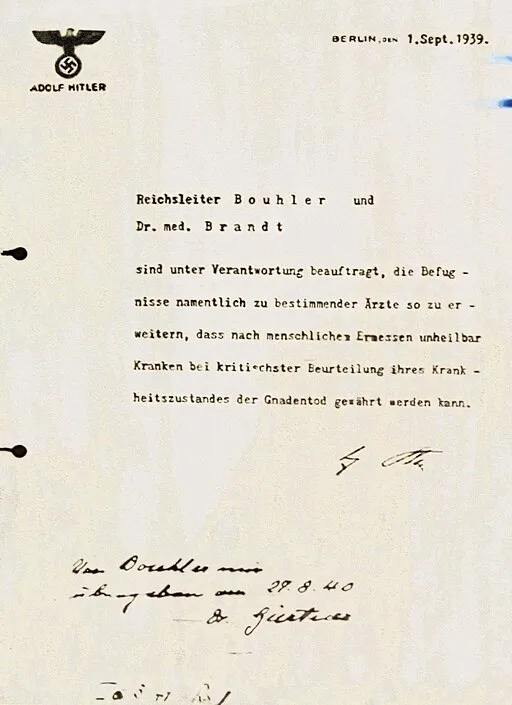
Hitler's Aktion T4 allowed the mass murder of people with disabilities, based on the narrative that ridding the earth of certain groups of people was a natural, preordained purpose: "Reich Leader Bouhler and Dr. Brandt are entrusted with the responsibility of extending the authority of physicians, to be designated by name, so that patients who, after a most critical diagnosis, on the basis of human judgment, are considered incurable, can be granted mercy death. -- A. Hitler"
But are we better today than our ancestors at keeping a balanced view of what does and does not constitute a real purpose? Not in the least!
I won't even get into the big modern conspiracy theories, except to point out that they are all, by definition, variants of the idea of a "grand hidden purpose" at play at the expense of their believers. But even excluding conspiracists, modern people are prey to purpose-dreaming just as often—and as badly—as those who came before us.
Take superstition, for instance. According to a 2020 survey, approximately 25% of U.S. adults and 62% of German adults self-identify as superstitious. Although not all forms of supersition are beliefs in nonexistent goals, most of them are. For example, according to an Indian poll, 60% of patients believe that their health is at the whim of luck or supernatural forces: hidden plans and purposes. It is fair to assume that the numbers are in the same ballpark in most other countries.
Often, such beliefs directly or indirectly harm those who hold them. In some documented cases from India and Nigeria, people were observed delaying medical treatment in favor of traditional healing practices relying on the intervention of spirits and gods, increasing the mortality rate of preventable diseases. Also, Belgians and Americans who self-identified as superstitious reported feeling more helpless and fearful during the COVID pandemic. Belief in the supernatural also exposes people to exploitation by gurus, who force their followers to "donate" money and labor, and emotionally blackmail, coerce, sexually abuse, depress, and traumatize the majority of them in the name of grand divine schemes.
Although society is indeed full of purposeful behaviors, where actual people and other creatures do things with real, specific intents, that doesn't seem to be enough for us. We thirst for more goals, higher purposes to dance to, and we seem to find them in virtually anything we see—living or not, understood or not. But hallucinating a nonexistent goal is harmful for us and others.
Why do we do it, then? Why do so many natural phenomena seem to behave as if someone had wanted and planned them? How can we keep hurting ourselves like this, after all the pain we have inflicted on ourselves?
More Questions from Science
Scientists call this tendency to see purpose everywhere "promiscuous teleology", where "promiscuous" means indiscriminate and "teleology" is the technical word for interpreting things as if they had a purpose and are working towards specific goals.
The first strong hints of inborn promiscuous teleology come from a large number of studies on children's thought processes. We know that children display much stronger teleological (purpose-based) thinking than adults. For kids, everything seems to have goals: mountains are there to be climbed and the night comes to let the sun sleep. Recent research suggests that the tendency might be hard-coded in our very genes.
All of these results paint a coherent picture: seeing goals everywhere is the natural way of being human, and it takes years of practice and constant focus in order to keep this propensity temporarily at bay.
Cognitive scientists hypothesize that each of us has a "hyperactive agent-detection device" somewhere in the brain—a neural module especially evolved to recognize intentional actions around us—sometimes appropriately, sometimes a little too eagerly.
But, again, why?
Why might humans have evolved this kind of a reasoning strategy? Lombrozo has several ideas. "One possibility is that if you look at our evolutionary past or at our experiences growing up, one of the things we did most often was explaining human behavior. And human behavior is generally goal-directed — it does involve intentions and functions. We may be taking the mode of explanation that we're best at and then applying it to other domains," she says. "Another possibility is that it's more effective. We're going to learn more about the world if we go around assuming that things have functions and then sometimes discovering we were wrong, rather than the reverse."
— Cognitive scientists Tania Lombrozo authored several of the above-mentioned studies. Interview by Hania Köver, UCBerkley News.
Finding the goals underlying various happenings is an excellent way to understand the world—when and where goals do exist.
The English word "why" (as do many analogues in other languages) perfectly encapsulates this deep-rooted confusion. We use it in two very different meanings without even noticing. In some cases, asking "why?" is a question about the past causes of an event, as in how come?:
Why did the parasol fall?
Because a gust of wind dislodged it.
In other cases, "why?" is asking about goals in the future, as in what for?:
Why were you running?
Because I needed to catch a bus.
Often, you can tell which of these two meanings applies, as in the two examples above, and no harm is done. Sometimes, though, things are not so clear-cut:
Why aren't people born with wings?
Why did those countries enter war?
Why did he hit his wife?
Do these questions warrant a how come answer, or a what for answer? There is a vast part of reality where the distinction between mindless causes and intentional action is far from obvious.
Even the scientific advances I cited above haven't fully cleared up this picture yet: what exactly does our hyperactive agent-detection device catch, when it triggers a false alarm?
To answer that, we need to understand what purpose is, and how it differs from non-purposeful Water Lilies.
The previous essay ended with this curious definition:
[!definition] Definition
A Water Lily is the particular state, out of many possible, that a system tends toward as the result of a feedback loop.
In a fully random world, none of the possible states is more probable than any other unless recursion happens. Recursion, here, means the property of a process to affect its own outcomes over time, implying a feedback loop. When the result of a process causes that same process to happen in a specific way the next time around, that means that cause and effect form a loop.
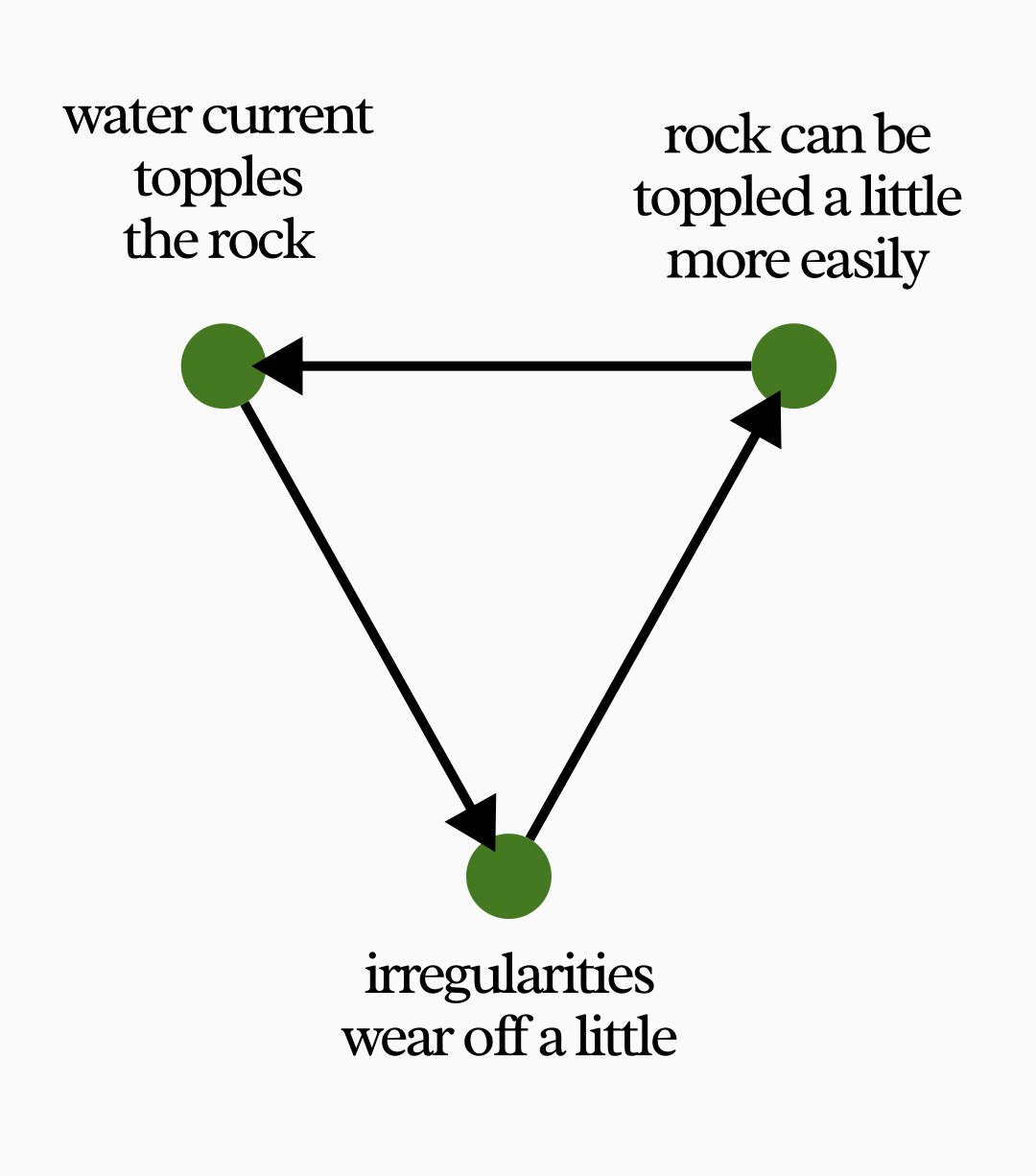
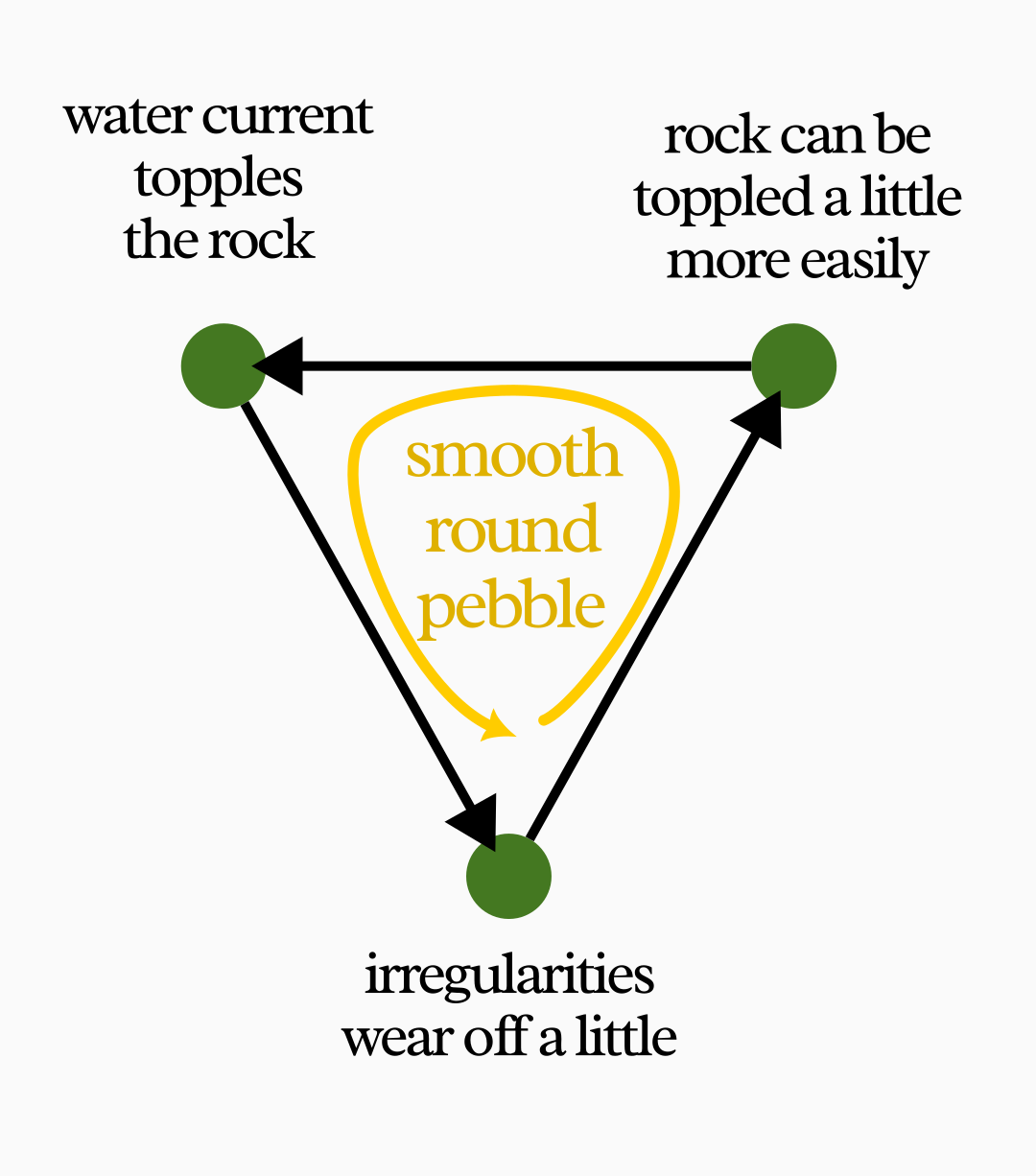
Remember the example of the rock tumbling under the waves on a beach: while tumbling, the rock's sharp edges and protuberances rub against the surrounding rocks, wearing off a little bit at every turn; this reduction of sharp edges allows the rock to tumble more easily, wearing off its irregularities even more; and so on, until the rock is smooth and completely edge-free.
The edge-free pebble is a Water Lily, the otherwise-improbable outcome of a recursive process.
In general, then, Water Lilies are mindless results of random recursion. They literally just happen.
Goals, on the other hand, are special cases of Water Lilies in which human intent is involved. Here is a parallel definition:
[!definition] Definition
A goal is a particular system state that a human wants to achieve by avoiding all other states
the process used to achieve a goal necessarily involves feedback, and we call it a control mechanism
The various examples of recursion covered in the previous essay. Only the last one constitutes a control mechanism.
The "that a human wants" part of this definition is the key difference that makes this a special case, one kind of recursion out of many.
(This might also apply to some animals, perhaps all mammals and several other intelligent species who can pull off the same kind of tricks with their minds, but we don't know much about that yet because they can't talk. I'll keep things simple and only talk about humans here.)
Every intentional action you take is a control process. You can't help it. Even seemingly instinctive acts like scratching your nose are very unlikely to happen without the enormous amount of control loops in your nervous system and muscles. Every instant, you keep adjusting the trajectory of arm and fingers based on feedback, using your body's ability to sense its internal state, called proprioception.
Individuals with impaired proprioception, who can't benefit from such feedback, have trouble doing elementary actions like sitting and walking straight. They bump into things often and appear clumsy with their actions. We just don't realize how heavily we rely on recursive loops to do everything we do.
To begin understanding how purpose works, look again at the first example I shared of a control mechanism involving a person.
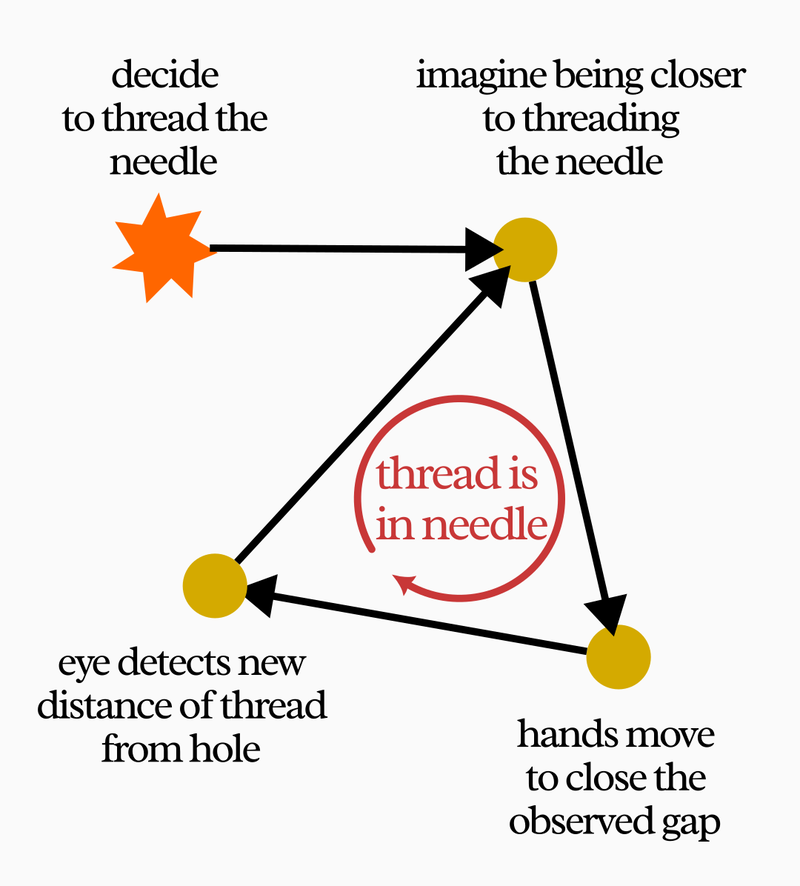
Sorry. I cheated a little when I made this diagram. It showed that a feedback loop was involved, and in this sense it did its job. But, for the sake of simplicity, I glossed over the most important aspect of human-driven control: the "want" part of the definition above. In order for the threading of a needle to happen, it must begin with someone's intention to thread the needle in the first place!
This is a more comprehensive version of the loop:
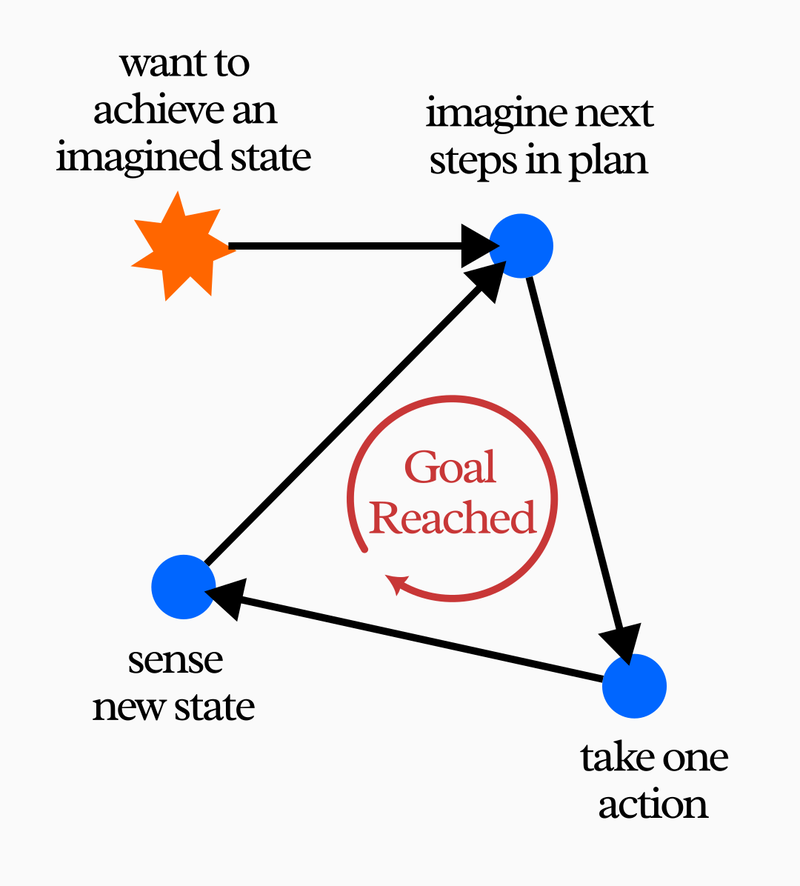
And more in general, covering all possible control loops:
Let's break this down into elementary pieces.
The Intent
Unlike the self-smoothing pebble and the tidily layered stars, those human actions don't happen due to random forces. You need to first imagine them—that is, simulate a possible state of the world in your mind, one that you want to become reality—and only then can you kick off the loop that will take you there. Whether the desired state is an increase in sales, a sense of accomplishment, or simply ice cream in your mouth, you have to know about it and imagine it at least vaguely to even hope to get it.
The key point is that the simulated reality in your mind is something that is unlikely to happen on its own, without your intervention. The needle won't thread itself [citation needed]. Your index finger won't randomly scratch your nose without you imagining, somewhere more or less hidden in your consciousness, "I sure would like my nose to be scratched now".
If something would happen reliably even without you trying to make it happen, then you wouldn't need to imagine it beforehand. You would just take it for granted. For example, you don't need to imagine "I want my room to be filled with breathable air 10 minutes from now", nor do you need to start a control loop to make it happen, because that is 100% going to happen anyway (unless you're in a spaceship's airlock, I guess).
Control is for the things that are improbable on their own, recursion is how you make them probable, and intent is how you start the control.
Here's the Plan
Now that you have a desired state in your mind, you need to change the world so that it reaches that state. In other words, you need to increase the chances of that state happening from its current low probability to a probability that is close enough to 100% as you can manage. You need to turn that imagined state into a Water Lily.
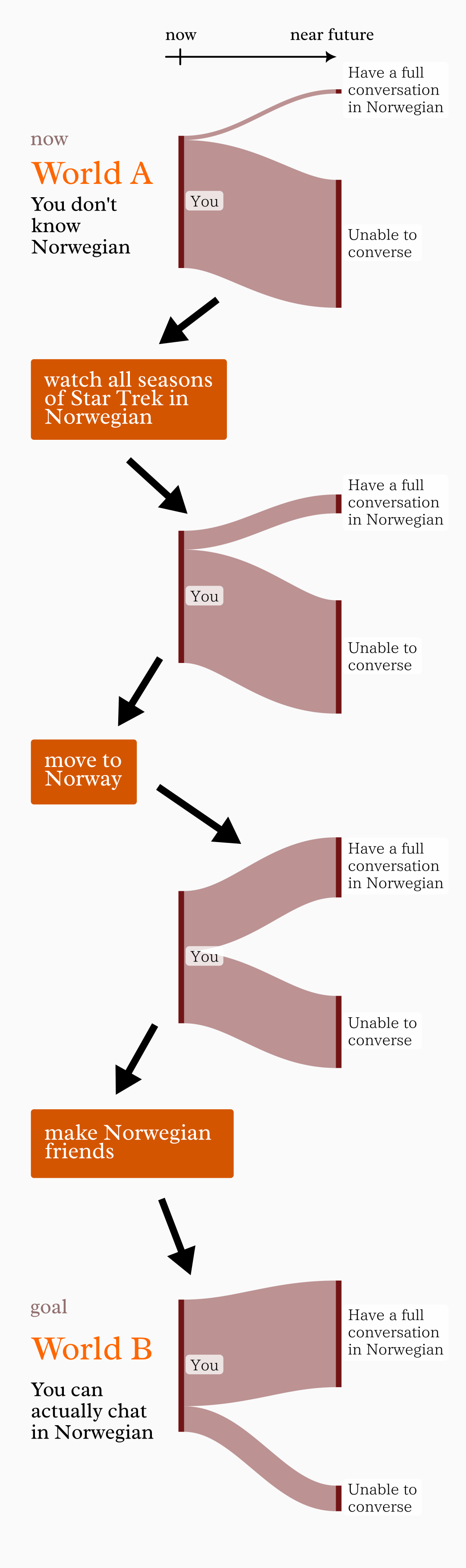
You start with a gap between what the real world is like now (call it World A), and what the desired world is like in your mind (World B). Then you ask yourself: what needs to happen in order for World B to become very probable? What things around me need to be arranged differently, what obstacles need to be removed?
If World B is "me with a less-itchy nose", or "me with eyes closed", the answer to those questions is simple. You only need to recruit a few muscles, i.e. something you can usually trigger easily with a single thought. An instant, and the goal achieved. Even in such simple processes your body triggers many feedback loops, but they come to you almost for free thanks to millions of years of evolution. Movement of your own body—within its specific and personal limits—is the one thing you can usually take for granted.
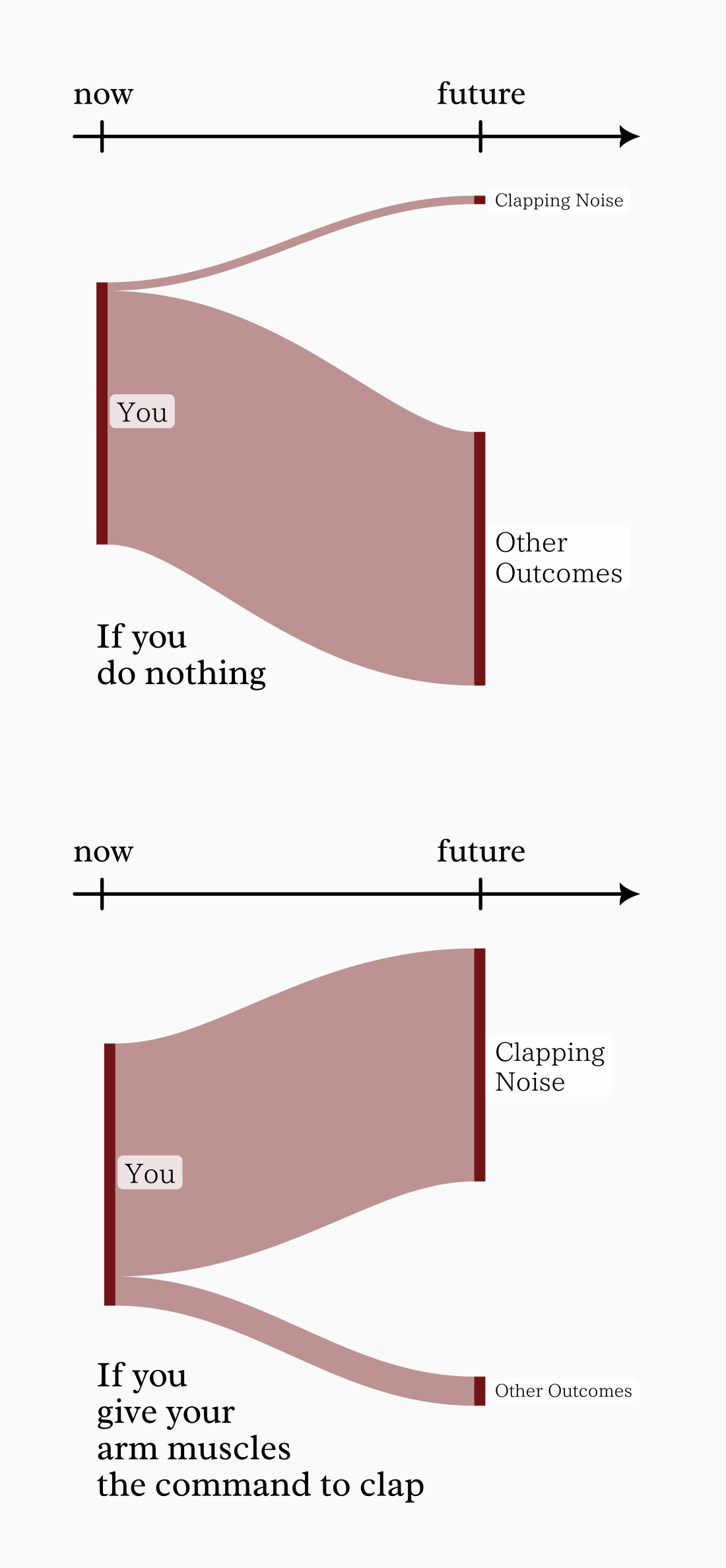
Probability of outcomes change when you introduce controlled action. If you do nothing, it's very unlikely for a clapping noise to happen near you. If you tell your muscles to make a specific motion, however, the probability becomes much higher, if not certain.
Many of our goals are harder than that, though. A single muscular action can't win you a degree or eliminate world poverty. Even a very mundane and achievable World B like "me, but less thirsty" usually needs more than a single twitch of a limb.
What do you do then? You use your brain's simulation abilities to imagine a sequence of intermediate worlds, each a little bit closer to World B, your goal. In other words, you break down the actions needed to get what you want into smaller goals, each increasing the probability of the next goal via control loops, until you can expect to reach the goal state. This is what we call a plan.
Even when you don't realize it, a new plan can only be created backwards: you start by imagining the final goal state, then you look for a neighboring world state, one that is very similar to it except for one realistic obstacle added in. When your purpose is to relieve your thirst, that neighboring state might be "me with a glass full of water at my lips": that state would not be the same as relieving your thirst, but it is only one easy step removed from it—just a (controlled) twist of your wrist.
The newly found neighboring state becomes a new goal in itself, what we might call a "sub-goal". You don't care about putting a glass of water to your lips for its own sake, but it's a good milestone to aim for, en route to your final goal.
Of course, the next question is how to achieve that sub-goal. You repeat the same process, imagine another neighboring state with an added obstacle ("standing next to a glass full of water") and make another sub-goal out of it. Keep repeating this process, build a long-enough chain of neighboring states, and you might eventually get to a state that is neighboring your current situation, World A. If you succeeded, you now have a plan—a sequence of recursive increases in the probability of your desired world state happening.
Each milestone increases your chances of achieving the goal when you want/need it. The "probability increase contribution" of each step is difficult to quantify and may vary a lot, but each step brings the world—and you—closer to achieving the goal.
More difficult goals will require more steps in their plans, and you may have to further break down your sub-goals into sub-sub-goals, going as deep as necessary.
Planning Caveats
This is, of course, a gross simplification. For one thing (as we'll see) plans aren't always so neat and linear. Another thing to keep in mind is that there is often no single way to divide the path from World A to World B into a progression of steps. Any purpose may be fulfilled in several different ways, and even within a single plan one might highlight different states as sub-goals—"hand on fridge's door" is just as valid as "standing in front of open fridge" as sub-goal for the purpose of being "less thirsty". Planning is an art more than it is a science. What matters is that you simulate intermediate states in your mind, then you execute by focusing on one sub-goal at a time.
Finally, most plans are doubly recursive. Recursion is certainly at play during the execution of every sub-step, but often you need to implement an additional feedback loop in the planning itself. Your ability to predict future states might be limited, the situation may change unexpectedly, or you may simply fail at one of the sub-goals, making your initial plan moot. In these cases you're forced to observe the new reality—World A v2—and to forge a new plan in your head. This could be a small correction to your previous plan, or a complete overhaul.
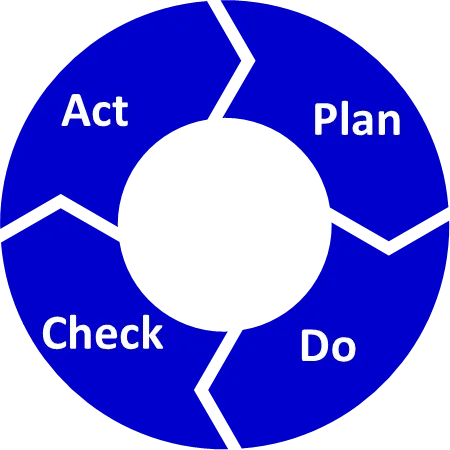
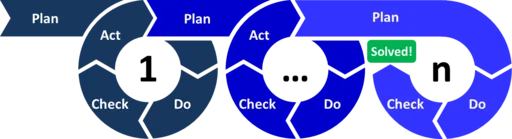
If you've heard of the Plan-Do-Check-Act (PDCA) loop, these concepts probably sound familiar. PDCA is sold as "a four-step problem-solving iterative technique used to improve business processes" (Investopedia), but it is really the fundamental function of every action of every conscious being. Talk about understatements. (Christoph Roser at AllAboutLean.com, CC BY-SA 4.0, via Wikimedia Commons)
The Key Difference
Now we have a new way to explain purpose very generally:
[!definition] Definition
Purpose is a simulated Water Lily that is part of a plan.
It's not just any Water Lily; it is one that you imagine ahead of time, and by intending to achieve it, you produce some form of plan to apply control (feedback) so that it becomes a real Water Lily. Purpose is always a figment, and it ceases to exist the moment the Water Lily is realized and your intent fulfilled.
Definitions are only as good as the power of distinction that they bestow. What is special about this kind of Water Lily we call purpose?
The special part is not the presence of feedback loops, nor is it the gradual convergence towards a specific outcome. That happens in any case, and Water Lilies of any kind, including random ones, can be very complex.
What is different in purpose as opposed to other kinds of Water Lilies is whether or not the order in which things happen matters.
In a non-purposeful Water Lily (I'll call them Wild Water Lilies from now on), it doesn't matter which step in its feedback loops kicked off the recursive action. Whether the first air current that formed a tornado was pointing south or northeast—whether it was a butterfly's wing-flap or someone's sneeze—has absolutely no bearing on what comes later. Only the fact that strong winds are strengthening each other in a deadly loop is important: all elements participating in the loop are equal peers.
Similarly, it makes no sense to try discovering the shape of the "first" rock fragment that seeded a planet's formation, because many such rocks and dust clouds attracted each other at the same time. And when a magnetic levitation train hovers at a constant height above its magnetic tracks, it is useless to argue whether it is the tracks or the train itself that "starts" the levitation.
The moment a feedback loop connects, it transcends the specifics of its initial conditions. Each part becomes the cause of all the others—and, of course, of its own future changes. Cause and effect cease to make sense. Something new and whole is happening, and the only direction of change is not among the elements of the loop, but of the loop itself towards its Water Lilies. It continues as long as it does with no way to mark a point of arrival.
The snow crystals in a rolling snowball feed their contributions to each other and trigger increasingly rare effects: a large amount of snow quickly moving downhill, a groove on the snowball's wake, the round shape of the snowball itself. All of these things can be considered Water Lilies, and there is no "goal state" in the loop itself. Every snowball comes to an end against an obstacle or at the bottom of the hill, but it doesn't matter, because it had no plan and thus couldn't fail.
Control loops are the exception. Physically, they work exactly like any other feedback mechanism, except that they are always triggered by someone's intent. They don't just happen: they're made to happen. This distinction breaks the symmetry, so that only in purposeful loops do the beginning (intent) and end (desired Water Lily) actually matter.
People usually say that chickens make eggs, while more witty thinkers sometimes claim, like Samuel Butler, that "a hen is only an egg's way of making another egg." It should be clear by now that neither is right, because no multi-generational intent or purpose is involved. Chicken and egg are together and inseparably one single Wild Water Lily. The chicken-and-egg koan is meaningless. (Photo by Debashis RC Biswas, Unsplash)
The problem with a word like "purpose" is that it feels so fuzzy and abstract, even though it's about something very practical. Let us try to visualize it, and see where that takes us.
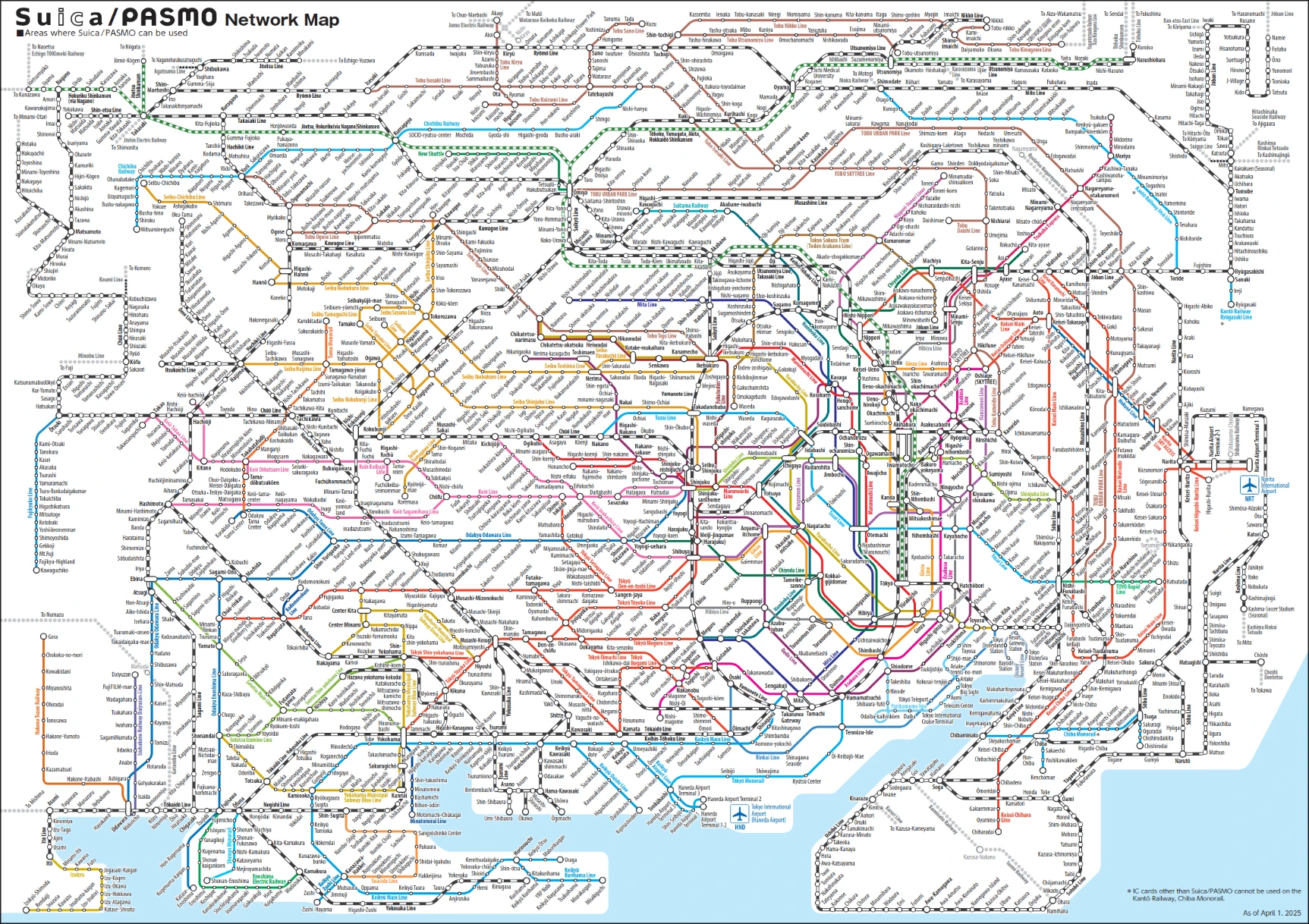
I've thought long and hard about this, and reached the tentative conclusion that the most representative, ubiquitous kind of purpose is "literally getting from A to B". As in: you're in a big city, you want to catch a train at Station A and arrive, as quickly and conveniently as possible, at Station B. A nice and easy purpose!
Click to enlarge: Tokyo Train Map (JR East).
"You being at Station B within an hour" is the goal, the imagined state of the world that you hope to turn into reality. It's not likely to happen unless you actively try to make it the Water Lily of several controlled feedback loops. Even jumping on a random train and changing trains randomly a few times isn't going to work. You need to look at a train map, mentally survey which lines arrive at Station B, and perhaps retrace your imaginary steps a few times in search of viable connections. Gradually, you construct a feasible, uninterrupted path that connects the two stations.
That promising path is your plan. All plans work like this: getting a glass of water also required you to make a mental simulation, but in that case using milestones like "standing up" and "holding the glass" instead of a sequence of locations. The intermediate stations you change trains at are the sub-goals in your plan, all subordinate to Station B and only important because they make your probability of reaching Station B gradually higher.
(Lost Man Maps/Matthew Hoffman & Amanda Barry, CC BY-NC 4.0)
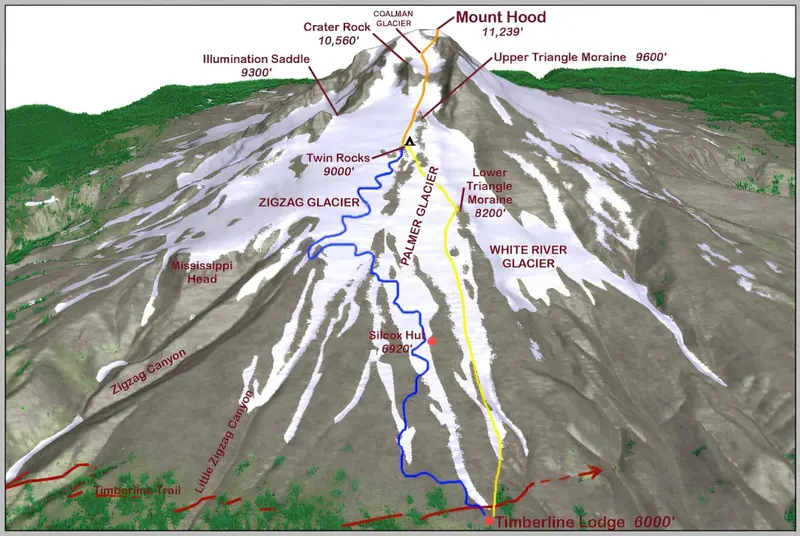
The goal is to get to the top of the mountain. This metaphor makes it clearer that the path is made more difficult by obstacles and geographical features. It's never straight and easy, but winding from one base station to the next, just like any other plan. We'll use this as inspiration to draw simple "purpose diagrams".
To keep the diagrams really simple, we'll draw the paths but not the "mountains"—just keep in mind that there are impervious "reality mountains" all around.
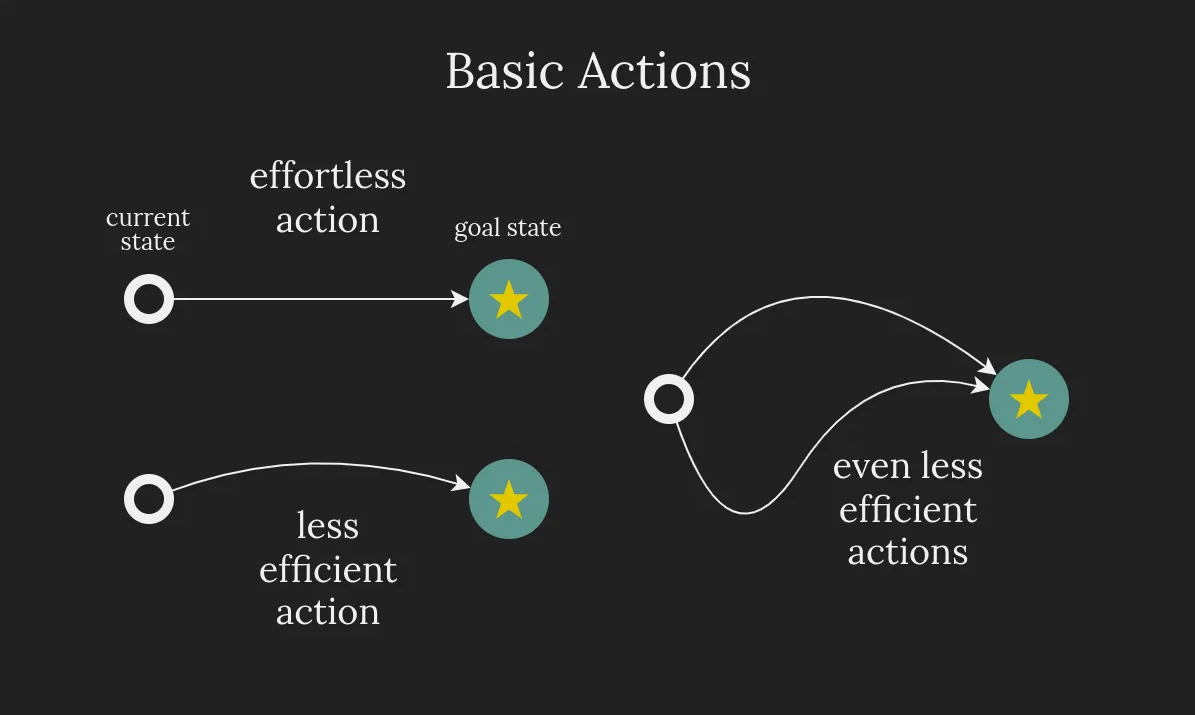
Let's also say that a straight line is the easiest and most efficient kind of action possible, like using a cable car. Examples of something you might draw as a straight line would be "blinking your eyes" or "saying a word", but anything harder than that will be a curved line: longer and thus more effortful, like climbing around crags and crevices.
An example of a less efficient action might be pushing a table aside in order to make room for a new sofa, or walking for a while: more effort or time is needed than a one-time muscular action, but still simple enough. We don't need to be precise here—the curvature is only a reminder that the steps of a plan aren't always equally easy.
[!aside] Aside: Arrows = Loops 🔁
I chose to use arrows for these diagrams, to lean into the metaphor of going places, but you should always keep in mind that behind every arrow is not a linear cause-and-effect process, but a feedback loop between senses, mind, muscles, and the part of the world the plan is trying to modify to match an imagined goal.
It's like when you're walking up a mountain path, where you have to keep a careful eye out for obstacles and adjust your every step to the local conditions. It is not apparent from these simplified drawings, but plans are always about control loops.
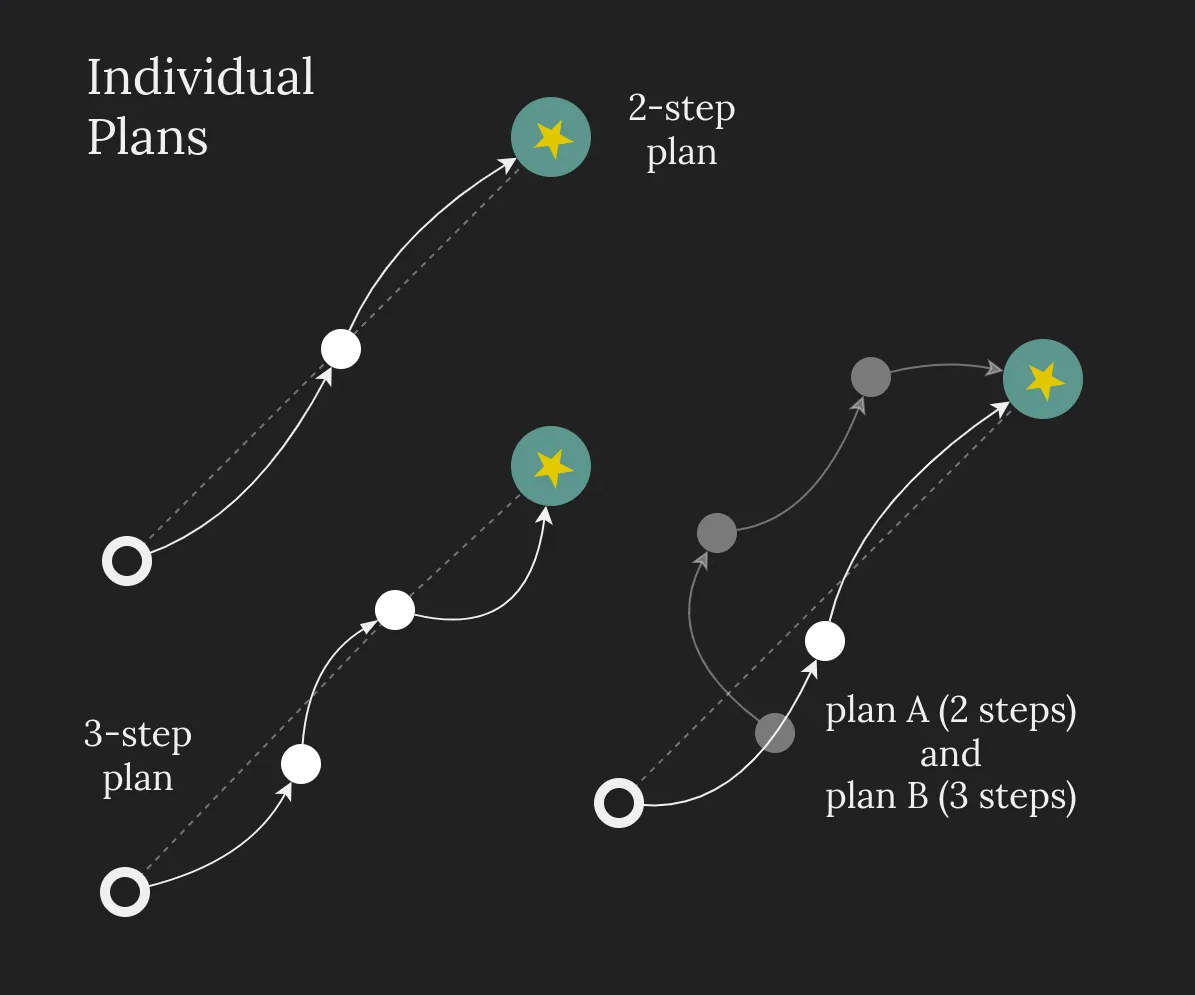
Now, since plans usually involve multiple steps, they tend to look more like this:
This is like the waystations on the mountain trail, a couple of images up. First you might plan to get to Silcox Hut and take a break, then go take a nice look at Zigzag glacier, then stop for the night at Twin Rocks camp, and so on. (Don't take my advice, though, I've never actually climbed Mt. Hood!)
Goals form chains connecting the Now to the final goal. Different plans will lead to different sub-goals, and thus to different paths to the same destination.
As we've seen, a plan doesn't pop up in your head fully formed in all of its details. You go by degrees, beginning with a very rough high-level plan and gradually thinking about the finer plans necessary to achieve the intermediate goals.
These diagrams are useful to understand the structure of a plan at a glance, and we'll use them more below, but they can get messy if you try to add a label for each little dot on there. Another way to represent a plan with its clear hierarchy of goals, sub-goals, and sub-sub-goals is with... a simple bullet list.
Here are some bullet-list examples of concrete plans you can explore by opening the section you want.
Relieving an itch
Goal: Relieving an Itch
Raise hand to nose
Move finger over itchy spot
Quenching thirst
Goal: Quenching Thirst
Go to kitchen
Stand up from sofa
Walk to kitchen entrance
Enter kitchen
Get an empty glass
Walk to cupboard
Open cupboard door
Choose a glass
Take glass out of cupboard
Close cupboard door
Walk to table
Place empty glass on table
Get water bottle
Walk to fridge
Open fridge door
Find water bottle
Take water bottle out of fridge
Close fridge door
Walk to table
Fill glass with water
Remove bottle’s cap
Pour water into empty glass
Drink water
Put water bottle down on table
Pick up water-filled glass
Drink from glass
Getting a haircut
Goal: Getting a Haircut
Go to shop
Get in car
Take keys
Open house door
Walk to parking lot
Unlock car
Open car’s door
Sit in driver’s seat
Close car’s door
Drive to the barber shop
Start car’s engine
Back out of home parking lot
(Abridged: several steps of driving through intermediate locations)
Drive into barber’s parking lot
Park car
Stop car’s engine
Exit car
Open car’s door
Step out of car
Close car’s door
Lock car
Enter barber shop
Walk to shop’s entrance
Enter the shop
Get haircut
Wait for own turn
Sit on barber chair
Locate specified barber chair
Walk to specified chair
Sit down
Allow barber to do their job
Explain desired haircut
Sit still
Wait for operation to be completed
Doing the laundry
Goal: Doing the Laundry
Prepare laundry
Gather dirty clothes
Walk to bedroom
Collect dirty clothes from hamper
Walk to bathroom
Collect dirty towels
Carry all items to laundry room
Sort clothes
Separate whites from colors
Check pockets for items
Remove any items found
Load washing machine
Open washing machine lid
Place sorted clothes inside drum
Close washing machine lid
Wash clothes
Add detergent
Open detergent container
Measure appropriate amount
Pour detergent into dispenser
Close detergent container
Set wash cycle
Turn dial to appropriate setting
Select water temperature
Adjust load size setting
Execute wash cycle
Press start button
Wait for cycle to complete
Dry clothes
Transfer clothes to dryer
Open washing machine lid
Remove wet clothes
Open dryer door
Place clothes in dryer drum
Close dryer door
Set dryer cycle
Turn dial to appropriate heat setting
Set timer
Start dryer
Press start button
Wait for cycle to complete
Finish laundry
Remove clothes from dryer
Open dryer door
Take out dried clothes
Place in laundry basket
Fold clothes
Pick up each garment
Fold according to type
Stack folded items
Put away clothes
Carry folded clothes to bedroom
Open dresser drawers
Place items in appropriate locations
Close dresser drawers
Going on a family trip to Lisbon
Goal: Going on a Family Trip to Lisbon
Plan trip
Choose travel dates
Check family calendar
Identify available dates
Confirm dates with family members
Book flights
Search flight options online
Compare prices and schedules
Select preferred flights
Enter passenger information
Complete payment
Save confirmation emails
Book accommodation
Research hotels in Lisbon
Read reviews and compare prices
Select preferred hotel
Make reservation
Save confirmation details
Plan activities
Research Lisbon attractions
Create itinerary
Book tickets for major attractions
Make restaurant reservations
Prepare for travel
Get travel documents ready
Check passport expiration dates
Gather all passports
Make copies of important documents
Store documents in travel folder
Pack luggage
Check weather forecast
Lay out clothes for each day
Pack clothes in suitcases
Pack toiletries and medications
Pack electronics and chargers
Check airline baggage restrictions
Prepare house
Stop mail delivery
Arrange pet care if needed
Set lights on timers
Lock all windows and doors
Travel to Lisbon
Go to airport
Call taxi or arrange transport
Load luggage into vehicle
Travel to airport
Arrive at departure terminal
Check in for flight
Find airline check-in counter
Present passports and tickets
Check baggage
Receive boarding passes
Board flight
Go through security screening
Find departure gate
Wait for boarding announcement
Present boarding passes
Board aircraft
Find assigned seats
Store carry-on luggage
Arrive and settle in Lisbon
Complete arrival procedures
Exit aircraft
Go through passport control
Collect checked baggage
Exit airport
Get to hotel
Find transportation to city center
Travel to hotel location
Enter hotel lobby
Check into hotel
Approach front desk
Present identification and reservation
Complete check-in process
Receive room keys
Go to assigned room
Unpack essential items
The fact that plans are made of chains of steps only means that there are many linked control loops like that at each level. Again, this idea is captured by common business frameworks like PDCA:
What some MBA textbooks call "PDCA multi-loop: the insight that (especially) for large projects, planning and execution are iterative processes." (Christoph Roser at AllAboutLean.com, CC BY-SA 4.0, via Wikimedia Commons)
But surprises happen, and often the mental simulation used to make your initial plan turns out to have been faulty all along. Like a mountaineer who finds themself in an unexpected cul-de-sac, in these cases you have to go back to the (mental) path-finding stage, and it might well be that the new path and milestones you contrive this time are nothing like the ones you initially envisioned: back to base one.
With these new ways to visualize and think about plans in the toolbox, let's leave our cozy climbing gym and briefly contemplate the veritable PURPOSE-HIMALAYAS that we call the Real World. Because purpose is very rarely as linear and straightforward as the pictures above may lead you to believe.
Plans Are Networks
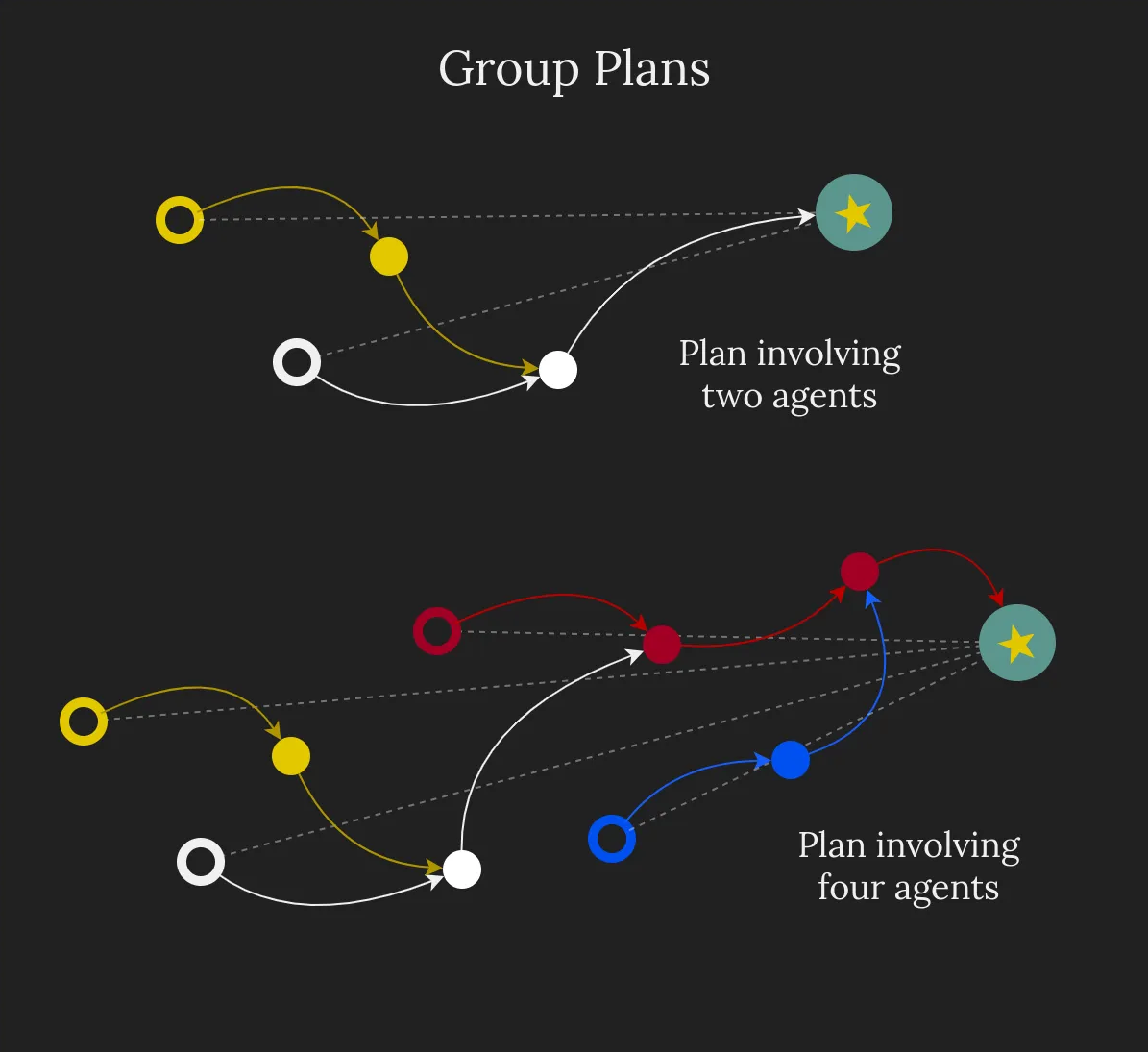
The thing is, no man is an island, and I've never heard of woman islands either. We work together, we dream together, and we make plans that involve many people at once. What do those plans look like? Something like this:
We devise plans that can be partially or completely executed in parallel. In the mountain-climbing metaphor, this is equivalent to receiving support during the climb on a difficult peak: sherpas joining you to guide you, other people climbing part of the way to stock and maintain the base stations, and so on. These are different plan paths meeting at certain milestones to make the final goal possible.
As an example from daily life, think about the goal of going to watch a movie with a friend: it's not enough for you to show up at the entrance of the movie theater if your friend doesn't do the same. The goal state isn't "me watching the film together", it's "we...". You have a shared goal, but you each have your own sub-plans that proceed separately until some point when you converge and begin acting together (the two-branch plan in the diagram above).
Another example with roughly the same level of simplicity might be eating a fish: your branch of the plan involves going to the fish seller and ordering (say) a Japanese pufferfish, and the seller's branch, which began hours or days before you arrived, involved buying your pufferfish from the fisherman and preserving it until you arrived. After you pay—settling the bill is another sub-goal, the only one you and the seller need to do together in this case—you continue with your own linear plan of bringing the fish home, preparing it carefully, eating it, and probably calling an ambulance.
You can imagine any number of even more complex group plans. A team of people building a house have a grand shared plan, seeded by the architect but greatly expanded and refined by engineers, general contractors, project managers, construction managers, and others. This plan includes not only the phases of building ("note: the roof happens after we excavate") but also the budgets and procurement schedules, the site logistics, the management of stocks of materials, the payment of wages, the safety measures. Trying to draw the purpose diagram of a plan like that would probably require thousands of branches meeting at hundreds of sub-sub-sub-sub-milestones.
But purpose networks are not all about converging toward a single goal. If that were the case, how simple would life be, and how boring!
We all juggle many concurrent goals at any given time. You don't just want to drink a cappuccino—you want to drink a cappuccino and have a chat with your friend the barman and not be late to your appointment with the lawyer. This is true at all levels of granularity, from the most immediate (get a breath outside and check your phone) to the lifelong pursuits (become an executive at your company and own a yacht).
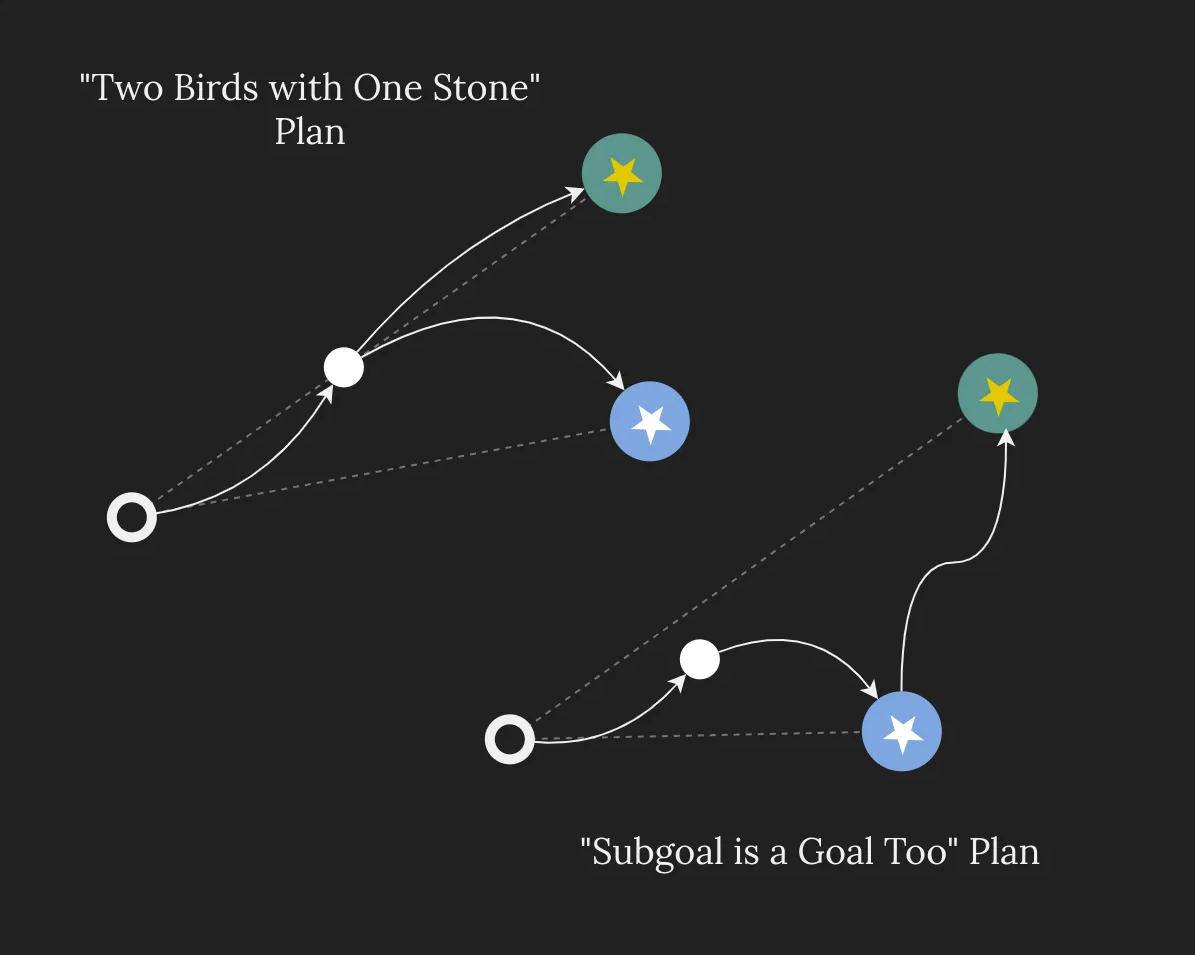
In these cases—which is to say most cases—we try to come up with the best plans that let us achieve all of our goals. Often, these plans have some synergy with each other, and can share some of their steps for extra efficiency. Drinking a cup of coffee and chatting with the barman are two separate goals, but they are very much compatible: just buy the cappuccino at the cafe where your friend works. We might call these "two birds with one stone" plans. If you're really lucky, one of your goals (e.g. learning Norwegian) is both a goal in itself—you would be happy to achieve it anyway—and a sub-goal towards a different goal (e.g. living in Oslo).
In all these cases, the idea is the same: some or all of the plan's sub-steps help increase the probability of more than one of your goals at the same time. Neat!
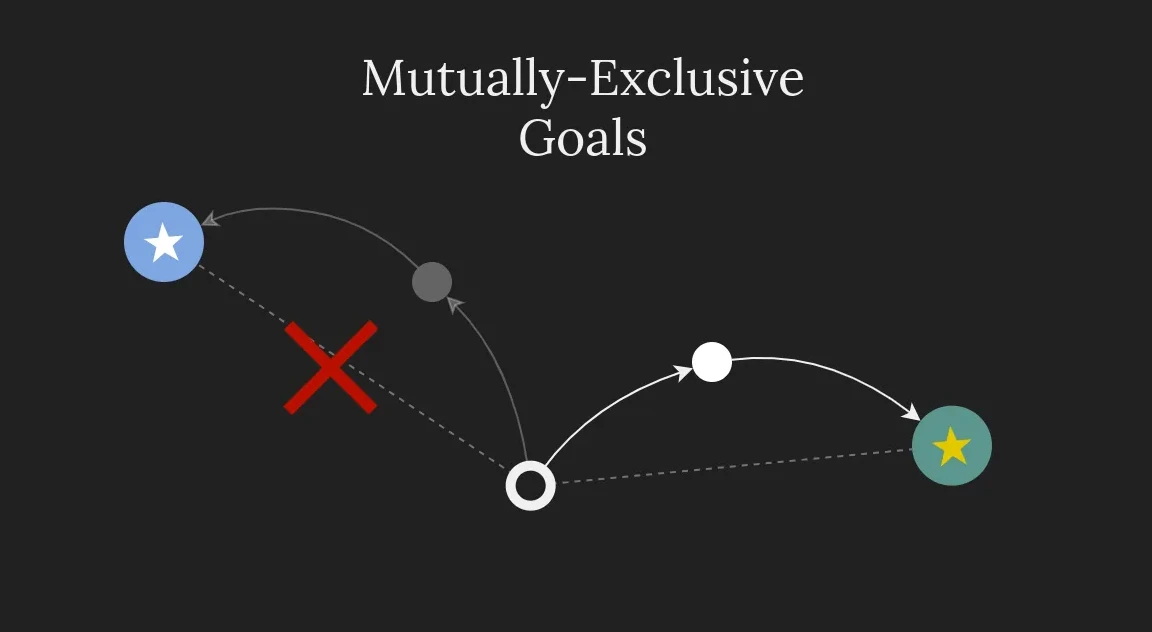
Needless to say, life is not always so obliging. Some goals seem to repel each other, and achieving one makes it much harder to achieve the other, not easier. This is what's happening when you contemplate the goals "eating as many hamburgers as possible" and "staying fit". In fact, people tend to be so keenly aware of cases like these, that I doubt I need to give any more examples.
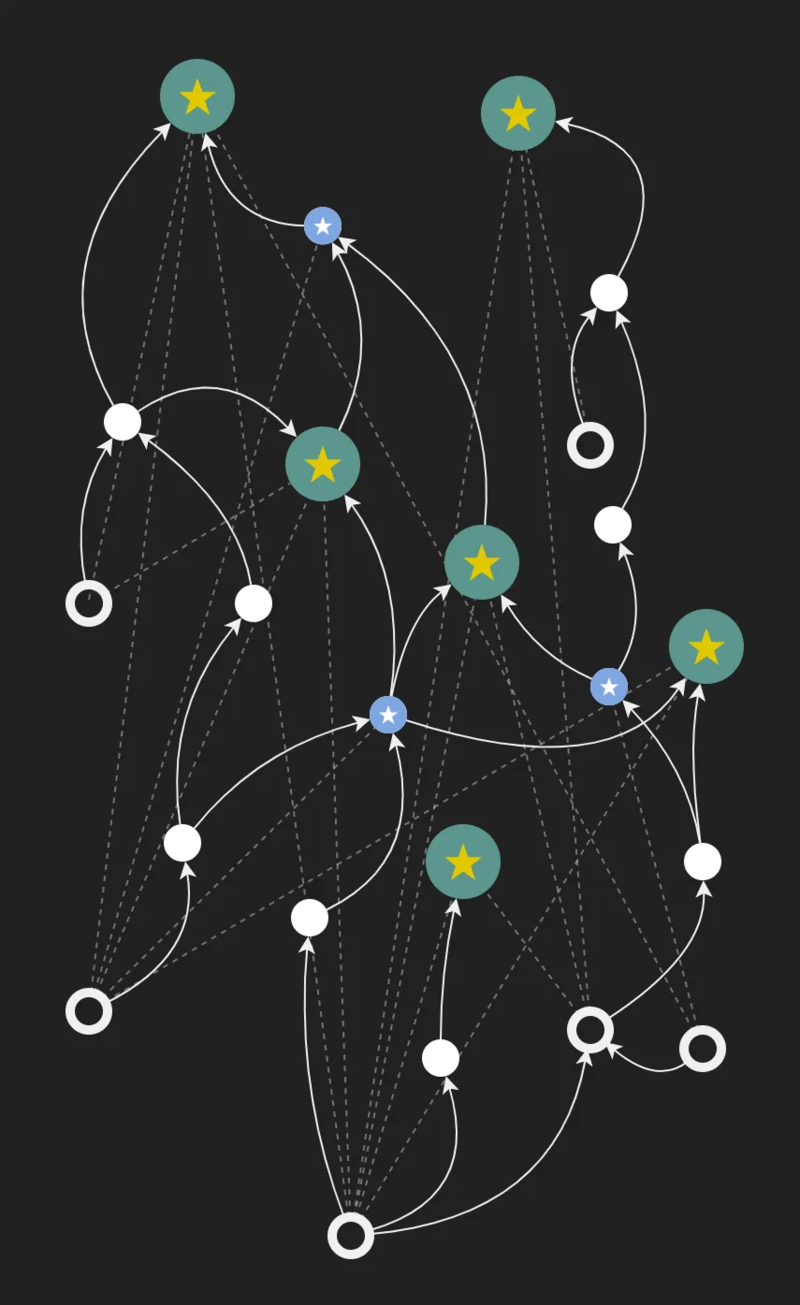
If plans forking out to reach multiple goals are common for individuals, they are ubiquitous in groups of people. In house construction, for example, everyone in the project wants the house to get built, but do they all want it for the same reason? Most likely, each participant might have bigger goals of their own, for which the completion of the house is but a stepping stone—the architect might have a goal of winning an award, the project manager might want to get promoted, while an apprentice carpenter might simply want to pay the bills for the time being.
Then, putting it all together, a more accurate representation of real-life plans would look something like this:
We went from linear A-to-B schemes to intricate webs of intermingling control processes. Like the Ripple Universe itself, human and animal purposes are all joined in a single, enormous network of cooperation, sabotage, synergies, and mutual interference. It is another layer of interaction that allows for the mass-production of mind-bogglingly sophisticated and unlikely new patterns.
Why Does Any of This Matter?
Given more time, there would be much more to say about purpose networks, more human situations that gain clarity through purpose diagrams, more arrows and dots to knot into garbles but... that's enough for today.
This little tour in the mountainscapes of purpose was the shortest necessary to get one key insight, one nugget of intuition that will lead us on into the dark depths of the next section of our journey.
The takeaway is this: because, as we've seen, purpose always has a beginning and an end, it also naturally creates hierarchies of goals, sub-goals, and even smaller sub-goals. And when a hierarchy appears, it becomes necessary to keep track of all that. This boils down to three things one needs to know.
First, you need to know the start. It's useful to know the starting point of a plan because it will tell you whose plan it is—a very useful piece of information.
Second, you need to know the end. The end point of a plan, of course, is nothing other than the goal itself. Knowing the end of your own plans is the only way you can hope to achieve them, and it's a good idea to learn the goals of other people's plans, too. Controlled action can turn some intricate and highly unlikely possibilities into reality: if you know where it's headed, that gives an enormous boost to your predictive powers.
Last and most important, you need to understand the structure of the purpose hierarchies at play. A web of purposes is made to be traversed. It is what decides the relative importance of different actions and even the value we should assign to things.
In general, this is not true for non-intentional recursion. When no intentions exist, no objective ordering or limits can exist either, and all you need to know and understand are the forces and interactions at play. Wild Water Lilies can have no absolute or relative value. They just are.
An ecosystem can't possibly exist for a particular purpose.
— Hayao Miyazaki
The presence or absence of objective ends, beginnings, and hierarchies in those loops: this, then, is the critical distinction between mindless recursion and purposeful action—between Intentional and Wild Water Lilies.
In General
With Intent
Wild Water Lily
Goal (Intended Water Lily)
Mindless recursion
Control process and replanning
Starting point does not matter
Starting point is key
End does not exist
End is the realization of the imagined goal
Events unfold by contingency
Events are controlled according to plans
No way to assign importance or value to events and elements
Hierarchies of goals, sub-goals and intersecting plans emerge necessarily
Table: Intentional action is a special case of recursion.
Wild (i.e. mindless, non-intentional) recursion "just happens". The resulting Water Lilies are whatever happens due to its feedback, with no inherent, defensible way to distinguish more or less "important" steps or hierarchies in their unfolding. As MIT professor John D. Sterman put it, "there are no side effects—only effects". Everything that happens as a result of a recursive process, in general, is equally (un)important.
This needs unpacking. I will use a snowflake to do it, because snowflakes are cool and because they are famous for being rather mindless. These folks are Wild.
Similar but Different
(Source: Alexey Kljatov, CC BY 2.0).
Consider how beautiful this bunch of H2O is. So symmetrical, so perfect, and yet just as unique as you and me (darling). If you throw pellets of dough against each other at random, it's very unlikely that you'll end up with such a neat pattern of molecules. In the previous essay I showed that this is, in fact, another product of recursion. It feels natural, then, to ask, "how did the snowflake happen?"
Well, it's more complicated than you think, involving several connected feedback loops, but if you're curious, read one or more of them here:
Spiky
How a Snowflake Gets Spiky
The tiny point at the end of an arm collects water-vapor faster than the flat sides. More vapor lands on that point, so the point grows outward fastest. The longer it sticks out, the more vapor it collects—forming a branch instead of a boring flat plate.
Positive feedback (growth enhances conditions for more growth)
How the Snowflake Keeps Itself from Melting Its Own Progress
Each time a new ice layer forms, it releases a puff of heat. That warmth lingers like a stove's pilot light for a few millionths of a second, creating conditions that temporarily prevent the next vapor molecule from depositing. Cooler air then flows in, the surface chills again, and another layer can form. The net effect is a quiet, rapid cycle of heat release and accumulation that keeps the whole flake growing steadily without ever halting its own growth.
Negative feedback (heat release temporarily inhibits further deposition)
If one branch gets a tiny head start, it begins absorbing the nearby water-vapor first. The air around that branch becomes poorer in vapor, so the other branches can't grow as quickly. The already-advanced branch therefore keeps winning, becoming the longest finger on the snowflake.
Positive feedback (growth enhances conditions for more growth)
How the Flake Carves Itself Into Perfect Mirror-Flat Faces
Water molecules attach more easily at certain "steps"—ridge lines where molecules can bond snugly—and form less readily on the open flatlands in between. Each newly arrived molecule settles only on those ridges, raising fresh mini-stairs that act just like the old ones. Round after round of this tidy stacking keeps re-etching the same straight edges, so the originally random lump steadily sculpts itself into the familiar six-sided windowpane.
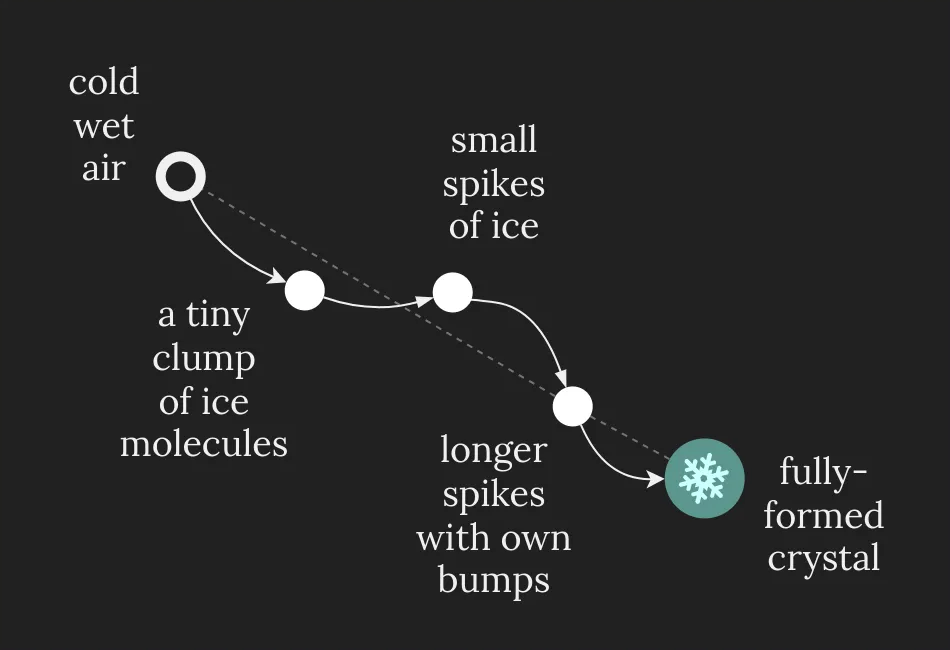
It feels tempting to say, here, that the "finished" snowflake is the end product, and the steps necessary to build it—making it spiky, selecting which spikes grow longer, keeping it from re-melting, etc.—are all intermediate steps towards that end. You might attempt to draw a purpose diagram like this:
Just like a recipe, we have a sequence of control loops—an action plan, a story with a happy ending!
Alas, this is only a hallucination of the human mind. You, the observer, start with the implicit premise that what you call "fully-formed snowflake" is the important state, then you go backwards and reconstruct the processes that led up to it. With a retrospective mindset like that, of course it all looks like a build-up to the pretty shape.
But in truth there is no "finished" snowflake, only snowflakes in the state they happen to be when you catch them. In a hypothetical fall from an infinitely high cloud, under the right air conditions, a snowflake would keep growing without bounds with ever more complex shapes. Yet you have a sense that there is such a thing as a "finished" snowflake, and you subjectively enshrine that as the end of what comes before it.
But why shouldn't you choose the first tiny bump on an irregular ice crystal as the "goal" of the process? Why not the water drop left after a snowflake melted? Whatever state you choose, at any point in space and time, has the same objective right to be defined as the "end product"—that is, no right at all.
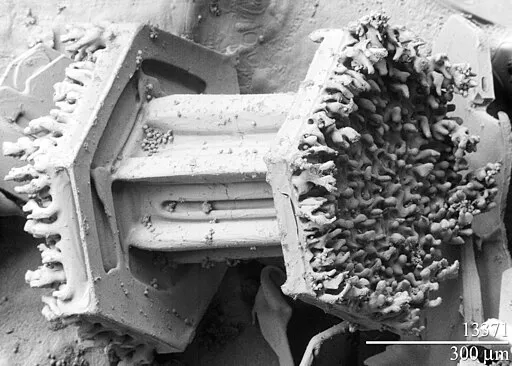
This is a snowflake, too:
It has an unfamiliar shape, but it can happen when the conditions are just right. Is this the "goal" of the preceding steps, too? Why wasn't the goal to make a more standard shape in this case? Who decides that?
Usually we pick the typically-sized, typically-shaped snowflake as the "end state" in our reflections only because we find them to be pretty, decorative, and mysterious. Everyone likes snow, and typical snowflakes have more recognizable shapes than most other natural phenomena, so it feels reasonable to give them a neat name like "snowflake" and to write lots of papers about them. That's molecular discrimination, if you ask me. Crystalline favoritism!
This kind of arbitrary goal attribution is something we do all the time. It reminds me of the story of King Midas, the mythical king of Phrygia who had his most ardent wish granted by a god: the power to turn everything he touched into gold. After a brief period of ecstasy as he transmuted trees and flowers into precious metal, he realized that the same fate awaited all of his food and drinks, so that he couldn't feed himself any more. When his daughter came to comfort him, he turned her into a golden statue, too. The gift was a curse in disguise.
We are all teleological King Midases—everything our thoughts touch immediately becomes imbued with our subjective purposes and interpretations. We graft our goals into the patterns around us, and suddenly we see beginnings and ends, hierarchies, plans, stories, and controlling forces in each of them. When all you have is a purpose, everything looks like control.
Is this wrong or silly? No, but also yes.
In one sense, it is not wrong to see Wild Water Lilies as if they were intentional, because their processes are very much like those of controlled plan execution: they involve recursion, and they make otherwise-rare patterns common. A snowflake is a Water Lily of its molecular feedback loops, just as a painting is a Water Lily of the painter's mental and muscular loops. The parallels run deep.
But, in another sense, it is wrong to treat those things equally, because actual plans have a baggage of assumptions absent in more general Water Lilies: that plans need to be either aided or fought, for example, and that they have hierarchies of value.
The moment you think you see a plan, you become entangled with it. You become an actor in that purpose, whatever the role is that you assign yourself.
None of that makes sense for snowflakes, planets, or ecosystems. Purpose plays a fundamental role in much of our lives, but not in everything. It has its proper place in reality. No more and no less.
Why Purposify the World?
As I mentioned in Part 1, the current best evolutionary explanation for promiscuous teleology is that it's better to be safe than sorry, so to speak. For example, it's less of a problem to incorrectly assume something mindless wants to kill you than to assume an actual killer is aimless.
But that explanation isn't fully satisfactory to me. Why would detecting plans so greedily be useful? Let me speculate for a moment.
We function by predicting the future. Being able to guess someone's (actual) goal ahead of time allows you to replicate the same mental simulation in your own head, and to find the most likely plans to achieve it. This is, in itself, an enormous boost in your predictive power: you can anticipate your enemies' plans, intercept your quarry with your superior foresight, and improve your family's chances of success by being there when they need you.
But reverse-engineering specific plans is the easy part. We are also busy trying to negotiate many intermingling plans at once belonging to groups of people.
This might be a major requirement and enabler of our sociality: navigating complex webs of nested purposes is difficult and important in social contexts, so having a keen eye for them would lead to better success, including more children to carry on your genes. Not to mention that people, when they coordinate their efforts in the right ways, can achieve things that would be impossible for separate individuals. Estimating each other's intentions and aligning them into unified purposes is one of humanity's biggest superpowers.
By extension, the same purpose-spotting skill could help us in our observations of many animals, like some mammals, birds, and certain fish, which some scientists believe might have analogous planning abilities.
The upshot is that we've become a keen, almost obsessive storytelling and story-loving species. Everything can be storified by a human brain, from series of events that actually had objective beginnings, ends, and nested plans to open-ended processes like people's lives and crystal growths, where all that teleological structure is absent.
Sometimes this is not a problem, and all is good. Other times it is a painful mistake.
Owning Up to Our Errors
This rather extended analysis of purpose and of our double-edged tendencies would not be worth the while if it didn't yield some practical wisdom. And, I think, the best wisdom comes not from knowing how to do things right, but from knowing all the ways to do them wrong. So here, at last, we can dissect our teleo-mistakes and make them easier to avoid.
The gist is this: we constantly underestimate how pervasive and fertile recursion is. But this simple issue manifests itself in two major forms: erring from too much purpose and erring from dismissing Wild Water Lilies.
Mistake 1: Erring from Too Much Purpose
It is usually safe to storify something—pretend it has a plan and purpose—when all you want to understand is the process that is happening. In these cases, having a true beginning, hierarchy, and end isn't critical to the discussion. Here you're not tempted to root for or against the success of that faux protagonist, so there is little harm in speaking in "intentional language".
For example, when David Attenborough says that a water plant "clears the surface by wielding its bud like a club", as in this excellent documentary, all his verbs are those you would normally use with an intelligent being.
Transcript: "It's a monster. It's well armed. It clears base for itself by wielding one of its buds like a club, and now it dominates the surface. This is a leaf of the giant water lily: it expands by over 20 cm a day and eventually measures more than 2 meters across. As each one reaches the surface and expands, more and more light is taken from those plants that are trying to grow beneath. Competitors are pushed aside. Some are crushed or skewered. Eventually, its immense leaves press their margins against one another, totally cutting off the light from the plants beneath them. The battle is over and victory is total."
The narrator's implicit assumption is, "let's imagine that the plant is conscious and that winning a battle against the other plants in the pond is its goal," and you (the audience) play along with that. This approach is entertaining, even poetic, and it might actually help you remember this scientific fact.
The trouble only arises if you shift from what happens to why it happens—the supposed "goal" of the process.
Remember, from Part 1, that the question "why?" can have two very different meanings: it can mean how come? (a question about the preceding sequence of events), or it can mean what for? (a question about the intentions involved).
If someone asked "why does the plant want to win the battle?" the temptation is very strong to answer, "in order to survive." Bad move! Now intention is a thing we need to handle and explain in some way. An answer like that is responding to the what for variant of "why", a question that only makes sense when real, intentional plans are in place. It's a slippery slope:
"If it does that in order to survive, why [what-for] does it want to survive?"
"Well, because it wants to pass on its genes to a new generation."
"And why [what-for] does it want to pass on its genes?"
"...because it wants to continue the species."
"Wait, really?"
The thought process moves farther and farther in the wrong direction, and it gets gradually more untenable. It's easy to pretend that a plant "wants" to get plenty of sunlight, but it's not so easy to believe that a single plant can possibly be thinking about the perpetuation of its whole species. I even know people who can't do that with their species!
A what-for-why question applied where there is no actual plan is like driving on the wrong side of the road—possibly safe for a couple of seconds, less and less so the longer you keep going.
The only meaningful way to answer the initial question is in the how come sense of "why". For example, the plant "wants" to win the battle in the pond "because in the past the more aggressive plants survived and reproduced more, so they took over the population." As I wrote in my mini-essay about water lilies (lower-case this time) there is no script, no higher or external purpose in the life of a plant. It is self-sufficient, self-creating, blind beauty.
Replace "plant" with any other feedback-rich process—a beaver, a smooth pebble, a layered star—and the situation remains the same. How-come-why is how you can understand things. What-for-why, interesting though it sounds, is how you paint yourself into a corner.
Mistake 2: Erring from Dismissing Wild Water Lilies
Projecting purposes too eagerly onto the world is only half of the problem. We also tend to downplay the self-sustaining, self-organizing power of Wild Water Lilies. They happen all the time and, unfortunately, we humans can't help triggering new ones with every action we take, like drunks dancing in a crystal shop.
This is actually the context of Sterman's quote, which I now cite again in a longer form:
There are no side effects—only effects. Those we thought of in advance, the ones we like, we call the main, or intended, effects, and take credit for them. The ones we didn’t anticipate, the ones that came around and bit us in the rear—those are the ‘‘side effects’’.
— John D. Sterman
Although some of what you do intentionally every day is indeed planned and goal-oriented, the effects of your actions ripple out into the world, through objects and people and larger patterns, and often trigger and participate in new, unplanned feedback loops. This is how human action, despite all the best intentions, can create Water Lilies that no one wanted.
It gets particularly bad when groups of people get together and kick off large, unstoppable Water Lilies while being none the wiser. As usual, here are a few examples you can skim through until you've had enough:
Hoy No Circula
Backfiring Traffic Bans
Mexico City banned cars one day weekly based on license plates to reduce pollution. Instead, wealthier residents bought second cars to circumvent restrictions, increasing total vehicles and emissions—the opposite of the intended outcome.
Intended Goal: Combat the city's air-pollution issues.
Water Lily: Increase in number of cars because people "gamed the system" by purchasing second cars.
Toad Holocaust
Australia’s Cane-Toad Holocaust
In 1935 Queensland sugar growers imported cane toads to eat beetles. The toads didn't exterminate the beetles but did multiply without bounds, and now occupy over 1.2 million km², poisoning native predators and pushing species such as the northern quoll toward extinction.
Water Lily: Continental-scale ecological crisis initiated by a positive feedback loop in which toads ignored beetles, bred explosively, poisoned predators, and left more ecological niches for further toad expansion.
U.S. Prohibition
U.S. Prohibition (18th Amendment)
The 18th Amendment (1919) slashed legal alcohol consumption, but enriched bootlegging syndicates so rapidly that prohibition-related arrests jumped 102 percent by decade's end, while murder rates surged from 6.8 to 9.7 per 100,000. Al Capone alone at one point earned an estimated $100 million annually.
Intended Goal: Cut alcohol consumption and social ills.
Water Lily: Explosive enrichment and empowerment of organized crime, whose profits from illicit liquor were reinvested in ever-larger smuggling networks, making underground supply more probable year after year.
Green Revolution
Green Revolution High-Yield Crops
Norman Borlaug's high-yield wheat and rice averted starvation for a billion people on the Indian subcontinent, yet those crops demanded substantially more irrigation. Today the Indo-Gangetic Plain's groundwater table is dropping at rates of 30-150 cm per year depending on location—with some of the most intensively cultivated regions experiencing declines exceeding 1 meter annually—threatening the food security the Green Revolution was meant to secure.
Intended Goal: Prevent famine via higher food output.
Water Lily: Intense and sustained depletion of the underground water table.
And here we reach the bottom of the rabbit hole: the source of many of the biggest problems of humanity stems from this refusal to respect Wild Water Lilies. I'm pretty sure it is these kinds of "side effects" that prompted cybernetician Stafford Beer to famously claim that the purpose of a system is what it does (a.k.a. POSIWID):
According to the cybernetician, the purpose of a system is what it does. This is a basic dictum. It stands for bald fact, which makes a better starting point in seeking understanding than the familiar attributions of good intention, prejudices about expectations, moral judgment, or sheer ignorance of circumstances.
— Stafford Beer, speaking at the University of Valladolid in 2001.
Stafford Beer. Someone with that beard and a *monocle* must surely have something interesting to say. (Universitätsarchiv St.Gallen, CC-BY-SA 4.0, via Wikimedia Commons)
His wording can be misleading, but what he means with POSIWID is this: don't pretend that those undesirable things like worse car pollution and extinct species are not your fault just because they were not part of your plan. Your alcohol prohibition law has decreased legal alcohol sales and gave us Al Capone, and no one cares that only the former was "intended". There are no side effects.
The system you created maybe does the things you want it to do, and it almost surely does a bunch of other things, too—some good, some bad. You can't separate them. They are all Water Lilies, whether you control them or not.
The temptation is to dismiss those you don't control, and this is the mistake: if anything, the ones you don't control need more of your attention, not less. If unsavory "side effects" bother you, study all the loops involved, understand how they work, and come up with a better plan. Dude.
Hunger, poverty, environmental degradation, economic instability, unemployment, chronic disease, drug addiction, and war, for example, persist in spite of the analytical ability and technical brilliance that have been directed toward eradicating them. No one deliberately creates those problems, no one wants them to persist, but they persist nonetheless. That is because they are intrinsically systems problems—undesirable behaviors characteristic of the system structures that produce them
— Thinking in Systems: A Primer, Donella Meadows
Surveying the Bottom (Line)
Thinking errors like superstition, creationism, holy wars, and many of the obstacles to scientific progress—the ills and woes I mentioned in Part 1—are due to the belief that highly improbable and complex things cannot possibly arise by chance, and that such things must always begin with single causes and proceed with unidirectional sequences of cause and effect until they reach predetermined ends.
No one is completely immune to this kind of bias, because it seems to be built into the way the human brain works. We can't help surrounding ourselves with the deceptive gold of purposefulness. Even highly-educated, reasonable people—including some scientists who presume that it is not even necessary to think about purpose—are prone to downplaying the scope and power of Wild Water Lilies.
When something complex puzzles us, we scramble to build stories to explain why it had to happen that way. When we break things we didn't mean to break, we try to sweep the fact under the rug of "side effects" and "unintended consequences."
Over and over, we forget
that recursion is behind both purposeful action and purpose-less feedback loops,
that recursion is much more common than anyone thinks, and
that purpose is much less common than anyone thinks.
Only when you internalize these facts can you begin to attribute purpose to its proper place and role. 💠
]]>Marco Giancotti<![CDATA[Recursion, Tidy Stars, and Water Lilies]]>https://planktonvalhalla.com/20241030-recursion-tidy-stars-and-water-lilies/2024-10-30T09:50:39.000ZThis is the second of four essays in a series. The previous one, titled Boundaries Are in the Eye of the Beholder was about the property of reality of being "stable" enough to talk about it: all logic seems to point away from that possibility. In this one, I turn to the only line of reasoning that I believe resolves the paradox. The next one will build on this to assign the concept of "purpose" to its proper, non-confusing place.
Tennyson said that if we could understand a single flower we would know who we are and what the world is.
— Jorge Luis Borges, The Zahir
What is the source of what we call order? Why do many things look too complex, too perfectly organized to arise unintentionally from chaos? How can something as special as a star or a flower even happen? And, for that matter, why do some natural phenomena seem designed for a purpose?
We live in a universe of forces eternally straining to crush things together or tear them apart. There is no physical law for "forming shapes", no law for being separated from other things, no law for staying still.
Boundaries are in the eye of the beholder, not in the world out there. Out there is only tumult, clashing, and shuffling of everything with everything else.
And yet, our familiar world is filled with things stable and consistent enough for us to give them names—and to live our whole lives with.
A map of the Cosmic Microwave Background across the whole sky. This is a picture of how the Universe started, long before stars and solid objects formed: a homogeneous mess of random quantum fluctuations. No matter how much you zoomed in, it would still look more or less the same. Everything that came after must have somehow bootstrapped itself from that state.
In this essay we'll tackle these questions at the very root. We need good questions to get good answers, so we'll begin by clarifying the problem. It has to do with probabilities—we'll see why those natural objects seem so utterly unlikely to happen by chance, and we'll find the fundamental process that solves the dilemma.
This will take us most of the way, but we'll have one final obstacle to overcome, a cognitive Last Boss: living things still feel a little magical in some way, imbued with a mysterious substance called "purpose" that feels qualitatively different from how inanimate things work. This kind of confusion runs very deep in our culture. To remove it, I'll give a name to something that, as far as I know, hasn't been named before: phenomena that I'll be calling—enigmatically, for now—“Water Lilies”.
Armed with this new tool for the mind, we'll be ready to move on to future essays about the workings of the Universe with extra lucidity. So here we go.
Toy Examples of Things Not Likely
Let's begin by assuming that no "cosmic purpose" or divine intention is at work, magically directing the transformations of the Universe. Also, suppose there isn't any invisible "world of the spirit" or "mind" that affects our material world in mysterious, non-physical ways. (We're going with Pierre-Simone Laplace here: there is no need of those hypotheses.)
What do we have that we can work with, then? One fundamental rule we have is the Law of Conservation of Energy: energy is transformed and transferred during interactions, never destroyed. But that is not enough on its own. A single interaction like a particle decaying into two other particles, say, can be described precisely in terms of energy, with a range of physically allowed outcomes, but it doesn't need to lead to any specific outcome in that range—much less contribute to more complex outcomes like a crystal, a volcano, or a kangaroo.
To be clear, a single physical interaction doesn't exclude the (eventual) production of kangaroos or diamonds. Those outcomes are physically possible, but you would need a very long, very specific sequence of interactions in order to produce those things. You need the elementary particles to somehow assemble, one after the other, in enormous numbers, each in a fairly specific position, like the steps of an Ikea instructions manual.
That sequence of events is what instinctively feels too unlikely to happen.
Imagine if all those containers were full of nothing but playing dice. That's on the order of 220 billion dice. Now imagine rolling all of them, and getting the same number out of every single one. Many things around us, like living organisms, are still more unlikely than that to happen by chance, from the random mixing of atoms. Photo by Chris Linnett, Unsplash.
Since each interaction is random and has several possible outcomes, assembling larger objects is a bit like rolling a sequence of dice. If you represent a physical interaction with a 🎲 die roll, then getting to a complex, stable outcome like (say) a flower would be more difficult than rolling enough dice to fill a container ship—and somehow getting only sixes.
If you're a little familiar with the probabilities of dice, then you know that the number of possibilities gets astronomical really fast.
Getting two sixes in a row has a 1 in 36 chance.
The probability of four sixes in a row is 1 in 1296. Beyond that, you can't even draw a meaningful diagram to scale, because the lines would get way too thin. Ten sixes in a row would have a probability of 1/60,466,176, and in the case of forty it would be
1/13,367,494,538,843,763,304,952,540,168,192
(We would need many more digits for the case of the dice-filled cargo ship, but I'll spare you those pixels.)
This dice-rolling analogy is easy enough to grasp, and it clarifies what we mean by the probability of sequences of events. But, it turns out, it vastly underestimates just how improbable things get in the real world.
Besides, dice are a rather weak metaphor of how things interact in the future because, by definition, each roll is independent from the previous ones and subject to the same circumstances. Real-world interactions, on the other hand, usually build on top of each other leading, at each event, to novel possibilities every time.
Lego bricks, which can be assembled indefinitely, are a much better representation. Start with a single brick. For example, a three-stud brick like this:
Suppose you want to add a second three-stud brick on top of it. How many unique ways are there to attach it? I count eight:
(Here we can ignore the colors, so I'm not counting the arrangements where the green brick goes under the yellow one, because they would be equivalent in shape to those shown in the image above.)
Imagine we have a way to randomly assemble the bricks, like a brick cannon shooting blindly (we'll see a more realistic method later). Each of these eight shapes will have some probability of happening. Some of these structures are more likely to happen than others, because of their symmetrical properties, but let's not worry about that here. As a first approximation, these combinations have a probability of about 1/8 (12.5%) of happening by chance.
What if we want to add a third brick of the same shape to the assembly? This becomes considerably more complex and time-consuming.
Instead of looking for all combinations, I will focus only on the combinations that build on the two-brick structure with the asterisk next to it in the previous image. To preserve my sanity, I divided them into three groups: 1) when the third brick goes on top of the second, 2) when the third brick goes on top of the first, and 3) when the third brick goes under the second. This gives us 30 possible structures:
Since I based these results on only one of the initial eight two-brick assemblies, I would have to repeat the count all over again starting with each of the other seven base assemblies, remove any duplicates, and come up with a full list.
Already, with only three puny bricks, I'm exhausted. It's hard to give a precise number without doing it all manually (or writing an advanced algorithm that computes it for me). I would estimate that there are more than 100 unique ways to put three three-stud bricks together. Given a random process, this means that some configurations have less than a 1% probability of coming up at random.
Imagine adding one more brick. For each of those 100+ three-brick configurations, we'd have dozens of ways to add the fourth brick: on top of the third or under it, on top of the second or under it, on top of the first.
Or imagine doing the same survey with two-by-four bricks instead—with eight studs each instead of just three. Now two bricks can go together in 24 distinct ways (compare it with the eight ways for the three-stud case), and three bricks give 1560 combinations! The numbers become unmanageable much faster.
Søren Eilers, a mathematician at the University of Copenhagen, has gone much further than me with the calculation. He studied two-by-four brick combinations with a proper algorithm, with the following results.
# of bricks
2 stories high
3 stories high
4 stories high
5 stories high
6 stories high
2
24
3
500
1,060
4
11,707
59,201
48,672
5
248,688
3,203,175
4,425,804
2,238,736
6
7,946,227
162,216,127
359,949,655
282,010,252
102,981,504
Number of unique combinations of 2x4 Lego bricks. Each row refers to structures with a given number of bricks, and the columns refer to the height of the tower made of those bricks. So, for example, there are 59,201 possible three-story towers made of four bricks. (Source: Durhuus, B., Eilers, S. On the entropy of LEGO ® . J. Appl. Math. Comput. 45, 433–448 (2014)).
For the six-brick case, the total number of unique structures is 915,103,765 (the total sum of the last row in the table). That's almost a billion ways, and it took Eiler's computer several days of number-crunching to reach.
Now that you have a better sense of the numbers we're talking about, take a look at this array of about a thousand pieces of various shapes and sizes:
There isn't a supercomputer on Earth today that can spit out the number of possible arrangements of those pieces in less than many times the Universe's lifetime. The probability of randomly getting this specific arrangement of those same pieces:
...out of all the possible arrangements is so vanishingly small that we can't even hope to compute it.
Lego bricks are a great example of something that happens constantly in nature: atoms, molecules, genes, people, companies, and so on interact, build on each other, and lead to new things without end, and in much greater numbers and variety than the toy examples above.
Some improbable processes are less Lego-like, though. Lego works by addition, but other things work as sequences. If you tried to reach the Great Pyramid of Giza from your house by walking randomly, you'd be very unlikely to get there: there are many sequences of steps that will take you there, but many more that won't. The same for a tree leaf converting the energy of a sunbeam into chemical energy, or a chef preparing a delicious croquembouche pastry.
Croquembouche. I admit it looks like they just fell there by chance, but apparently it's really hard to make. (Source: Eric Baker, CC BY-SA 3.0).
In all these long sequences of interactions and transformations, the process—be it a human trying to achieve something or a mindless process unfolding naturally—is made up of many small steps, each of which is required to land in a small subset out of many possible outcomes. Like rolling dice in sequence.
Here we've come to the heart of the paradox. If you focus on any single interaction, driven by mindless forces, it's impossible to explain how it would lead to one specific, interesting outcome, instead of many others—and do that again and again. For example, given that every water molecule is attracted by other molecules at random, why would trillions of them arrange themselves into pretty snowflake shapes just so, with straight lines and regular angles?
Back to the Basics
There is, of course, a way out of this conundrum. By now, one thing is becoming clear: if you look at one interaction at a time, like a pair of bricks connecting to each other, nothing but undifferentiated randomness seems possible. If all there was to physics was a series of isolated events, destructive chance would reign supreme. The key, then, must be to look at chains of interactions, instead of single ones. This is how things begin to get exciting.
When you have multiple connected interactions, you can get two kinds of outcomes—one straightforward and the other much more interesting.
Type 1: Open Chains
The straightforward kind is an open chain of cause and effect like this:
A affects b, b affects c, and so on, each dominated by whatever random events happened before.
It's a cascade similar to an avalanche or a domino-toppling performance. This is equivalent to the dice-rolling sequence example and to the cannon-based random assembly of Lego bricks. Chaos still reigns supreme here, and there is no escaping it. No specific result is especially favored.
Type 2: Loops
The second kind of outcome you might get with multiple interactions is something like this:
When a chain closes, each of the elements in the loop (a, b, d, f) gets to affect itself over and over. It's not so random any more!
In this case, later interactions feed their outcomes back to affect the objects and processes that caused them in the first place. The cause-and-effect chain "loops back" into itself.
We can call this phenomenon feedback. The difference between the linear chain of events and the self-affecting closed loop above is a case of emergence, a change from zero to one, so to speak.
A snowflake's symmetric shapes may seem artificial. (Source: Alexey Kljatov, CC BY 2.0).
This closing of loops has profoundly transformative effects. I associate it (with a bit of poetic liberty) with what happens when you align two mirrors in front of each other: before, they were merely reflecting the world around them; the moment they face each other, they spawn this terrifying dark universe of infinite recursion.
Feedback makes recursion possible, and recursion is what makes the unlikely likely.
To see how that is possible, let's return first to the dice-rolling example. Suppose you roll a die several times, but now every time you get a six, for the next roll you're allowed to pick a new die that is a bit more "loaded"—a bit more likely to result in a six. You begin with a fair die, with every face equally likely, but getting a six makes it more likely to get a six again the next time.
The dice-rolling game, with an added rule: if you get a six, the next dice you roll can be a bit more loaded in favor of six.
On the first roll getting a six is just as likely as getting any other number. Even if you do get a six the first time, the loading rule doesn't guarantee you'll get another one on the second roll. But things get more interesting as you roll more sixes.
Supposing each die is loaded so that not getting a six is 50% less likely than the previous die, you'll get a sequence like this:
In other words, getting a six skews the Tree of Possibilities of future dice in favor of more sixes.
The probability of getting four sixes out of four rolls is now roughly 1/15. Compared to the 1/1296 of getting four sixes with fair dice, it is more than 86 times more likely. What's more interesting, by the time you've gotten those four sixes, the dice you roll are so loaded that you're almost guaranteed to keep on getting more sixes after that. The chance of getting ten in a row is 1/16, and that probability doesn't significantly decrease if you want forty sixes out of forty rolls: it's still roughly 1/16, one million trillion trillion times more likely than getting that same result with fair dice.
Although 1/16 may still sound rather improbable, it's a huge improvement. This is especially true if you consider that, in nature, many random interactions can happen in parallel—for instance, particles bouncing around in a gas.
Imagine having a classroom of 30 kids playing this game of 40 die-rolls just once each. In the non-loaded case, the chance of even one kid getting 40 sixes straight is still so low as to be basically zero. With the feedback that gradually loads the dice, the chance is now 86%. The feedback mechanism we invented made something almost impossible into something more likely than not, even in the presence of randomness.
Of course, this artificial example works because we imagined manually picking ever-more-loaded dice based on the result of our rolls. Without a human doing that rather tedious work, rolling many sixes in a row remains very improbable. It's not a naturally occurring process. But this example demonstrates that, assuming there is some process that influences the probabilities of its own future outcomes, things that used to be improbable can happen quite easily.
Again, things get more realistic if we use toy bricks instead of dice. What could be a less-contrived feedback process involving Lego bricks?
More than Clean Bricks
One of the figures in Althöfer's paper. Notice the glass of champagne, indicating their celebratory mood at the time of the momentous discovery.
As with everything related to Lego, someone tried this already. (Equally unsurprising, it's another mathematician.)
The man, a professor at the University of Jena in Germany, is called Ingo Althöfer, and his contribution to the field of Lego science was pouring a bucketful of them into a washing machine and pressing "Start".
Now, the report he published wasn't peer reviewed, it's not written as a serious paper, and it's admittedly rather tongue-in-cheek. By no means is it useless or poorly executed, though. What Althöfer found is that many pieces stick together during washing, forming structures of two, three, or more pieces by the end of the cycle. For instance, after washing 326 separate two-by-four bricks in the machine for over an hour, this is what he found:
Out of the washer came 72 structures made of two bricks, 13 made of three bricks, and gradually fewer for larger structures. Around 130 bricks, or 40% of the original number, remained separated.
This is strange, because it's hard to imagine a more random process than tumbling in violent water. Why aren't there more shapes? What happened to all the other billions of combinations counted by Eilers? Althöfer repeated this experiment hundreds of times, always with similar results. Why did he always get roughly the same proportions between those few outcomes?
A follow-up experiment by Althöfer sheds some light on this question. He tried putting pre-formed pairs into the washing machine. Before the washing, they looked like this:
The numbers on the bricks indicate how many pairs of that color he used. Notice how these pre-washing pairs are monochromatic, with no mixing of brick colors. After the washing, the professor found this:
And this bucket of loose bricks:
From this, you can notice a few things:
Many of the original two-brick structures remained unchanged (left half of the second-from-last picture).
Some of the original two-brick structures have grown with the addition of one or more bricks (middle-right group in the second-from-last picture).
Many of the original structures have been broken down into single pieces (the bucket picture).
Some of the broken-down pairs must have recombined into new two- or three-brick structures, because many multicolored structures came out of the machine (right-most group in the second-from-last picture), whereas they were all monochromatic before washing.
In other words, there are two processes happening at the same time: breaking down and building up.
But, again, not every imaginable outcome is coming out of the washing machine. None of the resulting structures have bricks attached by fewer than six studs to each other, for example. Also, none are joined at a 90-degree angle, and none have more than five bricks together.
The reason for this bias in outcomes is the different stability of the various combinations. It's not that those billion missing shapes aren't forming at all during the random collisions: they do form, but the vast majority are unstable and break down at the slightest bump.
Even assuming that each collision between two bricks is random and has no preference for the structures it will form, most of the resulting structures will break down immediately and thus won't come out at the end.
Smaller structures are more numerous than larger ones because, again, the larger ones break down more easily. But they are more common also because two smaller structures need to form first before they can combine into a larger one.
Another feedback loop, in which the rate of creating and breaking down structures affects the future rate. Unlike the example with loaded dice, this time the loop is self-balancing, in the sense that two contrasting processes act to stabilize the outcome instead of making it grow indefinitely. Besides, stable structures break down less, so the result of this cycle is the gradual increase in those only, not the unstable ones.
If there are too many loose bricks in the washing machine, forming two- or three-brick structures is easier, because there are more collisions between single bricks. If there are too many big structures, their rate of breaking down will surpass the rate of growth. These are balancing processes that favor certain mid-way outcomes over all the other possible ones.
This is a great example of a kind of feedback that happens often in nature. If you replace the bricks with bits of DNA molecules, "stability" with "fitness", and "bumping into each other" with "recombining and mutating"... you see where this is going.
A simple substitution of terms in the previous diagram yields a very simplified description of natural selection.
This “washing machine + loose bricks” system is able to produce, over and over, the same predictable distribution of a few structures, out of the gazillion possibilities that Eilers has shown to be theoretically possible. And it can only do it thanks to a feedback mechanism.
Some Things Are Under Control
We come now to the part that gives rise to enormous amounts of confusion in science and in life in general.
The most well-known and understood kind of feedback is what scientists and engineers call "control". This is what's going on when you're trying to thread a needle: you apply a very tight feedback loop. First your eyes see the relative positions of thread and needle-hole, and determine the direction your hand should move to close that gap. Then you try to close the gap a little. Then you see the new relative positions, and so on until the thread is through.
Control feedback loop. The goal is to close the gap, and the loop builds on itself until that state is reached.
Of course this is a case of feedback, because each movement and observation goes to affect the next movement and observation. Threading a needle with random jerks of your hands, with your eyes closed, is very unlikely to work, but the repeated control cycle of eye and hand makes (with some training) that same outcome likely.
Control is also what you would use to build the improbable Lego house we saw before. For each piece you add, you use your sight and touch to sense the discrepancies from the configuration shown in the instruction sheet, and your muscles to "correct" those discrepancies. Do this long enough, and you're almost guaranteed to arrive at the desired shape, no matter how many trillions of other shapes are possible.
Inventors and engineers were the first to clarify the concept of feedback and control loops, because it's the only way to systematically design mechanisms capable of reaching and maintaining specific states in the face of random external forces.
The classic example is the thermostat, a simple mechanism that measures a room's temperature and, if it is lower than a predefined value, automatically turns on the heater. Conversely, when the temperature goes above the desired level, the thermostat turns the heater off. In this way, the room remains more or less at a constant temperature: something improbable in the absence of feedback.
One of the earliest control systems was Watt's centrifugal governor mechanism. When the fluid through a pipe moves too fast, it makes two weighed arms on a pole rotate, and the arms raise with the centrifugal force. This raising of the arms turns a valve in the pipe that throttles the fluid. In other words, the flow will never go above a pre-determined threshold. This is a balancing feedback loop similar to that of the thermostat.
A modern car—to take just one example among many that surround us every day—is crammed full of feedback systems in order to stay within its ideal ranges of operation. There is a control loop in the engine to balance the amount of air and fuel, adding more of one or the other when the proportion would lead to inefficient performance; another loop controls the engine's rhythm while idle, to keep it steady and fuel-efficient; cruise control is another feedback loop, stabilizing the car's speed; and more loops are in place to maintain the optimal wheel rotation speed, the amount of damping in the suspensions, the battery's voltage, the cabin's air temperature, and so on.
Don't even get me started talking about the sheer, mind-boggling amount and sophistication of the control mechanisms in something like a rocket or an airplane. Those things couldn't fly further than a stone's throw without a thousand feedback loops to keep them stable.
In each of these systems—the thread-eye-hand loop, the thermostat, the car's speed control—someone picks a specific "goal state", and then a mechanism to eliminate the differences between the current state and that ideal state.
In other words, this engineering view of feedback gives us a clear link between the definitions of "goal" and "control":
[!definition] Definition 1
A goal is a particular system state that a human wants to achieve by avoiding all different states;
→ the process used to achieve a goal necessarily involves feedback, and we call it a control mechanism.
This is where the confusion arises. Since the idea of feedback began in engineering, many still associate it with human-made things. It is very natural, in this context, to expect the definition above to be applicable to all feedback systems, not only human-designed feedback systems. It feels universally acceptable to say that the goal comes first, and the feedback later.
But this reasoning is backwards. As we'll see below, nature is full of "unintentional" feedback loops—none of which have pre-defined goals.
When you walk, multiple feedback loops are at work. One is, of course, the control loop to get where you want to go—reducing the distance between your current location and a goal location you have in mind. But you also have feedback loops that you're not even conscious of. Just to remain standing or sitting, your body is constantly perceiving your current posture and applying small corrections with muscles all over your body. At any given moment, you breathe faster or slower based on how much oxygen your lungs need. The same goes for your heartbeat, your eyelid movements, and a million other things your body is doing while you think about something else. The complexity here far exceeds that of even the most advanced rockets.
Can we still say that these bodily functions have "goals", like the machines we build? Although they are more organic and complex, they certainly follow the same principles of observation and "error-correction", and in that sense one might argue that they are control mechanisms.
But there is a clear distinction to be made: the control mechanisms of a machine and your conscious body movements unfold after you've thought about its goal in your head, while in the unconscious physiological loops the goal seems to be "simultaneous", embedded in the mechanism without preceding it. That goal wasn't produced by any thinking process—it wasn't the starting point.
This distinction, I believe, is key to a good understanding of anything in nature.
Mindless and Lifeless Feedback
It is the consistent behavior pattern over a long period of time that is the first hint of the existence of a feedback loop.
— Donella Meadows, Thinking in Systems: A Primer
I wrote above that it's a stretch to describe a bodily function like breathing regulation as a feedback loop with the "goal" of keeping you alive. We can dial that question up a notch: what about plants?
In There Is No Script in the Life of a Water Lily, I mentioned some of the countless feedback mechanisms that make the blooming of a flower possible: mechanisms to make it grow reliably upwards, to make it stop growing when it has reached the surface, to make it open and close at the right times, and more. It's possible, in theory, for a disordered bunch of atoms to "fall into place" together without feedback, pushed by random non-looping chains of events into just the right configuration to make a living water lily. But although this is physically possible, it's even more unlikely than the Lego house we saw above. So unlikely that we can ignore the possibility.
Even if, somewhere in the vast Universe, a flower did happen to come together, fully formed, by mere happenstance—perhaps a lucky collision of particles in a supernova nebula—it wouldn't last long in that form, and the likelihood of the same thing happening again would be no higher than before.
Yet, when the causal chains close and feedback happens like it does on Earth, the flowering of a water lily becomes a frequent, ordinary phenomenon. It happens many times, in every lily pond, every year, over and over! Here, like in the machines and the intentional actions of people, feedback enables the repeated, continued emergence of patterns of existence that would be too unlikely with the random sloshing and remixing of elements. But it's hard to argue that the plant's actions are goal-directed. They don't even have nervous systems.
Biologists are careful not to attribute things to purpose too easily—evolution, after all, is mindless and uncontrolled. But you might still be led to believe that feedback arose as a prerogative of living things. Both the dice and the Lego examples I gave above seem to require a human to select them or throw them in washing machines. Is feedback, perhaps, the key marker of life?
Not at all. On the contrary, feedback is the basis of phenomena much more fundamental than life and machines.
The pebble that is rolled about by the movement of the sea tends to assume a smooth surface that will aid further rolling. The effect here is the movement of the pebble which retroacts [=feeds back] on the resistance to movement factor rendering it continually less resistant. The more the pebble rolls, the more it wears away its irregularities, so the better it rolls—an example of positive retroaction [=feedback]; the pebble tends towards the annulment of its resistance.
— Pierre de Latil, Thinking by Machine
The pebble isn't smooth from the start. Its roundness is not due to a lucky accumulation of minerals just so that they end up in a smooth and simple shape. It's the feedback loop the pebble is caught in that gives it that shape, and the same happens trillions of times more to other stones in the wide seas. A very improbable state—a sleek round stone—becomes likely through feedback.
Or take the innards of a massive star. Most of the time, stars are made of a mixture of elements of different atomic weights. These elements all interact with each other randomly, but they result in this:
The heavier an element is, the closer it is to the center of the star. Silicon (Si) nuclei are lighter than Iron (Fe) nuclei, and they "happen" to be in a shell above; oxygen (O) is lighter than silicon, and it sits above it; and so on in tidy concentric shells all the way to the surface, which is made of hydrogen (H), the lightest element.
That's a very non-random way for the star to arrange itself. Haphazard mixing of materials doesn't look at all likely to produce this kind of tidy stratification.
Had we somehow observed the insides of a star in pre-scientific times, we might have been compelled to attribute this neat layering to the inscrutable goals of an obsessive god. But today we know that the stratification happens, not in one but in trillions of stars around the Universe, because of other—admittedly, sneakier—feedback loops.
A first-generation star begins as a hydrogen ball, where gravity-induced pressure triggers a repeating cycle: as nuclear fusion in the core converts lighter elements to heavier ones, the released energy temporarily counteracts gravity's squeeze; when that fuel depletes, energy emission weakens and gravity compresses the star further, raising temperatures enough to fuse the next heavier elements. This process recurs many times, resulting in an onion-like structure of concentric spherical layers, with the heaviest elements at the center and progressively lighter ones toward the surface.
This process is aided by buoyancy, which makes less dense plasma float above denser plasma—another feedback loop, although I'll leave the explanation of its mechanism to you as an exercise, if you're curious.
You can find any number of other non-living examples of recursion out there: the spherical shape of stars and planets, any kind of elasticity, the "solidity" of solid objects, the existence of rivers and ocean currents, chemical reactions, the capture of electrons around atomic nuclei. While feedback alone is too general to fully explain the particular outcomes of all these processes, it is a necessary driver for them.
None of these phenomena have anything to do with life, intention, or goals. They are like the water lily—an almost impossible outcome made probable by feedback—but we would be wrong to describe them as goal-seeking or error-correcting. There is no design: they just happen because their interactions affect themselves recursively.
Water Lilies, Capitalized
Going back to Definition 1 above, notice that "goal" and "control mechanism" come as a pair. The two concepts coexist like two sides of the same coin. You can't have a goal if you don't have a control process in mind, however vague, and you can't create a control mechanism that doesn't lead to something that might otherwise be unlikely, i.e. a goal. This means that we could turn around the definition to get another one perfectly equivalent to the previous:
[!definition] Definition 1B
A control mechanism is a feedback mechanism designed by humans;
→ a goal is the particular state, out of many possible, that the system tends toward as the result of that mechanism.
Usually we think of the goals first, and then seek control mechanisms that can achieve them. But nothing prevents you from starting with control first, and then seeing what "goal" it leads to.
For example, a chef trying to invent a new recipe does this when she puts ingredients together without fully understanding what the result might be. You do it, too, when you post a question on social media, awaiting reactions. These acts trigger "unconscious" feedback processes, their "goals" still to be revealed.
Perhaps, though, we would do better to use different words for these things, other than control and goals. We've seen that a control mechanism is just a special case of a feedback loop: an artificial one. "Goal", then, is a term that only makes sense for human-planned things. The distinction is crucial.
What do we call the result of generic feedback loops, including those that were not designed, like the smooth pebble and the layered star?
Unfortunately I haven't found a clear name for that in the scientific or philosophical literature. As far as I know, we don't yet have a convenient word to discuss and reason about those "highly improbable outcomes made probable by recursion".
But we need a word for this concept, as it's essential for understanding and reasoning about reality. As a tribute to the beauty that such phenomena can produce, I propose the term Water Lily.
[!definition] Definition 2
A Water Lily is the particular state, out of many possible, that a system tends toward as the result of a feedback loop.
A Water Lily is any outcome of feedback. It's the "consistent behavior pattern over a long period of time" mentioned in Meadows' quote. It's what makes some parts of the Universal Network somewhat discernible from all the chaotic mess that surrounds it. It can take a variety of (improbable) forms: stable material shapes and arrangements, oscillatory motion, sudden explosions, total annihilation.
All goals set by people—the thermostat's temperature setting, the goal of grabbing a ball in mid-air, your new year resolutions—they all involve trial and error, the feeding back of an outcome to inform the next action, and as such they are all Water Lilies. But not all Water Lilies are goals.
A flower blooming is a Water Lily because a web of feedback loops inside and across the plant's boundaries blindly amplifies or stabilizes certain behaviors until the flower happens. A growing baby is a Water Lily. The act of standing, the smooth pebble, the Lego outputs of a washing machine, and the tidy star are Water Lilies. Indeed, every solid object is a Water Lily because atomic bonds make feedback loops that prevent the atoms from going too near or too far from each other.
Once you start seeing things through this lens, most of the things to which we give names turn out to be Water Lilies. Many of them, like "solid objects", are so commonplace that we take them for granted, as if they were metaphysical necessities. We forget that they, too, emerged from a chaotic mixture of particles interacting wildly with everything around them.
As for the less common Water Lilies, like the complex structure of an eye, we can't help talking about them as if they had a purpose, e.g. "the eye evolved to see the optical wavelengths of light". That's not true. Rather, the eye evolved because there were feedback mechanisms involving light.
Goal-oriented expressions like that are harmless in most cases, and sometimes even helpful as simplified models, but they're still false and often misleading, because goals and purposes always imply intelligent, planned action. Any non-random phenomena outside of intelligent, planned action can't be said to be goal-oriented: they simply emerge as Water-Lilies, the products of feedback mechanisms.
The Universe we know, the collection of all things we're ever capable of talking about, is made of Water Lilies. Recursion gives structure to it all, and allows for differences to arise at many scales. It's how dynamical, complex behavior can arise and evolve into ever-more-unlikely outcomes.
Feedback doesn't fully detach parts of the Universal Network from the rest, and for that reason it can't give us neat, permanent boundaries—boundaries are still mostly in the eye of the beholder. Look closely enough, and you'll always find that things are not so distinct as we make them out to be. But feedback gives us something to work with, some order and structure capable of supporting more order and structure, and that's far better than nothing.
There is a missing piece in this line of reasoning, though. I wrote that, most of the time, thinking of Water Lilies as preceding their respective feedback mechanisms is thinking about things backwards. Why is it, then, that we always tend to think that way? That's the topic of the third essay in this series. 💠
Notes
Cover picture: detail of Nénuphar 2, by Maurice Pillard Verneuil.
Edit (June 19, 2025): I've corrected a mistake in the last paragraph.
Edit (October 10, 2025): Renumbered the definitions for clarity.
Edit (December 19, 2025): Updated to reflect that this is now a four-part series.
]]>Marco Giancotti<![CDATA[Boundaries Are in the Eye of the Beholder]]>https://planktonvalhalla.com/20240227-boundaries-are-in-the-eye-of-the-beholder/2024-02-27T11:21:23.000ZThis is the first of four connected essays about some very fundamental things we get wrong without even realizing it. This first one returns to something I mentioned before, like BAEB and the Universal Network, but tries to drive the problem home: we're able to use words for things, but it's not so obvious why and how. The next two will be about the central role of feedback in how reality works, and about purpose, or the lack of it. The fourth will bring everything together.
Here we are, blissfully going about our lives, saying fancy things like “pass me the ketchup, please” and “the projections for our year-close budget ain’t pretty, folks,” and we’re satisfied with that. We never stop to ask ourselves whether we’re lucky we can call ketchup ketchup or whether the thing(s) we call “budget” will still exist three seconds from now. We kind of take those things for granted, as a self-evident truth about reality. But I want to show you that there is nothing self-evident about that. Being able to use language, or even just to live our lives without disintegrating immediately, is a mysterious privilege, not a given.
(If you were looking to inject a mild dose of existential dread into your day, followed by a redeeming miracle, you’re on the right page.)
First, I’ll explain how language is a very flimsy and arbitrary tool in itself. It’s deceptively simple—even children can use it—yet it’s built on a mountain of assumptions and contingencies that could really be chosen any other way. Second, I’ll try to make the point that, regardless of how precise or imprecise our language is, our habit of distinguishing things from one another doesn’t seem to be justified by how reality is built.
The most useful framing to see those things is what I call boundaries are in the eye of the beholder (BAEB).
Family Resemblances
None of the sounds we use to communicate with each other actually mean precisely anything, nor do they have to mean what they mean. The very act of assigning words to things means approximating and sacrificing truthfulness for convenience.
To begin with, human language gives you the impression of being able to categorize things with names. Our words feel so clear, so unambiguous in our daily lives, that any ambiguity or fuzziness becomes instinctively repulsive to us. We consult dictionaries, we ask for clarifications, we argue and get upset over the "real" meaning of “free will”, “justice”, “consciousness”, and “I’m fine”. Of course we know that words can’t be all that precise, that their meaning depends on context, and so on, but that’s still underestimating just how unreliable they are. Wittgenstein is on the front line ready to shake us out of our contentment:
Consider, for example, the activities that we call “games”. I mean board-games, card-games, ball-games, athletic games, and so on. What is common to them all? — Don’t say: “They must have something in common, or they would not be called ‘games’ ” — but look and see whether there is anything common to all. — For if you look at them, you won’t see something that is common to all, but similarities, affinities, and a whole series of them at that. To repeat: don’t think, but look! — Look, for example, at board-games, with their various affinities. Now pass to card-games; here you find many correspondences with the first group, but many common features drop out, and others appear. When we pass next to ball-games, much that is common is retained, but much is lost. — Are they all ‘entertaining’? Compare chess with noughts and crosses. Or is there always winning and losing, or competition between players? Think of patience. In ball-games, there is winning and losing; but when a child throws his ball at the wall and catches it again, this feature has disappeared. Look at the parts played by skill and luck, and at the difference between skill in chess and skill in tennis. Think now of singing and dancing games; here we have the element of entertainment, but how many other characteristic features have disappeared! And we can go through the many, many other groups of games in the same way, can see how similarities crop up and disappear.
And the upshot of these considerations is: we see a complicated network of similarities overlapping and crisscrossing: similarities in the large and in the small.
— Ludwig Wittgenstein, Philosophical Investigations: 66 (translated by Anscombe)
Wittgenstein calls this kind of loose similarities “family resemblance”. Words help us refer to things, but they usually lack a firm, universal essence that is not situational. Even so, you might object that those family resemblances are still a family. Isn’t that a neat boundary, then? The Joneses don’t all look or act alike, but they are still all “Joneses”, after all.
Not really! That "complicated network of similarities" extends seamlessly beyond any barriers that our words try to put around them. The game of hide-and-seek resembles the police chasing criminals more than it resembles the game of chess; the game of rugby resembles two medieval armies clashing in battle more than it resembles Angry Birds; you might resemble your same-sex cousin—who has a different last name—more closely than your opposite-sex parent. Among all these loose links, we choose to group some under a given label—game, Jones—and not others, and it is a deliberate and arbitrary choice dictated by convenience. It's preferable for humans to confuse a game of rugby with a game of American football than with an armed battle.
But what about more concrete words? It’s not too hard to believe that abstract concepts like “game” or “free will” are inherently fuzzy, but is that really the case also for things we can see and touch?
Where to Draw the Line?
A well-studied case is the label words we use for colors. In English we use six major color words: black, white, red, green, yellow, and blue. If you grew up speaking English (or a similar language), you might believe that there are indeed six or so distinguishable groups of colors, and that they are somehow properties of the world that we simply "read out" with our retinas, subject to some physiological limitations.
But that assumption is true only in part, because different human cultures label colors very differently. Some, like certain tribes in the Ivory Coast, only have three color words: black, white, and red. Other languages have four colors, and others still have five.
Field researchers interviewed native speakers of various languages with color terminology different from English. They showed them, one at a time and in random order, colored chips covering all of the following colors:
For each chip, they asked the participants to name the broad category of the color, and mapped those categories on the same grid. This is what they got (click to enlarge):
Notice how, for example, the nine or so hues on the chart that we English-speakers like to call "yellow" have been entirely subsumed into "red" in the Wobé and Bété languages of the Ivory Coast—yellow is red for them; our "sky blue" is a variation of "black" in those same cultures, of "yellow" by the Culina of South America, and of "green" by the other three tongues. And the same study found that, even among groups with the same number of color words, exactly where they draw the line between, say, "red" and "yellow" can vary a lot.
Colors are pretty visible but not very tangible. To dial up on the concreteness even more, take a look at this chart (click to enlarge):
For the Japanese, the Indonesians, and the Savosavo there is no distinction between what Anglophones call “foot” and “leg”. They’re just the same part of the body for those cultures, with a single word to refer to both together. The Lavukaleve speakers of the Solomon Islands don’t even need a distinction between arms and legs; they’re just limbs after all. Hands are just arm segments. But then they would laugh at the Indonesians, because obviously feet are separate from the rest!
We can't even agree on what parts of our body merit to be treated as their own things.
This is part of a rich field of research in linguistics and psychology about how and whether different choices of categories like the above affect people's thoughts and behavior. That's a very interesting and important question to ask, but it's not my point here.
My point is: the words we use define boundaries for things, giving us handy ways to tell things apart, but those boundaries are not universal. They're not "in the world", they're practical shortcuts that exist only in human heads. If you look really closely, or if you look at the science, there is no strong reason to draw those lines one way or another. There is no defensible distinction between a mountain and a mountain range, or between a mountain range and the Earth's crust, or between the Earth's crust and the Earth. A mountain is the Earth, and calling it a "part" of it is a convention that suits us when we want to talk about going places, or studying cloud formations, and other very human goals. Some things seem to have more clear-cut separations between them, like the boundary between an egg's shell and the air, but even then the demarcation is clear only under certain conditions (i.e. a certain range of temperatures and air pressures) and size scales (i.e. not at the atomic level or in terms of astronomical distances) and time scales (i.e. the egg stops existing as a distinguishable object after a while).
At this point it might sound like it's all a problem of language, but that's not the whole story. Even if we assume that the words of your language are "good enough" and stop worrying about definitions, the question of how to draw the boundaries between things remains.
One Big Network
When you look at this stock photo, what do you see?
Most people would say something like "a robot arm giving a flower to a woman". In other words, we tend to segment the picture more or less like this.
What we don't generally do is describe the picture as "a woman touching a flower-carrying robot"...
...and definitely not as "a woman-touching-flower-carrying robot".
We stubbornly see these things as three separate entities. But why three rather than two or one? Maybe you would answer that it's because
they each have different names (which we've temporarily decided are "good enough") and
they can exist and do various things independently: they have independent identities that are consistent over time.
Let's take those arguments separately. First, the fact that they have their own names can't be a reason to separate them in that unique manner. We could give a name to the whole subject of the picture, say, "gadorblk", that from now on we can use to refer to woman-touching-flower-carrying robots whenever we see them. Not very useful, but not prohibited either. You hear of languages that have words for weirdly specific things like "the effect of sunlight filtering through the leaves of trees, creating a dappled pattern of light and shadow" (komorebi from Japanese) and "the roadlike reflection of moonlight on water" (mångata from Swedish). Why shouldn't a language have a one-word noun for the content of this picture?
As for the idea that we need to count three entities because each of them—the robot, the flower, and the woman—independently has consistent properties (an "identity") of its own, the question then arises: why not more than three, then? Why not count each panel and screw of the robot separately? You could distinguish each garment worn by the woman, and each petal of the flower, each with its own independent uses and properties. All these things are "attached" to each other by physical forces that, when you look closely, are the forces of atoms pushing or pulling at each other. Just like the atoms of the robot and of the woman's hands are pushing and pulling at those of the flower.
We prefer to distinguish three objects in the picture because of convenience and habit, not because there is a deep, clear-cut distinction between them. Most of us see more meaning in this threefold separation than in any other. A robotics engineer, a botanist, or a fashion critic at work might find boundaries more meaningful.
Possible boundaries as seen, respectively, from the eyes of a robotics engineer, a botanist, and someone who cares about clothes.
Now we've gone beyond the realm of language, and are talking about the very nature of reality. The universe is one seamless, uninterrupted network of rippling and overlapping differences, and words merely project fuzzy boundaries that need only work well enough for our temporary and circumstantial needs. Even in very limited contexts where the words are relatively precise, our choice of terms to describe anything is arbitrary. In truth, everything is interacting, directly or indirectly, with everything else, and there is no obligatory, objective way to cut that web into separate entities. Nature has no “boundary-formation law” nor requirements for things to clump together and stay clumped long enough that we can give them names. In fact, the laws we have are all about energy transformations and waves and forces pushing and pulling stuff around: none are about keeping things still.
And yet, things do clump together, and they do remain still or stable, and we do have enough time to make up labels for them. The stability we take for granted—from that of the solid objects we see and touch to that of long-lasting processes like photosynthesis and life itself—seems to be some kind of freak accident. Stability comes as a side effect of mutability.
That, dear reader, is a very surprising thing. It’s like removing the familiar white cover (i.e. language) from your pillow to discover inside a frothing tangle of wriggling rainbow-flashing worms. “Have I really been sleeping on that all along?”
We might call this the "miracle of stillness", and it's a topic for the next essay. 💠
Notes
Edit (December 19, 2025): Updated to reflect that this is now a four-part series.
]]>Marco Giancotti<![CDATA[There Is No Script in the Life of a Water Lily]]>https://planktonvalhalla.com/20231207-there-is-no-script-in-the-life-of-a-water-lily/2023-12-07T06:26:00.000ZDisclaimer: This is a repost of a Twitter thread I published recently, with all the stylistic quirks that the format entails.
Life creates itself, and self-creation is made of feedback loops.
In this thread I'm going to make that point using one of the most beautiful flowers as exemplar: the self-creation of the water lily 🪷
(This is not a thread about evolution. Evolution is itself an amazing castle of feedback loops, and it's the process that made all I'm going to talk about possible. But plenty gets written about evolution already. Here we're going to focus on a single, fragile seed of the water lily, an aquatic flowering plant that grows all over the globe. We'll grow and blossom with it.
We're going deep, rather than wide, this time 🤿 )
Photo by Bernard DUPONT.
But first, take a moment to look at it. Its beauty is so delicate that it feels almost impossible.
The question is, how does a little clump of cells at the bottom of a pond grow and develop into something so complex and pretty? And how can that happen over and over, under different conditions, in such a consistent way?
Spoiler: it's not "just" genetic pre-programming.
One might think that plant growth is fully dictated by a genetic blueprint, with each step unfolding according to a set of instructions, much like a jack-in-the-box: doing exactly the one thing it was designed to do, with only one way to do it.
source
Sure, you might say, every plant looks somewhat different from the others in the details, but that could be attributed to minor errors in the execution of the instructions, right?
Well, only in part. The first few steps after the fertilization of a plant ovule are precisely programmed. Biologists have figured out the steps and manners in which a plant zygote (the first embryo cell) divides in two, then four, then eight, then becomes heart-shaped, and so on.
So plant growth has predefined stages that it has to go through in order to mature.
But if it was all pre-programming, some things wouldn't add up.
The water lily seed is pushed around by random water currents, placed in random spots, at random depths, with random orientations at the bottom of the pond. No two seeds find themselves in the exact same conditions. Toss a jack-in-the-box against a wall: what are the chances that it will pop upwards and facing, say, north after landing?
Similarly, why don't most water lilies grow in arbitrary directions, instead of always up? How do they know when it's the right time to make leaves, or to stop making them?
The answer to such questions is feedback loops.
Without feedback (aka "self-regulation"), you get simple chains of cause and effect. To a large degree, that's what happens with the jack-in-the-box.
There is only one way for it to act. It bursts out, facing whatever random direction it finds itself in.
Feedback is the closing of the chain onto itself.
For example, if we wanted to make a "smart" jack-in-the-box toy, we could add a small compass connected to a motor to rotate the doll. If it's not facing north at first, the motor turns it until the compass says "north". Feedback is precisely defined only with mathematics, but a non-technical way to put it is this:
"The very fact of being X triggers chain Y leading to a change in X"
I.e. X affects X itself.
In the above example:
The very fact of being [not facing north] triggers [the motor rotating the doll] leading to [the doll facing north more].
So Jack is able to face north even though the toy maker couldn't possibly predict its initial orientation.
A less-contrived example you might be familiar with is the wobbly doll, or roly-poly toy.
The very fact of being [not upright] triggers [a gravity pull on its bottom part] leading to [the doll being more upright].
Self-regulation is so simple—just a recursion—yet it allows for things to happen that would have been very unlikely without it. Feedback makes the Improbable much more probable. And the marvel that is a water lily pond in bloom is nothing if not improbable.
Water Lilies, 1907 — Claude Monet
Starting small: every single cell in the water lily relies on an intricate network of feedback mechanisms simply to remain alive. You'll find no blueprints or linear chains here. Everything affects what everything else will do next.
Metabolite linkage map representing primary and secondary plant metabolism in opium poppy (Zulak et al. 2008)
The right mix of chemicals, the right storage and distribution of energy, the right direction of cell division, the right flow of substances to and from neighboring cells... All these things are so improbable that there would be no hope of them happening by chance, and there are way too many factors to program their operations precisely in the DNA.
The DNA is a starting point, but the cell (and organism) has to solve its problems on its own.
When one of those myriad factors gets off the mark, chains of events kick in restoring them to their "right" levels. (Here "right" = for the current circumstances, an unpredictable state.)
So, back to the water lily seed.
Like most plants, it has specialized cells (statocytes) containing starch packets (statoliths) that sink under gravity. In doing so they activate the release and redistribution of "auxins", hormones that facilitate growth.
Root tip of a plant, with statocytes capable of sensing gravity from the movement of the statoliths inside them (Chen et al. 1999).
Root cells are built to grow in the direction of the statoliths (down), while the cells in the plant's stem grow in the opposite direction (up).
In other words, the very fact of being randomly oriented triggers a tumbling of statoliths leading to a re-orientation of the plant so that it grows vertically.
So similar to a roly poly toy!
Feedback is what allows the water lily to find its nutrients (downward) and the surface of the pond (upward), where all the sweet oxygen and sun and honeybees are. 🐝
These plants (and many others) also produce special molecules that react to light. Cells at the tip of the plant's shoot that face the sun will have a higher activation of those molecules than cells in the shade, with the effect of kicking the auxins out of the sunny side.
Richer in auxin, the shady-side cells grow longer, so that the shoot bends itself towards the light source.
Another marvelous example of feedback.
But how does the growing water lily shoot "know" when it has reached the surface, so that it can stop growing vertically and start producing its round floating leaves and flowers? Also, many water lily flowers have a daily opening and closing cycle, some preferring to open during the night and others at daytime. They're also gender-switchers.
Bot, 2015
Do they have alarms set inside them, or pre-written calendars to pick the "right" days to do these things?
Of course, these are rhetorical questions. Most of these processes fall under the category of "photomorphogenesis", the light-based creation of form: self-regulation. E.g. certain proteins (cryptochromes) react to blue light to regulate the plant's circadian rhythm.
These and many other mechanisms allow the plant to infer its current circumstances and, if its state turns out to be too far from an ideal range set by the genes, chains of hormone transmission activate, eventually bringing the state of the plant back towards its ideal.
(We've only just scratched the surface, but it's time to wrap up.)
Think about the sheer impact of this concept of feedback. Cut off any one of those loops, preventing a part from regulating itself, and the plant will be at the mercy of whatever random conditions it finds itself in, unlikely to survive, let alone thrive. The plant's DNA isn't a script to be executed, then, but a survival kit. It sets up the feedback mechanisms, and the plant uses those to improvise.
From seed to embryonic shoot and rhizome
to sinuous, vertical stem
to leaves on the tranquil surface
to a symmetry of pink-white petals
to the fruit and the birth of a new growth cycle...
Water Lilies, Study for the Youth and a Mermaid (1896), Albert Edelfelt
...at each step, at every level of organization, in every ephemeral condition, a water lily—and all other life forms—is the transformation of extremely improbable phenomena into reality by means of feedback loops.
Feedback sharpens the possible. Beauty is self-made. 💠
]]>Marco Giancotti<![CDATA[Mass-Producing the Mistake Minimizer]]>https://planktonvalhalla.com/20230905-mass-producing-the-mistake-minimizer/2023-09-05T09:14:00.000ZAbout this essay. I wrote this for an anonymous essay competition organized by the Foundational Questions Institute with the theme "How could science be different?" (it arrived third place!). But I also wrote it, from the very beginning, as a sort of manifesto for Plankton Valhalla, the essay series that forms part of this website. It sums up what those essays are about.
Halfway through the 19th century, Ignaz Semmelweis was obsessed with preventable deaths. A terrifying number of women were dying every month in his Viennese maternity clinic, as puerperal fever deprived babies of their mothers at rates of one or two women every twelve. At the time, it was common for physicians to examine patients and deliver babies shortly after performing autopsies. Semmelweis had noticed a pattern: having the doctor clean his hands after an autopsy seemed to help. By 1847 he was sure. Within a few months of introducing the use of chlorinated lime to cleanse all physicians' hands between operations, the death rate had dropped by a factor of ten. The Hungarian scientist rushed to publish his findings and recommended that all doctors follow that same practice.
If he expected to take the world of medicine by storm, be hailed as a savior of thousands of lives, the reaction of his peers was, to say the least, underwhelming. Most physicians ignored his appeals, and many were offended by them. The idea didn't make sense. There are so many possible causes for childbed fever, they said, and expecting something as banal as washing one's hands to eradicate them all at once was beyond ridiculous. Was he trying to push the blame on them? Semmelweis escalated his calls for hygiene reform to the point of hysteria. He accused his detractors of murder and gave in to alcoholism. Needless to say, this breakdown only worsened his position. He lost his post at the clinic and his career declined for years.
Then, one day, a colleague invited him to a professional visit to "one of my new institutes". That was a lie. The institute turned out to be a mental asylum and Semmelweis' end. Guards badly beat him when he tried to leave. Perhaps due to those injuries, he died from an infection two weeks later.
How could that happen? We know today that Semmelweis was right in his insistence on hand hygiene in the hospital. Even children know that. Yet, to most of his contemporaries, it felt wrong. Cognitive dissonance might have played its part, but even excluding that particular bias, the Hungarian's claims begged for a suspension of disbelief.
What Semmelweis failed to do was provide a convincing explanation of why hand washing is important. That explanation only became clear in the years following his death, when Louis Pasteur, Robert Koch and others used their microscopes to observe bacteria, study their behavior, and discover clear links between the microorganisms and the spread of diseases. The scientific community eventually—and not without resistance—accepted their evidence as truth, and the rest is history. The "germ theory of disease" is now considered one of the greatest triumphs of modern medicine, likely the salvation of millions of lives.
Beyond the fantastic advancements in treatment and prevention that it brought forth, there is one key lesson hidden in this tumultuous success story. Today we—not only trained doctors, but the public at large—take the idea of bacteria-induced maladies for granted. It feels right. I think it is safe to say that every human being with a little education has an intuitive grasp of the way these tiny organisms are distributed right about everywhere, of how they have many ways to enter one's body, and that in many cases this is a bad thing.
This is a kind of miracle. The "germ" has entered our cultural pantheon of granted truths, and it alters, every day, the behaviors of billions of people. By virtue of being wonderfully simple and "sticky", an idea that had taken decades to be confirmed scientifically is now serving humanity well beyond the walls of hospitals and clinics. The same recommendation that Semmelweis had failed to spread in his lifetime has taken wings of its own soon afterwards, all thanks to a simple reformulation.
This begs the question: does this kind of beneficial spillover into culture happen all the time in science? I want to argue that the answer is "not nearly enough".
A poster from the US Center for Disease Control about handwashing: in a couple of sentences and a few evocative pictures, the fruit of decades of research and debate can take hold in a child's mind.
Ask twenty people what science is, and you'll get twenty answers. Some will call it the pursuit of knowledge about the Universe, others will say it is a vocation, a passion, or just another career choice alongside gardening and law. Many of these definitions are "true enough" for the needs of the individuals who use them. But this lack of generality is damning.
Doubts bubble up. Science may be a passion for many, but what makes it so? What is "truth" for its own sake worth? Is science only for full-time scientists? Is its contribution to society only to save lives? Francis Bacon, in his Novum Organum, claimed that science is "the endowment of human life with new inventions and riches". Disciplines like astronomy and quantum gravity may bring us riches at some point in the future, but it's difficult to argue that this is the main reason why their scholars get up in the morning.
We can try a different angle. According to Merriam-Webster's Dictionary, technology is "the practical application of knowledge especially in a particular area". What, then, is science a technology for? What deeply human need did we design science to fulfill?
The reflexive answer, "to solve problems", is a near miss. While that's what we struggle with daily, experience should make it clear that we don't need to, nor can we hope to, solve most problems: we just want to make them bearable. A better answer to that last question, then, is that science is humanity's mistake minimizer. If you want to drive a nail into the wall, you use a hammer; if it's a mountain you're climbing, you use mountaineering gear; and if you want to generally make the minimal amount of mistakes in something, you use the scientific method.
Perhaps surprisingly, this definition seems to work in practice. Philosophers realized long ago that science can't be about something as simple as "getting things right". The world is too messy, our senses too imperfect, and our minds too feeble to aim so high. Humbly settling for being "less wrong than before" is a more achievable aspiration.
The key assumption, the brilliant insight of the founders of modern science, is that we are always wrong at first. In everything, we begin from a state of maximal mistakes, and our task in doing science is to reach the fewest mistakes possible through a certain process of observation and theory-testing. A lot of our mistakes consist in our inability to understand and predict what happens around us, so we use science to make models and causal explanations. Everything else is downhill of this definition: all of the passions and specializations, all of the life-saving and riches-endowing.
Even the weaknesses of science stem from its role as "just" a tool for the gradual elimination of errors, because the tool itself can be misapplied. We often see, among other things, biases in the focus of research and in its participation, political and commercial influences, and the dangerous tendency to be misunderstood as a quest for the truth. The scientific world is not a mistake-free culture, even though it strives hardest to become one.
Still, the implications of seeing science as our tool to reduce errors are vast. First, it means that there is no such thing as "alternative science". The scientific method is explicitly designed to incorporate all the ways to shrink the mistakes we make. Any endeavor external to science, however flashy and inspiring and anecdotally good, will—by definition—either fail to consistently reduce mistakes or be eventually refined and incorporated into science.
Second, this framing tells us that science transcends the level of most other areas of knowledge. Sure, salespeople, plumbers, and (even) lawyers are essential and entirely respectable professionals on their own terms. But they, too, must wish to make fewer errors! The scientific approach works better in certain domains than others—compare, say, ocean-floor exploration to poetry—but in principle it is mutually-exclusive with none.
Third, and more to the point, is the realization that it would be unkind to deprive anyone of this wonderful technology for the mind. If mistakes are everywhere, then we must not limit the use of the mistake minimizer to the specialists and the hobbyists. Doing so would be like putting great effort into building the fastest, biggest cargo trains and none in developing cars for the masses to get around with. Yet it looks like that's exactly what we are doing. A brief survey of the world of scientific information paints the picture of a walled garden—or myriad walled gardens barely connected to each other and scarcely with the rest of the world.
Every week, the scientific community produces an immense torrent of new insights on all aspects and layers of reality. The way things work now, there are three major ways in which the human population benefits from this veritable cornucopia of information: progress, education and, for lack of a better term, entertainment.
Progress is the evident gift from science to humanity. Over the past centuries, scientists have directly and indirectly "endowed" the world with "inventions and riches" far beyond anything that Bacon might have dreamt of. While there is debate on the possible destructive outcomes of future progress, let it suffice to agree that we do want some level of progress to continue.
This Baconian progress, however, is a top-down affair. The fruits are gifted or sold to the people, but the people don't have access to the fruit orchards. Scientific research itself is impenetrable to the general population. Academics are absorbed in their chase for explanations—or, better, mistakes to remove—ever more sophisticated, complex, and minute. In doing so, they are forced to invent jargon and whole languages that capture the necessary nuances of the field, thus making their words opaque for all others. The moat gets deeper and deeper, giving rise to two distinct classes of people for each field: the givers and the receivers.
We might hope for education, the second category of science output, to come to the rescue. Schooling is well-positioned to unlock the doors to the gardens of science and, at least in theory, that's exactly what it strives to do. Unfortunately, it doesn't work—not in general, and with all the caveats that such a sweeping statement needs. The focus of basic science education around the world seems to be knowledge-stacking rather than thought-enhancing. Kids learn about the scientific method like they learn about South Africa's main export resources in geography class. To a child, science looks like a quasi-random collection of facts, just like all other subjects. It's kept on the same level and mutually-exclusive in scope. This might be enough if the only purpose of science curricula were to select future professionals. But it is not enough if the goal is to equip everyone with as big a mistake-minimizing toolbox as possible.
Of all the science data points that children learn over their first two decades of life, only a tiny fraction will eventually prove useful in those who pursue STEM careers. Almost none of it ever serves a purpose for the non-STEM people—which, in a scientific-workhorse country like the United States, account for more than three fourths of the population. Pick a schooled adult at random and, more likely than not, they will not know or remember what, say, "critical thinking" even is, let alone being able to do it. At their best, schools try to make kids say "I like science", but they fail to instill a more fundamental notion: "I need science like I need shoes".
We come to the third channel of mass-dissemination of science, in which I group all of the non-school, non-academia sources of scientific thought. These include science outreach programs, science news outlets, and popular science in general. They are the closest we get to the timely democratization of mistake minimizing. Natural science museums are open and legible to everyone. Pop-science paperbacks bring the latest developments of neuroscience and biochemistry to the artist's bedside table. YouTubers deliver crystal-clear animated explanations. As a science-lover, I benefit daily from this fantastic flowering of expository generosity. Too bad that a short reach and perverse incentives put severe limits on this industry's influence.
According to NPD BookScan, the whole science nonfiction genre accounted for a measly 2.5% of sales out of the top 25 bestselling books, all through a single entry in the 13th place. Even when comparing only with nonfiction books, the number of popular science entries is dwarfed by that of the self-help genre (see, for example, this list of the highest-selling nonfiction books of all time). The situation isn't much better in more "modern" media, such as online videos. According to Wikipedia, out of the fifty most-subscribed YouTube channels, none are what we could define as "popular science" channels. The most-followed science-related channels in English, like Kurzgesagt, Veritasium, and TED Ed, each sport 20 million followers or less. While that is a very large number—and great news in absolute terms—it's still less than half that of the 50th most-subscribed channel, a Russian-language entertainment outlet from Belarus.
The reason for this marginalization of science exposition is not a problem of quality—most of these sources are very high-quality—but of the battlefield they must compete on: the entertainment market. In an ad-based, high-noise industry, "survival of the loudest and flashiest" is the reigning law. Pop-science media need to play by those rules, and are forced to shift all the emphasis toward the "sense of wonder" inherent in scientific understanding or, when that is not enough, to sensationalism. Eye-catching titles are the norm, and it's not rare to see books advertised with grandiose blurbs on their covers like "A firework display of popular science" or "Genius... has you gasping in amazement". Is an adrenaline rush the biggest promise of science?
The end result is that all the expository efforts are focused on the newest, most awe-inspiring, most spectacular bits of science. Better than nothing, perhaps, but far from a thorough dissemination of the mistake-minimizing tech. More worrying still, this niche market is mostly a "preaching to the choir" affair, aimed at people who already have good scientific foundations and those who profess to have a passion for science: precisely those who gain the least from it.
We are left with a huge gap. Scientists routinely hone and master a vast array of "instruments for the mind" but few of those are reusable by others. What we need is a liberalization of this thought technology, and I believe there is reason for hope. All the ingredients we need are ready: we just need to begin using them a bit differently.
There is a kernel of science-based intuition or wisdom that is shared by almost everyone with minimal education. As I mentioned above, a prime example is the germ theory from the late 19th century. In Semmelweis's time, the unscientific idea of a "miasma"—bad air causing illness—was an insurmountable obstacle for his hand-washing recommendations. Nowadays most people learn about bacteria and hygiene as common sense, directly from our parents. A few examples exist in other domains too. It is now common knowledge that the universe is unfathomably wide, and that we're not at the center of it; that we are animals ourselves, and have much in common with all other life forms; and that seemingly small personal choices, like the use of home appliances, can collectively affect the global climate in negative ways.
While rudimentary, these insights are broadly correct. They serve as anchors that keep us from slipping towards some easy mistakes. Lack of science-backed intuitions leads to more magical thinking, superstition, and biased discrimination, even in the presence of high practical skills and intellect. While they are not always enough, at least they put bounds on the magnitude of our errors.
Even as most classroom-acquired knowledge soon disappears into oblivion like sand castles on a beach, a few scientific insights like these manage to remain with us, like rocks unmoved by the waves. Funnily enough, we don't know exactly why they remain. Here is, then, a "mistake" ripe for our minimization efforts: we don't know how to manufacture this kind of sticky life-long scientific intuitions. How do we turn basic science into something that can be handled by literally everyone? How do we package good ideas so that people can start taking them for granted? Achieve that, and we're one step closer to coming together as a wise civilization.
Science communication researchers and practitioners are making some progress. There is increasing attention to the evidence-based communication of science, and more institutions are now required to include outreach as one of the pillars of publicly-funded research plans. But short of completely overhauling the education system—a tempting and infeasible dream—we can't make everyone into science professors. Some people will "like" science more than others, and many will have no interest at all in such topics, not to mention such a career. That's alright. Converting all people into fans or academics is not necessary nor (very) desirable. Any progress in the teaching and communication of advanced topics like population genetics, quantum entanglement, and evolutionary neuroscience should be encouraged and celebrated, but they can only ever hope to reach the minority of individuals already receptive to science. The bigger ambition is to provide everyone—regardless of personal interests—with a basic but broad "scientific survival kit" made of simple but powerful intuitions, evidence-based wisdom helpful in everyday life.
Phenomena Aron Visit Christmas Eve, Paul Jenkins
What if we could make a sticky “heuristic”—a rule of thumb—out of the idea that reality is a deeply interconnected network of interactions, with energy and information as currency? What if everyone could learn to "see" the feedback loops scaffolding our lives as easily as we already "see" the possible germ hotbeds in our surroundings? And wouldn't it be a major milestone for humanity if the mathematical concept of "non-linearity" and "chaos"—and their slippery unpredictability—became accepted as an obvious and essential aspect of life? Such notions, basic as they are, would introduce some vital nuance in the way we experience our lives. We would recognize the more complex problems and avoid expecting to solve them with simple solutions. We would seek the "leverage points" in the systems we care about and distance ourselves from absolute statements that discount all uncertainty.
In a 2009 paper titled A beginner’s guide to forcing, the mathematician Timothy Y. Chow coined, in passing, the striking term "open exposition problems". He first mentions the pre-existing concept of "open research problem", i.e. a well-defined technical question for which no one has managed to find a satisfactory answer yet. Then he adds:
I propose the less familiar concept of an open exposition problem. Solving an open exposition problem means explaining a mathematical subject in a way that renders it totally perspicuous. Every step should be motivated and clear; ideally, students should feel that they could have arrived at the results themselves.”
While Chow's proposal was directed at mathematicians, his idea is a powerful framing applicable to all STEM disciplines and to all audiences. Open exposition problems exist at all rungs of the "understanding ladder" of knowledge. The lowest ones, however, are particularly important because they are often only barely out of reach for most people. How wonderful would it be if whole labs and departments were dedicated to lowering those rungs, putting important-but-obscure foundational ideas into universally-accessible terms? I'm writing this essay because I believe that we have much to gain by solving more open exposition problems.
A valiant undertaking of this kind was Donella Meadows' Thinking in Systems, a Primer, in which she turned the difficult study of complex connections and non-linear dependencies in social, ecological, and biological systems into a highly-legible and memorable set of heuristics. More recently, Daniel Kahneman drove home the ubiquity of cognitive biases in all of us, elucidating his group's research in Thinking, Fast and Slow, a very accessible book. Nassim Nicholas Taleb's several best-sellers manage to lead—"shock" might be a more appropriate verb—most readers into an intuitive grasp of the threats and opportunities of random phenomena. And a subset of the "science internet creators" are now exploring non-textual ways to aid the instinctive understanding of science, from the animated explanations of YouTubers like Grant Sanderson (3Blue1Brown) and Steve Mould to the interactive blog posts of Kevin Simler, Bartosz Ciechanowski and Nicky Case.
These are only some of my favorite examples of the winning approach: to various degrees, they avoid technical lingo and are written in a frank and unassuming tone. Most important, they shine light on core scientific notions of immediate impact for anyone, rather than tantalizing advances in half-understood frontiers. In other words, they provide useful and user-friendly lenses to see the world, not final answers or roller-coaster rides.
There are many great open exposition problems waiting for us almost unchallenged. To name a few: the real meaning of the word "information"; the disentanglement of causation from correlation and of goal-oriented explanations from the purely causal ones; the preponderance of our blind spots in virtually everything we do; and, to indulge in a previous point of mine, perhaps the role of science not as a "discipline among others" but as a universal open-source toolset available for the good of each and every one of us. Many more examples exist, and we need capable people to study them methodically and spot more opportunities of this kind.
We already have what's needed to tackle these problems. The experts, the educators, and the storytellers can unlock new synergies by joining forces. It's true that schools tend to forget the value of quality over volume of knowledge, but they can and do sometimes remember it. By repositioning some—not all—parts of the science curricula as "life lessons" instead of lists of facts, educators could leverage their capillary reach for a deep social transformation. Most science communicators may be too busy amazing their audiences, but they have the skills to engage with their followers and turn the important messages into viral memes. What if governments enlisted them to complement the institutional efforts? Lastly, the academic publication system pressures researchers into chasing breakthroughs and publishing jargon-rich papers, but many scientists are ready to go out of their way to distill the necessary translations. Even a little shift in incentives could turn the tide in favor of a fairer dissemination of useful insights.
Mass-distribution of tools always has some downsides. Ball-point pens can be used to write lies, kitchen knives can kill, and simplified heuristics will give you wrong answers when misapplied. Some scientists dislike what they call the "dumbing down" of sophisticated scientific theories, and they have a point. For example, believing too naïvely in germs may lead to undue fear of dirt, too much hygiene, and over-reliance on antibiotics. This, in turn, can increase the likelihood of allergies, skin conditions, weaker immune systems, and the emergence of superbugs. Indeed, even the "viral" intuition of the germ theory, which helped save millions, was an obstacle when the time came to research the "deficiency diseases" (illnesses not caused by germs).
Or look at the (rare) critiques of Meadows' Thinking in Systems book. Some have said that it misleads its readers into believing they have become "system thinkers", while the only way to really achieve that is to study how a real system works "in immense depth". Others have condemned it for oscillating between a "naive realism" and a "muddled constructivism", failing to clarify subtler links. While some of these comments might come off as stingy "pearls before swine" statements when taken out of context, they are valid arguments: a simple framework of "systems", "stocks" and "flows" must not be taken to be the whole story, and more nuance is needed to apply them in complex situations.
Just as a pen's usefulness usually surpasses the dangers of its misuse, I believe that these are mostly acceptable risks. Science-backed intuitions are nothing more than tools, and learning when and how a tool can be used effectively is part of its user's job. A rudimentary, naïve scientific intuition is better than no intuition at all, and much better than an unfounded intuition received from superstition or manipulation. Once in place, a mistake minimizer serves as a stepping stone for further refinement.
In Bacon's time, perhaps, a caste of noble philosophers bestowing new inventions and riches upon the masses was all that science could hope for. The majority of the population received no schooling, and the idea of sharing science with all must have sounded like a delusion. In the centuries since, the world has changed. In Semmelweis' and Pasteur's time, many lay people were ready to grasp the key scientific discoveries, given the right format. And today—despite dire inequalities lingering in some parts of the world—almost 90% of all adults can read and literacy is spreading fast. We are lucky to have extensive infrastructure to deliver the insights; we have thousands of talented scientists and communicators eager to share the goodness with whoever is willing to listen; and we have a rich list of open exposition problems waiting for our collective brainpower.
To leverage these strengths, we need to overcome the so-called "deficit model" of science communication, where the public is faulted with an ignorance that must be cured from above. Instead, let us move on to a quest for inclusivity: make our best mental tools practical enough for whomever might wish to use them. Can we put our forces together in a way that benefits humanity in an equitable, empowering way? There is no reason why science, our one and only Swiss Army knife of mistake-removal, should not be in the pockets of every single person on Earth. 💠
]]>Marco Giancotti<![CDATA[The Plankton Valhalla Bestiary]]>https://planktonvalhalla.com/20230720-the-plankton-valhalla-bestiary/2023-07-20T07:07:16.000ZUpdated on: July 2, 2026
This page is a showcase of the word definitions and transformations that I use in my essays. It's a living document that I'll update as more terms appear in future essays.
I think it's worthwhile to tinker with the tools at one's disposal, and the tool I have is language. My Plankton Valhalla essays are about their content as much as they are about the exploration of new or underrated ways to explain those ideas.
A language is a fluid, plastic tool of the mind. Its way of changing is slow and organic, without anyone deliberately driving it. At some point people look back and realize that their great-great-grandparents wrote in a funny way. But sometimes people make changes to language intentionally, with specific goals in mind. This happens a lot in science: "virus" used to mean "poison" long before it was employed to mean a "microscopic infectious agent", and "field" still has its own distinct meaning(s) outside of the concept used by physicists, like "magnetic field".
I sometimes modify or tune words on this website, and (usually) it's intentional. Most often I do what's called semantic broadening and semantic narrowing, meaning that I deploy an existing word with a broader or narrower meaning than usual. In most cases I borrow them from great thinkers of the past and present, rather than inventing them myself. I believe that making those changes is necessary to un-muddle certain topics and to shed light on points easy to overlook.
Still, changing the meaning of words out of the blue can be confusing! Hopefully the following list of customized terms will help you keep track. I'm not insisting that everyone adopt these modifications, but I do believe they are better in the contexts I use them in.
[!definition] Definition
BAEB stands for "Boundaries are in the Eye of the Beholder".
A "thing" is a part of the universe that you—that is, an observer—decide to consider differently from the rest. To understand the world, we draw boundaries and give the inside of those boundaries names: "Alice", "dog", "rock", "drift", "tomorrow".
But those boundaries are arbitrary, a convenience for the observer and nothing else. They don't exist in reality as we tend to assume. This is an important point, so the acronym BAEB comes up often on this site.
[!definition] Definition
Computation is the transformation of information from one form to another.
Like with "information" (see Information), the word "computing" has been appropriated by some physicists and philosophers to have a much broader meaning: to transform something with a well-defined process, whether it's an electronic device or not, living or not. So they say that an ecosystem, or a quantum state, or a group of cells—in short, anything physical—"computes".
The insight in this usage of the word is tremendous. It leads to a very deep understanding of reality, and I will write about it extensively. But using the word "computation" so loosely is counterproductive. It strongly implies, in the mind of the average person, something that is designed, intentional, and aimed at a specific goal. Of course, the scientists that use the term know that no intention is necessary for such processes, so they can get away with it. But when you try to explain their research to a layperson, saying that "the universe computes" is very confusing.
In my essays, I dial back the breadth of the word's meaning to be only the transformation of information, where the word "information" is itself much more limited than the way those scientists use it. More on this in Carving Nature at Your Joints. 💠
[!definition] Definition
Control is a human-implemented recursive process designed to achieve a pre-established goal.
You can look at things this way: when you have a goal, you find yourself in a "wrong" version of the world in which that goal state is still not achieved. So you have to take steps to correct the state of the world until you find yourself in the "right" version of the world, the one where your goal is realized.
The key word here is "correct": you can gradually get closer to the goal by observing in what ways the current state of the world is wrong, doing something to eliminate those errors, observing again, and so on until you have converged to the desired result.
No matter how easy or difficult or (un)planned this process is, no matter how little or long it takes, it is always a feedback loop: a series of steps involving observations and corrections based on those observations. In other words, you create a recursive loop (see Recursion) tailored so that you—if you did it right and with a bit of luck—achieve your purpose.
Whereas recursion is made, in general, of causal loops that "just happen", control consists of causal loops that are created by someone. In other words, control is intelligently designed recursion.
The term "control" is originally an engineering term, but I find it useful to expand its use like this to better understand many phenomena around us. I explained the concept in Recursion, Tidy Stars, and Water Lilies. 💠
[!definition] Definition
A difference is a trait, property, or feature that can be distinguished from others.
This is the meaning of the word that is generally understood, no tricks or modifications here. However, I make it work a lot harder than usual. Beyond being a convenient term to distinguish two things in everyday speech, I believe that "differences" between things are a fundamental idea for the understanding of reality. The reason should be obvious: if a difference isn't there, nothing will happen because of it—and if something happens, it was because of some differences.
I treat "differences" as a parent category for "information" (see Information). In other words, all information is made of differences, but not all differences are information. 💠
[!definition] Definition
Information is a difference that makes a difference.
Here I differ from the common use in physics when defining this word. Physicists use this term in an extremely broad sense, to mean roughly "the recognizable arrangement of things". In that sense, even a photon and a black hole contain information. This runs counter to the intuitive meaning of the word ("something that informs (someone)"), and is unnecessarily confusing.
I shun that usage, and instead base my definition on Gregory Bateson's idea that information is those "differences which make a difference" (see Difference). Particles, black holes, people and everything else in the universe are made of differences, but only a very small subset of those differences counts as what I call information.
[!definition] Definition
The correlation between information and purpose is called meaning.
The word "meaning" is one of the vaguest and most ambiguous in existence. People seem sure they know what meaning is, but few seem to agree on a definition, or even be able to spell it out. I take a pragmatic approach for this: there can be no meaning without purpose (see Purpose).
Although information is "differences that make a difference" (see Information), meaning is which differences are made towards whatever purpose you have. In this sense, those differences have a correlation (i.e. are sides of the same coin) with your goals, thus they are meaningful. In this set of definitions, all information is meaningful, and any difference with meaning is information.
This definition is not as sharp as one might like—how does one measure this "correlation"?—but I think it's much better than the others I've seen, and quite simple. I explain this in Carving Nature at Your Joints. 💠
[!definition] Definition
Purpose is having a goal, and a goal is a particular system state that a human wants to achieve by avoiding all other states.
To get what you want, you first have to set it as a goal (even if only vaguely in your head), then plan how you're going to get to it, then try to execute that plan. As stated in the Control entry, a goal is a version of the world you want to turn into reality.
(If you want something but don't set it as a goal, you will probably never get it; you may call that a dream, but not a purpose.)
The execution of your plan toward a goal is always a recursive process (see Recursion), but of a special kind called "control".
Also, note how the definition of "goal" parallels that of "Water Lily" (see Water Lily): a goal is a special kind of Water Lily—one intended and implemented by a human.
[!definition] Definition
Recursion is when some differences affect their own future changes.
Everything is part of a network of interactions between differences (see Difference): A interacts with B interacts with C and D, and so on forever. Often, loops close onto themselves, as in "A interacts with B interacts with A". This can take a few steps or many, and there can be multiple such loops "feeding back" into themselves, changing what happens to the upstream differences.
This simple closing of the loops, and the seemingly innocent self-affecting that it causes, open up a new world of possibilities that would be impossible with only open chains of interactions: recursion allows for the growth and suppression of patterns, chaos, periodicity and stability, explosion and control (see Control)—basically everything that matters for the Universe as we know it.
Once again, my definition of this term differs somewhat from the mainstream one, and is more general. See more in Recursion, Tidy Stars, and Water Lilies. 💠
[!definition] Definition
A system is a set of differences that is treated as an active and interactive unit by an observer.
This is another of those very important, popular, and rather vague terms. Each discipline seems to be using "system" in its own way. My definition is one of the broadest, closest in meaning to that of General Systems Theory developed by Ludwig von Bertalanffy. Here, a system is not just a collection of things: it includes their networks of interactions and transformations. You can read more about it in The Invention of Systems.
Note that this definition is different from the one used by one of the greats of systems science, Donella Meadows. She wrote in Thinking in Systems, a Primer:
Is there anything that is not a system? Yes—a conglomeration without any particular interconnections or function. Sand scattered on a road by happenstance is not, itself, a system. You can add sand or take away sand and you still have just sand on the road. Arbitrarily add or take away football players, or pieces of your digestive system, and you quickly no longer have the same system.
In my definition of the word, all those things can be systems: boundaries are in the eye of the beholder (see BAEB). The examples she calls "system" are what I'd qualify as "complex" systems, i.e. a subcategory. I prefer my broader definition because it helps, among other things, to clarify the distinction between living and non-living things. 💠
[!definition] Definition
A Water Lily is the particular state, out of many possible, that a system tends toward as the result of recursion.
When a system (see System) experiences recursion (see Recursion), several non-random things can happen to it: it can stabilize itself, destroy itself, oscillate in a regular pattern, and other things and mixtures of all these. Exactly what will happen to the system due to recursion depends on the specific conditions and the structure of its interactions, but it can become something very specific (although it doesn't have to). That "something" is what I call a Water Lily, capitalized.
I made up this term, because I needed it and no one else had given it a name. Almost everything around us is a Water Lily: that's how disarmingly general this concept is. So, out of the infinitude of possible names I could have given it, I chose the name of one of my favorite examples: the white flowers that grow in many ponds around the world.
Note that in no way does this definition imply the presence of a human, or any other kind of intelligence or intent, or even a living process: Water Lilies, in general, just happen as a consequence of looping chains of interactions, and that's it. In the extremely unusual case (on universal scales) in which a human being plans and intentionally forces a certain mode of recursion to achieve a given purpose, we call that forcing work "control" (see Purpose and Control), and its Water Lily is the goal.
]]>Marco Giancotti<![CDATA[A Non-Magical, Example-Rich Introduction to Emergence]]>https://planktonvalhalla.com/20230525-a-non-magical-example-rich-introduction-to-emergence/2023-05-25T07:42:05.000ZAbout this essay. I wrote it to be self-explanatory enough on its own. Still, my other essays might help you get a better feel of some terms I use here, like "differences", "alignment", and "trees of possibilities". Links to the relevant essays are in the text.
Out of the many charming short stories in David Eagleman's Sum: Forty Tales from the Afterlife, one in particular has stuck with me. Its title is Ineffable and it's short enough to be read in five minutes. This version of the afterlife (each story in the book gives an alternative variant) is not for people, but for the larger things that their associations create: platoons live during the war and die when their soldiers disband; stage plays have a short life of their own, beyond that of individual actors; stores and congresses perish long before the humans that made them possible. All of these ephemeral entities, the narrator tells us, go on to exist forever in their own special heaven.
Although it is difficult for us to imagine how these beings interact, they enjoy a delicious afterlife together, exchanging stories of their adventures. They laugh about good times and often, just like humans, lament the brevity of life. The people who constituted them are not included in their stories. In truth, they have as little understanding of you as you have of them; they generally have no idea you existed.
I find this to be a wonderful thought. I don't believe in souls or in life after death, but if they did exist for people, why shouldn't they exist for projects, for companies, or societies? Aren't they alive in some sense? Don't they have their own stories, personalities, and vices above and beyond those of the people within them?
This is a deep rabbit hole to jump into. When you think about it, so many words in our daily vocabulary refer to kind-of-abstract-but-real entities like that. Many of these notions involve living things, like "school", "herd", and "ecosystem", but we also have tons that are not made of life forms: "river", "cloud", "galaxy", and so on. Intuitively, it feels like all these words point to more than mere groups of things like human beings and vapor droplets. They are more than the sum of their constituents. They seem to have some level of independence from their members. But what are they exactly?
It turns out that science has a word for this concept, and that it's a hot topic. They're called emergent phenomena, and the general word for their appearance is emergence. It's a crucial idea in modern science. Its proponents hail it as the best paradigm to understand the world. Its detractors might quibble about what it is exactly, or how important it is, but very few outright deny that it is a thing.
Emergence isn't really a new idea. It happens all around us, and for the most part it isn't that interesting. It seems like it's so common that scientists, well... they "forgot" to study it for a few hundred years! From Descartes and Newton up to the late 19th century, everyone was having a lot of success taking things apart, analyzing what stuff was made up of, and no one was doing research on how new properties emerge when you put things together.
But we've come to realize that emergence also does some very interesting things, and it's finally been accepted as something worth studying more in depth. The problem is, it can be confusing.
Triviality on the Grills
Like some other scientific terms—"information" and "entropy" come to mind— "emergence" suffers from a stubborn aura of mystery, a smoky intangibility, an almost magical nuance. It has something to do with holism, so it must be pseudo-scientific new-age fluff, right?
It doesn't help that when you open the Wikipedia page for emergence, or watch an online lecture about it, you're immediately thrown into philosophical disquisitions of "weak" and "strong" emergence, into its battle against "reductionism", and similar intellectual roller coaster rides. In other words, you find a barrage of abstract philosophical terms and debates that might be interesting for the specialists, but probably aren't what the majority of non-philosophers need to care about. Most of us want to know what emergence is in practice and how we can use this idea to fare better in our lives. Explaining things like "epistemological" vs "ontological" emergence is about as useful for the layperson as expounding on the nature of the Self or the meaning of causation. An intriguing thought for some, a distraction for most.
To top it all, scientists in different fields use the word "emergence" in subtly different ways. Which is the right one in general? One more obstacle to overcome.
At the end of the day, emergence isn't a difficult idea at all. To put it like network scientist Petter Holme, emergence is profoundly trivial—profound, because it's about the very structure of reality, and trivial, because we all see and work with it just fine every day. We all understand emergence already. We just struggle to see how far-reaching it is.
The trick to grok it is to go by degrees, from simple to complex.
Example 1: Tongs
For starters, imagine a pair of grill tongs, like the ones they use to flip food at a barbeque.
In simplified form, this "tongs system" is made of two long metal strips connected by a spring or elastic joint or two. When you squeeze it around a juicy morsel, its tree of possibilities may look similar to this:
It's very likely that you will succeed at gripping the piece of food, but sometimes you might fail to pick it up, or grip it tight enough to break it down in two or more pieces. In some rare cases you may be so clumsy that you fail to even nudge the item at all. (Exactly how thick each "branch" of the tree above should be drawn depends on a few things, not least your "barbecuing chops". But the thickness isn't important in this discussion.)
Next, unhinge the poor instrument, snap one of its two arms off, and use that single arm ("tong"?) to handle the food again.
Some of the results you could get with the full tongs are still possible with only one of the arms. You can toss the foodstuff around, you can hack at it to break it apart, maybe you can even manage to flip slices (careful not to drop it through the bars!). But there is at least one thing you definitely can't do with it now: holding the food firmly.
This is emergence at its most basic. With the intact tongs you can do something different from what you could do with a part of the tongs. It's not that tongs with two arms can do "twice as much" of what a single arm can do. Even with the exact same materials and parts, changing the structure of the system—the alignment of its parts—makes a qualitative difference.
If all this feels obvious to you, it's because it is. There is no hidden magic. Sure, I could climb on a chair and yell, "Behold! Upon assembling two insipid components, a whole new branch of the possibility tree hath materialized from the very ether!" and it might sound a little mysterious, but honestly, it's a stretch. Emergence, in this sense, is trivial. We see it all the time.
The same argument holds for the head and handle of a hammer, for the parts of a wheel, and for almost anything that needs to be built in a given way to work as intended. We are master aligners of stuff. We make new possibilities emerge all the time. It's how we humans destroy control the world.
An Emergence Staircase
Instead of jumping straight to the most interesting cases of emergence—which can be jarring and mystifying—let's ramp up our intuition with a series of examples of increasing complexity. Each example includes a depiction of its tree of possibilities.
(As always with these diagrams, we should keep in mind that these are all simplifications, that they can only be drawn when we have a purpose in mind, and that the exact branches and their thicknesses depend on how much we know about those systems. In fact, I'll give all branches the same width in these examples, to keep the spotlight only on which branches exist. Quality, not quantity.)
Plain Complementarity
The simplest kind of emergence is what we've just seen above, but it doesn't hurt to have more examples. We might call this emergence plain complementarity, or feature emergence. It's about a few smaller systems each contributing in their own special way to the new emergent effect.
Example 2: Heavier-Than-Air Flight
Remove a wing from the airplane, and you won't make it to your trip destination. Only with both wings (and a lot of other parts) in the right places will the emergent marvel of flight allow you to enjoy those tropical beaches.
Example 3: Two-Body Orbits
Two-body orbits
A single planet in the middle of empty space will move in a boring straight line. Introduce a second planet (or moon, or star) nearby, and the reciprocal gravitational pull will make them move in very predictable ways: neat ellipses described by Kepler's laws. Exactly what will happen depends on the alignment of the two bodies: their initial positions, masses, and speeds.
Advanced Complementarity
As you add more elements, and as the number and types of interactions between them increase, the results get more interesting and sometimes outright puzzling. But they are essentially the same kind of emergence as the previous examples, so we can call them "advanced complementarity".
Example 4: Cooking
Eating a hot pizza right out of the oven is not the same thing as eating each of the ingredients separately. Mixing liquid cheese into the dough itself isn't going to work either. You need the right elements combined and processed in the right order to produce its unique flavor. Compared to the tongs and airplane examples, it is harder to understand exactly how the different materials complement each other. The interactions are happening at the tiny scales of molecules and cells. But they're still cases of feature emergence.
Example 5: Three-Body Orbits
Three-body orbits
Return to Example 3 and add a third planet of similar size. You might expect to have more or less the same kind of motion, like the usual elliptical orbits, but with three bodies instead of two. Not in general!
As long as the planets are all close enough to each other, what you get is a whole world of absolutely insane orbits that defy even the wildest nightmares of Johannes Kepler. This is the famous Three-Body Problem, a long-standing mathematical problem known to be unsolvable (unpredictable) in general. Two bodies lead to periodic elliptical orbits; three bodies lead to chaos.
Example 6: Protons
We say that protons are made of two up quarks and one down quark, but another way to put it is that when those quarks get together something with the mass and charge and other properties that we call "proton" can be said to exist. Aligned differently, the same quarks produce a particle with very different properties, called a delta+ baryon. A different combination of the same quarks (up + down + down) will lead to yet another particle, which we call "neutron".
What's more striking is that the mass of the proton is not the sum of the masses of the three quarks, and it does things very different from what individual quarks can do, like teaming up with other protons and neutrons to form atomic nuclei. In other words, protons (and many other composite particles) are emergent phenomena. (We don't understand quantum physics enough to tell if that's the case for all particles, but that's a story for another day.)
Example 7: Software
At the core of every computer is a Central Processing Unit (CPU), a.k.a. its processor. A modern CPU is essentially a grid of billions of transistors (and other things like wires and resistors, but the transistors are the most interesting bit).
Each of those transistors is a simple electronic on/off switch. It's almost as boring as the switch on your bedside lamp. But when arranged and connected in specific ways, they allow us to compute basically anything we can imagine. Software is the emergent behavior of the hardware, and so are the effects of software on our lives.
While this example might also belong to the next category of emergence I count it as a case of advanced complementarity because the transistors and other circuits are grouped into regions with complementary goals: control units, caches, clocks, etc. Remove one of those regions, and the software won't emerge.
Context Emergence
The next "level" of emergence isn't really a level. It's not so much a question of the number of elements any more—although the number often matters—nor about parts doing complementary jobs. In these cases, whole new laws and behaviors emerge out of subsystems that might all be doing more or less the same thing!
I like to call this last category context emergence, because they are all groups of simpler systems combining in ways that turn them into a "context", a unique kind of space in which strange new things can happen. Each of those structures becomes a canvas onto which specific physical laws and, often, whole new worlds of existence draw themselves. Another apt name would be physics emergence, as opposed to mere feature emergence.
Example 8: Waves On Water
Circular ripples on a water surface.
Put enough water molecules together and a new kind of synchronized motion becomes possible, which we call waves. But the oscillation of water isn't everything that emerges out of the blue: these waves follow a set of laws of their own. Waves propagate with specific speeds, shapes, and wavelengths. When two waves overlap, they make "interference" patterns. When they hit an obstacle, they rebound in what physicists call "diffraction".
All of these emergent laws can be written mathematically (for example, the characteristic wave speed in shallow water is simply 3.1×water depth meters per second) and they don't require any knowledge of the individual water molecules that are doing the actual shaking. An H2O molecule on its own can't be diffracted. It doesn't have a "characteristic speed" depending on how far it is from the bottom of the tank it's in. Those notions only begin to make sense when a lot of them are aligned in a special way that we call "liquid water". Only then do they become a context where clear wave equations apply.
Waves, of course, happen in many other things that are not water, like air, ropes, solid objects and even crowds (you need at least three people to make a human wave). The exact laws vary a little from context to context, but they all resemble each other.
Example 9: Swarms
Each bird (or fish, or sheep) is looking at its peers and reacting as its simple instincts tell it to. There is no leader or controller guiding the group to make certain shapes. The mesmerizing motion emerges from their interactions, and it has its own tendencies and laws which we can study mathematically.
More Examples
Most things with this kind of emergence are so complex that I have no hope of drawing meaningful trees of possibilities for them. They include things like:
Thermodynamics: behaviors of matter like temperature and pressure—and the laws they follow—emerge from their simple molecular building blocks.
Chemistry: the relatively simple physics of molecules leads to all sorts of crazy chemical reactions and endless ways in which different materials interact with each other.
Solid state physics: when a lot of molecules condense, they take on a whole new set of properties that makes everything solid around us possible.
Life: a bunch of molecules, mostly carbon-based, aligned in patterns that make them move, regenerate, and replicate those same patterns.
Sociology: social classes, progress, religions, wars and other baffling things like that all emerge from billions of small interactions between human beings. No one is in control (and not for lack of trying).
Consciousness: the classic example of ultimate emergence. How can a pile of dumb nerve cells lead to sophisticated conscious thought and sensations?
And a billion more things. These contexts also overlap, build on top of each other, and disturb each other in all sorts of ways.
This catalog is impressive, but I hope it doesn't feel magical. I can't stress this enough: the juice is in how things are organized. Nothing is popping out magically out of thin air. Like for the case of the tongs, new things are possible when new ways to align and interact are put in place.
Still, context emergence may be non-magical, but it is by far the most studied, yet least-understood, kind of emergence. It's so important that some scientists (especially physicists) typically use the word "emergence", without any other qualifier, to mean what I call "context emergence", ignoring the simpler complementarity categories altogether—a big source of confusion, if you ask me.
The Tough Bits
Emergence is at play when the behavior of a system only makes sense by zooming out and looking at the bigger system it's in. You can't explain how a flat piece of steel can keep food suspended near it unless you zoom out and look at the whole "tongs system" that includes it. And training your binoculars on a single bird will make it look utterly insane unless you observe the flock swarming around it.
Another way to put it is that a difference (property, behavior, law) is emergent if it can only happen when all the different parts (complementarity) or enough of the same parts (context emergence) are present and aligned in a specific way.
You don't need a PhD or even high-school education to understand that definition. Why, then, do people treat it as a difficult, slippery topic, shrouded in an aura of mystery? I think it is because, even though the idea is simple, in many cases it turns out to be almost impossible to model, predict, and control. It's a bit like a game of Jenga in ultra-hard mode: easy rules, hard game.
There are three major reasons why emergence is hard to predict.
Combinatorial explosions are the first problem. For each part you add to the whole, there is a rapidly growing number of options to choose from: the kind of parts to add, the order in which they're added, the way they align. The number of possible changes goes astronomical very soon, so that it's impossible to try them all. There will always be mountain-loads of structures which might lead to some kind of emergence, but you'll die long before you get the chance to try them—even if you had a supercomputer to simulate them.
The second reason emergence is tough to crack is that many emergent effects are what's called nonlinear behaviors. Nonlinearity means that if you doubled the inputs to the system, in general you'll get something other than just "double the effects". An example might help here.
Imagine a small island populated by rabbits and rabbit-eating foxes. After a while, the number of rabbits and foxes, and the amount of rabbit-food, reaches an equilibrium: an ecosystem has emerged.
Now, let's say that you really like rabbits, and want to see more of them on the island. At first, you bring a few rabbits from elsewhere, and the effect is that the rabbit population simply grows by that much. That looks linear and predictable enough! But as you keep adding rabbits, a few at a time, they'll slowly deplete the food on the island, until suddenly they'll run out of things to eat and begin dying of starvation. At the same time the foxes will be feasting in this abundance of prey, and their numbers will grow disproportionately.
Now the rabbits are under-fed and over-hunted. If you're unlucky, your hopeful shipments of cuddly creatures might result in all the rabbits on the island dying out. Then, of course, the foxes will starve, and before you know it you'll have a deserted island.
Usually predator-prey populations go through cycles of growth and decay, rather than being constant. This is also a form of balance.
That's nonlinearity. We're still far from understanding this kind of predator-prey system completely, despite the fact that it is very simplified, and despite the fact that we've studied it to death. Most other real-life emergent systems are even more of a nightmare to assess.
The third reason emergence is difficult is an extension of the nonlinearity problem: chaos. Many nonlinear systems can become chaotic (remember the three-body problem example), which means that tiny initial differences will snowball into very large differences later on. Put differently, in order to predict the system's outcomes accurately you would need to know all its details with excruciating precision. Make a hair-thin error in your knowledge, and soon that error will make your prediction useless.
This is true if you have exact equations describing the system, and even more true if you don't. Needless to say, in reality we neither have exact equations nor exact measurements of our systems.
Chaos is the ultimate barrier to our understanding of all things emergent. Even if we could try all possible combinations of systems, and even if we could work out precise equations that explain their nonlinearity, we have little hope to know the systems precisely enough to predict their chaotic behaviors. And sometimes, like the eye of a cyclone, the most interesting emergent behaviors happen right in the midst of chaos.
Reality Emerges
So emergence can be fiendishly difficult to calculate. Even then, I think we shouldn't treat it as a dark art, a riddle of the ages. We can admire, paint and climb a mountain even when we're unable to reach its summit or map it accurately; and we can understand emergence and benefit from it even with our weak predictive powers.
Knowing about emergence—seeing the patterns around you as both byproducts of their parts and "things" on their own right—is not only useful in understanding the world, but it also unlocks some fascinating thoughts. Here's perhaps my favorite:
Reality is emergence, and emergence is reality.
If very physical things around us are emergent, then we need to be careful of what we call "real" and "not real". If emergence is behind the feel and shape of the materials we touch, the wetness of water, the stability of atoms, the synchronized movement of groups of objects, the evolution of life, the collective behaviors of ecosystems, cities, and factions, then anything else that emerges is equally real. It has an effect on the world, regardless of what its "context" is.
Text on a computer monitor is as physical as text on paper: they have very different contexts (electrons inside grids of pixels vs cellulose fibers and ink) but what emerges in those contexts has the same effect for the reader's purpose. Online chess is as real as physical chess for the same reason. A simulation of something—say, a VR roller coaster ride—is different but not any "less real" than the thing being simulated. The map of a country is the country, in the constrained sense that you can say "I am here, and I'm going towards this place". A fictional story is as real as a true story for the purpose of inciting certain emotional reactions in the reader.
Eagleman's story is about a heaven for emergent beings. People and minds are emergent, and so are battalions, teams, and shops. The latter are more than groups of people. They are qualitatively different from the elements that form them, with their own independent reality, laws, and identities. They exist in their own unique contexts, and they "have as little understanding of you as you have of them; they generally have no idea you existed". 💠
Notes
Cover image: The Dents Blanches At Champéry In The Morning Sun (1916), Ferdinand Hodler.
All the "tree diagrams" on this page are made with SankeyMATIC.
In example 6 I mentioned that protons do things very different from what individual quarks do. It's actually very difficult to separate a quark from inside a particle. They are like emergence-making machines. Here is a nice explanation of that.
If you're puzzled by my statement that the mass of a proton is not the sum of the mass of its three quarks, this video may clear things up (or puzzle you even more).
Read this if you're curious about the physics of human waves.
]]>Marco Giancotti<![CDATA[The Demon and the Tree]]>https://planktonvalhalla.com/20230323-the-demon-and-the-tree/2023-03-23T06:30:03.000Z
When two pieces of wood are rubbed together, they make fire.
When metal and fire are pushed together, the metal becomes molten.
Round things always spin.
Hollow things excel at floating.
This is their natural propensity.
— Huainanzi (2nd century B.C.E.)
We all need anchors and ropes. We're afloat in an ocean of uncertainty and doubts. That ocean is here to stay, but we can learn to navigate it. My proposal, as in several of my other essays, is to equip ourselves with general and snappy tools for thinking. The more tools we have, the more powerful tools we can craft with them. Using what we already have, in what follows I want to introduce four (!) more tools that will serve us well when the waves are high and squalls sag the sails.
In The Invention of Systems, I started with the observation that Boundaries Are in the Eyes of the Beholder (BAEB): where one "object" ends and another begins is a matter of human choice, not a property of the world around us. We've been making this choice implicitly every time we've given a name to something. But, I argued in that essay, defining "systems" is often more useful:
While objects are about themselves and nothing else, systems are about what happens inside and outside of them, and are explicit about the fact that their boundaries are not set in stone.
That's pretty much as basic as it can get. It's easy to grok. From here, I want to enrich this idea a little, turn it into something more functional that opens our way to more understanding of everything around us.
The premise for all that follows is that stuff, to take place, needs interactions. Only when two or more systems interact can anything happen—be it by the force of gravity, a transfer of sound waves or photons, the impact of a slap on a cheek. Exactly what it is that happens depends on three things:
the structure of the systems involved (how their matter is distributed),
their behaviors (how they're changing and what comes out of them), and
their alignment.
Regardless of the details, every system is a physical arrangement of matter and energy. The way this matter is arranged is what we call the structure of the system, and it determines what happens when differences pass through the system.
Change the structure, and different things will happen. Move things around the human body even a little bit—say, move a fingernail to the inside of the heart—and chances are the body will stop working as it did before. A teacup's structure is what allows it to be used to drink tea. A tectonic plate's structure makes it more or less susceptible to earthquakes and drift. There is nothing happening in our reality, at any level of scale or complexity, that is not dependent on the structure of a suitably defined system.
The "Pleiades star cluster system" has a structure too: their positions and velocities with respect to each other, their sizes and masses, their internal structures, the gas clouds floating among them. All these things determine how gravity pulls them around, how they appear to our eyes, and everything else they do. (Source)The structure of a "prokaryotic cell system": it's made mostly of protons, neutrons, and electrons, just like the Pleiades. But the different quantities, chemical composition, and material arrangements mean that it behaves very differently from a star cluster. (Source: Wikimedia)
Next, the flip side of structure: behavior. Things are almost never still: behavior is all that changes within and around the system. That includes the "Other stuff goes out" arrow in the diagram above, but also the changes in structure that go on inside the system without escaping its boundaries. Bowel movements, rocks rolling down a hill, civil wars, and all other events are the behavior of some system.
The relationship between structure and behavior is not always as plain as it sounds. What about, for example, a "computer system"? Part of its behavior is not too surprising, like displaying meaningful text and images on a screen. Even without understanding all the details, we can guess that it's due to the shapes, materials, and other structural properties of the monitor, the cables, and other hardware components. Where it gets less obvious, though, is when you think about the programs running on the computer.
Does software have a physical structure too? Of course. Or rather, "software" is the name we give to the behavior of the hardware.
The solid state drives used in modern computers keep information in a gazillion floating-gate MOS transistors, all roughly sporting this same structure.
(Source: Wikimedia)
Information (the differences needed to remember and compute what the user wants) in the computer takes the structural form of the difference between the number of electrons and the number of protons in the chunk of silicon labeled "floating gate" in the picture. Of course, this is only a part of the structure that makes the machine do what it does.
And a "person system"? We have less clarity about the details here, but we know that information takes some kind of physical form, and that it's probably the number of bulges ("dendritic spines") on each neuron's synapses. At the risk of oversimplifying a barely-understood theory: increase the number of spines on some synapses enough, and the person will start saying and doing different things than they would have said and done otherwise.
Of course, the structure of neurons is not all that matters for animal behavior. The rest of the nervous system, and most other organ systems of the human body, and even the environment are part of the structure that influences the final outcome.
Source: Wikimedia
Things get even more subtle and surprising when you try to control more complex systems like economies, governments, and ecosystems. Which is why we spend a lot of time figuring them out, creating whole disciplines such as anthropology, behavioral psychology, and economics. Probing those links is a fundamental task of humanity today.
Hunger, poverty, environmental degradation, economic instability, unemployment, chronic disease, drug addiction, and war, for example, persist in spite of the analytical ability and technical brilliance that have been directed toward eradicating them. No one deliberately creates those problems, no one wants them to persist, but they persist nonetheless. That is because they are intrinsically systems problems—undesirable behaviors characteristic of the system structures that produce them
— Donella Meadows, Thinking in Systems
This is very nice and all, but can we say anything more precise than "stuff takes place"? How do we think about behavior in practice? This is where our next two thinking tools come into play.
I use the word alignment here to mean how the interacting systems are positioned in space and time with respect to each other. Alignment is the distance, orientation, phasing, relative speed, and other geometrical and timing factors that determine whether a given interaction actually happens and how.
An aspirin pill won't heal you if you put it in your ear citation needed. It only does its intended job when it's "aligned" with your digestive system in a specific way (inside its hollow components, top-end entry).
Air at sea level has average temperatures in the life-enabling range of 273° to 293° Kelvin as long as the Sun and the Earth are "aligned" at a specific distance (which they fortunately are). Make the distance significantly shorter and the temperatures will shoot up. Make it longer, and the planet will freeze. Air temperatures also depend on a lot more things being aligned just right inside the atmosphere, like how many carbon atoms are in the air rather than underground.
As a thinking tool, alignment is useful when you try reasoning about emergence, synergy, and what systems do when they happen to have a "purpose". More on that in later essays.
In practice, we talk about systems because we want to understand how their behavior affects whatever we care about. We crave to predict what the systems will do in the future, so that we may prepare for them, affect them, use them to our advantage.
If we knew with perfect exactitude the structure of the system, we might be able to predict a system's behavior exactly. We would have no room for doubt. This is the hypothesis first proposed by a very smart guy who lived 200 years ago:
An intellect which at a certain moment would know all forces that set nature in motion, and all positions of all items of which nature is composed, if this intellect were also vast enough to submit these data to analysis, it would embrace in a single formula the movements of the greatest bodies of the universe and those of the tiniest atom; for such an intellect nothing would be uncertain and the future just like the past would be present before its eyes.
— Pierre Simon Laplace, A Philosophical Essay on Probabilities (1814)
Source: Wikimedia
Now, even if this idea, called "Laplace's Demon", were true—something which has been in doubt since we've discovered quantum mechanics—you and I are no demons.
For us puny mortals, ambiguity abounds in all directions. We never know things like the structures and alignment of two systems exactly enough to perfectly predict their behavior. Usually we know, based on the partial information we have, that there are a few possible outcomes, and we know that some of those outcomes are more probable than others, but we don't know which one will actually become reality.
In other words, in our heads we have something resembling a sort of "tree" of potential outcomes that branches out into all possible behaviors of the interacting systems. We can't tell for sure which of those possibilities—which branch of the future—will happen to come true, but we know that it's probably one of them. I call this metaphorical branching out a tree of possibilities (ToP for short).
As a first example, consider a penalty shot in a soccer game.
On first approximation, this is an interaction between two systems: the soccer ball and the player's foot. We know that there are a few possible outcomes, based on how the two will be aligned:
The ball can fly outside and beyond the goalposts (and crossbar).
The ball can end inside the goalposts (what the goalkeeper does isn't important for this example.)
The ball can hit a goalpost or the crossbar.
The ball might stop rolling before even reaching the goal.
But wait. We know something more about the composite system of ball + foot. From our experience watching or playing soccer games in the past, and from what we've heard from other people, we might remember that some of these branches are more probable—thicker—than the others.
For instance, it's very rare for the ball to stop short of the goal, at least with professional kickers. We might also guess that it's a bit rarer for the ball to hit a bar instead of going in or out of the goal's rectangle, because the bars are relatively thin. But we may not be sure about which of the two other options is more likely. Updating our tree with this information, we get:
If you're more familiar than me with this sport, you might object to the thicknesses of the above diagram. For example, you might say that it's obviously more common for the ball to go within the goalposts (whether it is intercepted or not by the goalie). Also, if I told you that we're talking about a specific player—say, Argentinian superstar Lionel Messi—you might be able to improve the tree even more, claiming that there's no way his kick can stop short of the goal or fly past it!
And if I showed you a video of Messi running up to the ball and swinging his foot, but pausing the playback one millisecond before the kick actually happens, you might be able to improve your estimates of the tree's branches by studying the leg's swing.
All of this goes to highlight an important thing about trees of possibilities: the tree is a reflection of how much we know about the systems at play. I can't stress that enough. The tree is not something that exists magically in the systems: it's only in our heads. In fact, Laplace's demon might crawl out of a hellish fracture in the ground to tell us that the tree should look like this:
Only one branch, a 100% confidence that it will go within the goalposts (for example). The demon's trees are all un-branching stumps.
If the demon does us the favor of telling us, we'd better listen, and bet all our money on that outcome. In all other cases, we're stuck with our imperfect information, which gives us many-branched trees.
Of course, most of the imaginable outcomes have practically zero chances of happening. When the player kicks the ball, you can be pretty sure that it will not make the ball explode. When you clap your hands, you don't expect to give birth to a swarm of butterflies.
Physical laws and ephemeral conditions constrain the shape of the tree: which branches exist, which combinations are allowed or prohibited, etc. We may be more or less familiar with these laws and conditions, but in most cases we have a range of possible outcomes in mind, and we can safely ignore the infinity of other imaginable effects.
For another example, let's say you're trying to bake a cake. When you put—you align—the dough in the oven, you might have this ToP in mind:
As you practice your baking skills over time, the "Delicious cake" branch will get fatter and fatter (as will your guests).
Very often we want to predict what will happen not after a single, specific interaction, but after two systems stay "more or less aligned" for "some amount of time". This is especially common when one of the two systems is "the environment", i.e. the part of the Universe around a given object/organism/system.
For instance, you might want to predict what happened to the wallet you dropped on a sidewalk thirty minutes ago. You could frame the situation like:
System A = the wallet
System B = the environment, i.e. the sidewalk and everything that existed near it in those thirty minutes
The ToP approach works just fine for such cases too, and as usual it reflects your knowledge of the systems. You'll have to consider many more branches accounting for the broader range of outcomes that you can't rule out in your uncertainty.
Here is how I would draw my ToP in the case of Tokyo, the city I live in:
If you dropped the wallet in a shady corner of New York City instead, you might picture a fatter "stolen by an adult" branch than if you dropped it in central Tokyo. Each environment is different.
Note the "??" branch at the bottom, which I put there because my imagination and experience have limits. Maybe a hippo escapes from a zoo and eats the wallet, or the whole sidewalk is disintegrated by a terrorist's bomb. We just don't have all the knowledge necessary to determine all the branches of the tree in such high-uncertainty cases. Sometimes that's fine, sometimes it isn't, but that's another story.
As far as thinking tools go, the structure, behavior, alignment and tree of possibilities of a system should feel natural to most people. I believe we do this kind of assessment about the world in our heads, all the time. In fact, you can find similar ideas in the work of thinkers from all ages and disciplines.
Ancient Chinese Taoist and Confucianist philosophers talked about the "propensities" of things, as in the quote at the beginning of this essay. A similar idea is discussed by modern philosophers, who call those propensities "dispositions". "Structural determinism", developed by biologists Humberto Maturana and Francisco Varela, strongly influenced my description of the link between structure and behavior. A concept of "possibility branches" is implicit in the idea of "affordances" in ecological psychology, and related to the mathematical construct of "configuration spaces", so fruitfully employed by physicists. It's also in the notion of Stuart Kauffman's "adjacent possible": the range of all possible futures that are one step away from the present. And it's in this strangely energizing drawing by Tim Urban of Wait But Why:
It's practically being rediscovered every five minutes!
Why, then, not use this idea more intentionally? Why not give it a memorable name, like "tree of possibilities", and make it part of our sense-making toolkit? 💠
Notes
Cover image: The Turmoil of Conflict (Joan of Arc series: IV), Louis Maurice Boutet de Monvel, US National Gallery of Art.
In the penalty kick example I listed a few simple branches of the tree of possibilities ("in", "out", "on a bar", "stop short"). These won't be enough if you're goalkeeper: you need to split the "ball within goalposts" branch into finer twigs to be weighed, like "a little left of center", "all the way to the top-right", etc. This seems to be very tricky to estimate even for professionals.
All the "tree diagrams" on this page are made with SankeyMATIC.
For those confused about the word "alignment": this has nothing to do with the field of "(AI) alignment" popular in the X-Risk community.
]]>Marco Giancotti<![CDATA[Toying with Ideas of Glass Circuits]]>https://planktonvalhalla.com/20221216-toying-with-ideas-of-glass-circuits/2022-12-16T12:27:20.000ZWhen you want to solve a new, hard-to-define problem, chances are old expertise won't cut it. You either make a groundbreaking new discovery (good luck!) or find new useful ways to combine the things you already know, new connections between things that no one before had thought to be connected.
In 2013 researchers analyzed some 18 million scientific papers to see how they combined ideas. They found that the most impactful—the most cited, i.e. influential—papers were those that mixed ideas from fields of science that few had mixed before. Morestudies are finding the same kind of insight.
Citation impact of 80 thousand pairs of sub-disciplines. Red means that citing subfields of that column field leads to more citations for the in journals for that row. The opposite for blue. For example, if you're an earth scientist, your paper will be more successful if you cite chemistry and infectious diseases (no idea why) than other earth scientists. (source)
At the same time, human societies—including the scientific community—really want to go in the opposite direction. This is one of the pillars of our civilization: I specialize in this, you specialize in that, and we'll do a better job than we could have done if we both tried to do everything. It's easier to go deeper than wider. Before you know it, everyone is digging knowledge holes so deep that they can't hear each other any more. The things in common between fields of expertise are buried under different jargons, and the specialists create their own mutually-exclusive mental models.
Here we have a tension. On the one hand, it's more efficient and easier to have people go all-in on separate things. On the other hand, bridging between different disciplines seems to be the thing we need the most right now.
How do we strike a balance between these two forces? I wish I knew! It's a big question and I'd rather tackle it in small steps. I'd rather take it here in a playful way.
Let's see that power in action with a little exercise. What happens when you look at systems not in the details of their operations, but only in terms of what happens when differences pass through them?
A system is a part of the Universal Network around which you (a human with some purpose) have decided to draw a boundary for whatever reason. It is made of differences and it can have a flux of differences coming in from its environment—other systems—and a flux going out.
Take an ecosystem, for example. An ecosystem is made up of a myriad sub-systems, both animate and inanimate: plants, fungi, herbivores and their predators, insects, bacteria, the terrain on (and in) which they all exist, the water and minerals they metabolize, and so on. They don't live in a bubble, though. Photons from the sun bombard the ecosystem every day, water flows in from distant mountains, then out to distant seas. Air passes through in a similar way, carrying with it oxygen, carbon dioxide and the seeds and spores of other ecosystems. All sorts of nomadic creatures that don't live in the ecosystem enter and exit its territory whenever it suits them.
All of this is so intriguing! At this point an ecologist would dive in to study the inner workings of this little world. She'd look at the energy exchange, the food webs, the carbon and nitrogen cycles, and more subtle complexities. The call of the wild (specialized knowledge) is ever-alluring.
But we're not ecologists, and we'll bravely resist the urge of plunging head first into the juicy eco-dynamics. Behold our glorious model of reality:
Neat! This is all we need, because we're going to make a catalog of all sorts of systems. It's an intentional oversimplification, a trick to get out of our innate urge for concreteness for a while. There are two components we can study here: what happens to the system, and what happens to the differences rippling across it.
First, let's focus on the system itself. As differences pass through it, a system might change. How much it changes depends, of course, both on the system and on the kind of differences that traverse it. An ecosystem is very good at remaining more or less unchanged under an intermittent flow of rainwater, but it won't be unchanged if a huge wildfire enters it, dragged by the wind.
Another example is a vase. It will be highly resilient to, say, the changes in room temperature. Not so much to a cat's paw.
To me, a system's property of being more or less affected by the things moving through it looks a little like the property of an electric circuit to conduct electricity. Some circuits, like cables, are designed to pass electricity around without doing anything with it. Other circuits are meant to be changed by the current: to make a motor spin, for instance.
In a sense, then, every system is like a circuit that carries one kind of difference or another, and it has a difference conductance describing how much the transmission of those differences affects it.
Here are some examples of systems with varying degrees of difference conductance:
On the high-conductance end:
A prism spreads the light out, but remains intact in the process.
A TV is unscathed even as it transforms the signal (for example, HDMI) into images.
Flowing water has only a tiny effect on the river's shape on human time scales.
The human body can survive a cup of water just fine (I've heard). But depending on the quality and quantity of the water, over time it can cause side effects like kidney stones, cognitive differences, and other changes in the metabolism. So we can think of the body as being slightly less than perfectly conductive of water.
On the low-conductance (=high-resistance) end:
Tobacco smoke passing through a smoker's lungs will leave a lot of tar and chemicals behind, with well-known health consequences.
A battery's internal structure, and thus its performance, degrades gradually as electrons pass through it.
A student takes in the words and pictures provided by the teacher and comes out of the lecture changed by the new knowledge. Yeah, that's the idea.
A country bombarded by a military enemy remains deeply scarred by the violence of that input, both physically and socially.
Old-style photographic film is explicitly designed to be changed permanently by incoming light.
In this way, any system can be roughly positioned somewhere on the same scale. There are no barriers between disciplines here. We can do this with anything that we can give a clear enough name to.
In case it weren't clear, this is far from an exact science. It's about as exact a science as pointing at stars and saying "that one is bigger than that other one, and more reddish!" I don't know of any way to accurately measure "difference conductance", and even the relative positioning of systems with similar conductance depends a lot on the definitions and assumptions that we use. But the mere attempt at doing it is an exercise in borderless system-centric thinking.
The second thing we can study about the oversimplified system diagram above is what happens to the differences coming in and out. They can change, too. In that sense, systems have another property, similar to how different kinds of glass can be better or worse at letting light through: difference transparency.
Some systems let the differences out almost exactly in the same form as they were when they got in. Perfect transparency isn't possible, because some interactions must be happening in order for us to say that the differences got in. But they can get very transparent indeed, especially when we look at the subsets of differences that we care about.
On the high-transparency end:
Colorless, flat glass as used in modern windows is pretty darn transparent for visible light, especially the light that is coming in perpendicularly.
The whole point of a telecom "repeater" is to be as transparent as possible to the information entering it. Radio repeaters, cellphone data repeaters, Wi-Fi repeaters, they all have advanced tech built into them to make sure that no data is lost in transit.
A good mirror, like glass, can emit light patterns that look almost exactly like those that entered it. But the transmission is less efficient than plain glass, and the direction of the outgoing light is reversed.
A camera-equipped modern smartphone can use its screen to emit very good—if imperfect—replicas of the light patterns that entered it when you closed the shutter.
On the low-transparency (=high-opacity) end:
A historical-novel writer might do a lot of research about past events and people and strive to be as accurate as possible, but the stories he ends up writing will inevitably be highly modified versions of reality.
When you play a Chinese whispers game with a group of friends, the fun is in how the initial message ends up hilariously bungled up at the end of the chain.
The TV mentioned in the conductance examples is very opaque to the AV signals that pass through it. In fact, those signals never come out again in that shape, and are instead turned into patterns of colored pixels on the screen.
Frosted glass may transmit the photons to the other side, but it destroys the images in the process.
(Of course, most things are even more opaque than frosted glass, e.g. a 2-meter-thick wall of lead vs visible light. But those are the uninteresting examples in this story.)
With a little artistic license, then, you could say that systems are like glass circuits. They transmit differences more or less well, and they are affected by those differences to various extents. Let's put those two axes together, and fill the space in with more examples.
The positions of the system-difference pairs are imprecise and rather subjective, because they depend on our fuzzy definitions of the words (here I'm assuming the most common meaning of each word). Please don't take the exact arrangement of my examples too seriously.
Still, even with all these caveats, I find this arrangement refreshing, almost uplifting.
Any system has a place on this plane in reference to any kind of input, whether artificial or natural, whether simple or extremely complex, regardless of the scientific field studying it. It's a sort of Universal Declaration of Systemic Rights. We, the systems of the Universe, with all the differences that make each of us unique, are all equal in front of the Laws of Causation. Whether you are a human, a progressive web app, a methane raindrop on Titan, a colony of naked mole rats, or Sydney's transportation system, you and I are brothers and sisters! Nothing fundamental separates us! Nothing can deny us the freedom to mingle with the ripples that wed us to the rest of the Big Network of Existence!
Alright, I'm not going to start a System Liberation Movement just yet. But I think this "glass circuits" framing helps expose the need for more interdisciplinary thinking. The social drive for specialization, necessary and inevitable as it is, shouldn't make us oblivious to all the parallels and analogies that exist between disparate contexts. The chart above makes you ask some interesting questions, like:
Why do engineers put so much effort into pushing batteries and air filters more towards the right side of the plane?
What did we gain and lose by moving from photographic film (middle-left of the chart) to digital camera sensors (lower-right)?
In what ways is a software microservice like a light-splitting prism or a Chinese whispers game?
The idea of "glass circuits" is too limited to do much with it in practice, beyond making my point. Which is: such questions are the building blocks of the bridges we need to be raising. The trend is promising. Several (small) groups of researchers and some institutions have committed to blurring the borders between the realms of knowledge. They are looking at things with the same level of abstraction (though not, perhaps, with the same metaphor). How do we get more people to do that? 💠
]]>Marco Giancotti<![CDATA[The Invention of Systems]]>https://planktonvalhalla.com/20221006-the-invention-of-systems/2022-10-06T00:53:35.000Z
What's Montague? It is nor hand, nor foot,
Nor arm, nor face, nor any other part
Belonging to a man. O, be some other name!
What's in a name? That which we call a rose
By any other name would smell as sweet;
— William Shakespeare, Romeo & Juliet
GWENDOLEN
[...] my ideal has always been to love some one of the name of Ernest. There is something in that name that inspires absolute confidence. The moment Algernon first mentioned to me that he had a friend called Ernest, I knew I was destined to love you.
JACK
You really love me, Gwendolen?
GWENDOLEN
Passionately!
JACK
Darling! You don’t know how happy you’ve made me.
GWENDOLEN
My own Ernest!
JACK
But you don’t really mean to say that you couldn’t love me if my name wasn’t Ernest?
GWENDOLEN
But your name is Ernest.
JACK
Yes, I know it is. But supposing it was something else? Do you mean to say you couldn’t love me then?
GWENDOLEN (Glibly.)
Ah! that is clearly a metaphysical speculation, and like most metaphysical speculations has very little reference at all to the actual facts of real life, as we know them.
— Oscar Wilde, The Importance of Being Earnest
The Dangers of Metaphysical Ticket-Buying
What would happen if one were to take the argument that the world is one big, intricate network a little too seriously? How would such a person talk about things?
Imagine you went to a movie theater and asked an old-style bearded ticket seller where you could sit. The name tag on his chest says "Zack".
"Hello valued customer, we have some room in the Universal Network," says Zack.
"Uh, I mean, which seats are available?" you reply.
"Uh, in the Network."
"The numbers. What row and number of seats can we get? I'd like them near the center."
"Valued customer, I don't understand what you mean. There are no 'seats', only a continuous network of connections linking everything that exists in this vast reality."
"What."
"You and I are part of it too, of course. The movie experience is connected with us already in a myriad ways!"
"Listen. There is a screen, and there is a bunch of chairs, right? And some of those chairs are taken and some are still free, I hope. Just tell me which chairs are free and I'll choose one to sit on."
"There is no such a thing as a 'chair'," says the young man, his eyes twinkling. "Why would there be a separate thing called 'chair' that you can single out from all the other parts of the network?"
"A chair is a chair! I don't want to sit on the floor or stand in a corner, I need a chair to sit on!"
"I've heard this before. You're one of those folks who believes that there are separate things. You're gonna tell me that there is something called 'chair' (air quotes) and something called 'floor' (air quotes) and that they're separate and independent."
"But they are separate! A chair is specifically made for sitting, a floor for walking."
"Why do you think they're separate?"
"Well, you can move a chair around, and its stays a chair. It doesn't turn into something different. It has the identity of a chair, and it's independent from the floor."
"Can't you move a part of this 'chair' thing around separately from the other parts too?"
"Well... I guess that if you pulled strongly enough you could pull pieces of the chair apart. But that doesn't change it being a chair."
"You need to use a certain strength to pull this 'chair' away from the floor, too. Is it just a matter of how strongly you have to pull? Do you have a strength limit beyond which you start calling two things separate?"
"No... I don't think strength is the point."
Zack bends forward over the counter and politely grabs your neck with one hand and your right shoulder with the other. "Shall we see how strongly I have to pull to detach these two parts here? Then we'll know if, by any chance, they are actually independent?"
"I'll... I'll take a ticket for a place in the Universal Network, please."
Naming Things 1.0
The "natural" way to talk about this tangled mass of interconnections that we call Universe should be as a continuum, not as a collection of separate, independent objects. Zack is right: there is no essential separation between chairs and floors, nor between chair parts among themselves. Everything is connected in one way or the other.
Yet, reflecting this truth in the way we talk would make our language effectively useless. That is why (I imagine) our pre-historic ancestors came up with a genius technology to make this mess a bit more amenable: naming things.
Names make it practical to talk about the things that matter to us. The chair and the floor may not be really separate parts of the Universe, but calling some of those parts "chair" and the flat thing down below "floor" sure makes it easier to achieve many of our goals, like buying movie tickets. Names are shortcuts—inaccurate but useful approximations.
When a baby is born, what her parents are really dealing with is a bunch of atoms coming from all over the Solar System, organs connected to each other by molecular bonds, limbs that interact bi-directionally with the Earth's and the Sun's and Aldebaran's gravitational fields, lungs that continuously transform the composition of air, and a gazillion other relationships with the Universe. But the parents don't treat the baby as all those gazillion things. They give her a name, and treat her as a single, whole, independent being: they call her "Hellen", or "Petal Blossom Rainbow", or something like that.
Naming something means deciding where its boundaries are. In the case of the parents, the essence of what they're doing is saying "we'll refer to the part of the Universal Network going from here to here with the sound 'Hellen', and we won't use that sound for any other part of the Network".
If you're a parent, you get to choose what to name the plot of network inside the dashed line.
Naming things is a human technology invented to achieve human goals.
We Homo Sapiens decide where to put boundaries around patches of the network that are helpful in our communication, and stock up hundreds of thousands of shortcuts to do the things we do in life like raising babies and buying tickets. It may be the most successful technology in the history of humanity. (Whether naming things was "invented" by evolution, by a brilliant cave-woman, or something else isn't really that important here.) It is the secret sauce of language, and without language humans are hardly better off than chimps at making sense of the world. It's a "divide and conquer" strategy embedded in everything we say.
We thrive thanks to this technique, and our continued existence depends on it. That is to say, until it stops working.
Boundaries Are in the Eye of the Beholder
The problems begin when we forget that names are practical shortcuts, not absolute truths. The boundary that a name assigns to a patch in the network is arbitrary, and it could be set differently without making it more or less "true".
In fact, we do set different and contradicting boundaries all the time already. A chairmaker will not care so much for the word "chair" as they do for words like "cross-stretchers" and "back" and "armrests", because those are the things that they need to work with daily. For the chairmaker, those parts are what need to be bounded and treated separately in order to get to the end product that people simplistically call "chair".
Another way to put it is that boundaries are in the eye of the beholder (abbreviated BAEB, pronounced "babe"). We name things based on what our goals are when using those names. If our goals change, or if another person's goals take precedence, we change boundaries and word definitions.
That's all nice and good, but often boundaries set by words simply don't—can't—fit the world in a coherent, stable way. Then things can get confusing.
If words were enough to describe reality in unambiguous ways, we wouldn't need supreme courts. All judges could be substituted by non-AI computers, blindly selecting outcomes based on simple yes/no algorithms using dictionaries for databases. Instead we do have judges and supreme courts, and sometimes the Universal Network is so tangled and dynamic that they have to say things like this (emphasis mine):
I shall not today attempt further to define the kinds of material I understand to be embraced within that shorthand description [="hard-core pornography"], and perhaps I could never succeed in intelligibly doing so. But I know it when I see it, and the motion picture involved in this case is not that.
— Justice Potter Stuart's statement about a supposedly obscene movie, Jacobellis v. Ohio ruling (1964)
Similar problems crop up everywhere:
[...] What is this thing country? What does country mean? [...] I spoke with others who said country meant Home, but who added the caveat that Home resided in people rather than places—a kind of portable Country... I tried to tease out some ways in which non-Indigenous people have understood country. I made categories: Country as Economy. Country as Geography. Country as Society. Country as Myth. Country as History. For all that I walked, slept, breathed and dreamed Country, the language still would not come.
— Melissa Lucashenko (Aboriginal Australian writer), Unsettlement (2005)
The way you define a country can make the difference between citizenship, deportation, and slavery for minorities. It can lead people to healthy companionship and bitter violence. All because boundaries are in the eye of the beholder and, by definition, most beholders are part of the majority.
When a name is too static a label to capture the dynamism and connectedness of reality, each person gets to interpret it—redraw the boundary—to fit their own goals. Whether the others agree to play along with that re-drawing is a different matter.
Scientists and philosophers have been wracking their brains trying to define exactly what words like life and species "should mean". Is a virus alive? And a 15-day fetus? At exactly what step, four billion years ago, did a bunch of molecules become a living creature? What is consciousness? How do you tell if two birds that look and behave almost, but not exactly, the same, are the same species or not? (Wikipedia has a discussion dedicated to the frustrations of biologists on this matter.)
Three herring gulls conniving with (gasp!) a British lesser black-backed gull, which is a whole different species. (Photo by Andreas Trepte)
You'd expect such fundamental questions to be among the most researched and thought-over, and they probably are. Some of the best minds have worked on them in the past couple of millennia. That no undisputed answer has ever come out of those attempts is because it is more than just difficult to find such answers. It's not that we need to try for another millennium or two and then our Naming Things technology will finally click with full clarity.
No answer has come out because that technology is just not up to the task. Looking for universally true word definitions is like trying to play Beethoven's Symphony No. 9 with a pots and pans set.
We Homo sapiens hate this kind of vagueness. We want our words to be categorical and our boundaries to be crisp. English speakers will ask you to "call a spade a spade", Italian speakers to "say bread to bread and wine to wine," and Chinese speakers will lament that you are "calling a deer a horse." Confucianism has a whole doctrine called "the rectification of names," declaring that a good leader must periodically "reset" the names of things to their "true" meaning, because they inevitably drift into falsehood and lead to political disaster.
If language is not correct, then what is said is not what is meant;
if what is said is not what is meant, then what must be done remains undone;
if this remains undone, morals and art will deteriorate;
if justice goes astray, the people will stand about in helpless confusion.
Hence there must be no arbitrariness in what is said.
This matters above everything.
— Confucius
On the surface, the problem is that "the people" misunderstand and greedily misuse words to their own advantage. If you're a monarch or dictator—the "superior man", to use Confucius' words—you should try to "set things straight" and force everyone to talk properly.
But that won't cut it for most societies, BAEB. The root problem is that words and expressions depend on their users' goals, and of course different people have different goals, so they must draw different boundaries.
On top of that, even the goals of a single person will change over time, leading to a periodic redrawing of boundaries. If tomorrow you join a pilot school, you get the new goal of flying in airplanes without crashing into mountainsides. This means that you'll need to employ a host of new words to distinguish different kinds of aircraft and instruments and phenomena related to aircraft. The word "airplane" will become nearly useless for you in that context.
Alba Needs a System
Suppose your architect friend Alba is the arch-enemy of Zack, the movie ticket guy. Alba rejects all that nonsense about networks, chairs connected to distant stars, yadda yadda. Let's call things by their names and get down to the damn business!, she says as she designs your new house in an hour. A few months later, the house is built. It has a roof that looks like a roof, four walls, a door, some windows, and even a chimney. Alba definitely knows what a house is, you think to yourself.
Then you move in, and you begin to notice a few anomalies. Yes, there's a chimney on the roof, but no fireplace, and the heating system consists of a single electric heater in the basement. The bathroom door will only open halfway because it's obstructed by the toilet seat. There's plenty of kitchen surface, but no room for a refrigerator. Worst of all, the house has the same inclination as the slope of the hill it rests on, so that all the furniture slides downhill and ends up resting against one corner of the room.
The house example feels so contrived... ah, thank you Internet.
When you complain to Alba, she responds that you wanted a "house", and she designed you a "house". She does have a point there. The thing does look like a house, and it has all the parts that one expects to see in a house. Yet she seems to be missing something important. It's like she's drawing the name-boundary for what "house" means in all the wrong places. Her naming tech is failing her, and you, in a bad way.
Most architects can do better than Alba, and so can most (some?) people whose job is to design, create or understand things that actually work in the real world. They do this by employing a newer technology: the concept of system.
Naming Things 2.0
Stated plainly, a system is a group of things that interact among themselves. The interactions between the parts are just as important for a system as the parts themselves. A system can also interact with other systems around it, and the parts that are inside it are systems, too. A chair is a system; a house is a system; a person, a team, a society is a system. The solar, limbic, and eco-systems are some of the more in-your-face examples.
Any "thing" can be called a system and part of a system, and this is the subtle bit: whatever you call a system, you might also call an object. "Objects"—the things we've been giving names to all these millennia—and "systems" are alike in that both define arbitrary BAEB boundaries that don't exist in reality, but they are unlike in that they make us think about their subjects differently. While objects are about themselves and nothing else, systems are about what happens inside and outside of them, and are explicit about the fact that their boundaries are not set in stone.
In other words, the idea of a system goes quite well with the ideas of a Universal Network and of the propagation of differences. Systems are the new "language tech" on the block. They're Naming Things 2.0.
Object
System
Static: an object "is".
Dynamic: a system "interacts" and "transforms".
Has properties: color, weight, etc.
Has structure and behavior: stocks, flows, phases.
Makes you ask: "What is it like?"
Makes you ask: "What happens when those parts are together?"
Can be referred to on its own.
Needs mention of its exchanges with the surroundings.
Usually has a crisp and easy name.
Often has descriptions/qualifiers rather than a simple name.
For a non-terrible architect/interior designer/furniture maker, a "house system" comprises not only its walls and fixtures, but all the things that come in and out of it, all the things that move and interact and unfold inside it.
The inhabitants of the house are part of its system. The shape and structure of the house affect the patterns of behavior of its human inhabitants: for a human, a bathroom next to the bedroom is much more convenient than one two floors away. Some inhabitants (e.g. spiders, kids) may build whole new structures from scratch (spiderwebs, Lego castles) that become part of the system and interact with other systems (flies, brooms, the soles of parents' feet). And people usually dislike living in places with inclined floors.
The house system also has relationships with what goes on around it: flows of clean air and water, photons from the Sun (possibly obstructed by nearby buildings), heat, food, electricity, garbage, sewage, and so on. Cut off any of these interactions with the outside and the house isn't a house any more.
Architects and engineers don't just tick off boxes from a checklist, but design something different every time, case by case. They are not satisfied with calling things by static names. Instead, they describe their creations in terms of interaction diagrams, dynamic demonstrations, and specifications of interfaces between the human systems and the engineered ones.
Scientists, too, treat their subjects of study—atomic lattices, cells, organisms, forests—as systems changing and interacting all the time, inside and out.
Now, every technology has its limits. For one thing, some questions are so complex that even a systemic view will struggle to capture them. A system may be a more realistic approximation of reality than a name, but it's still just an approximation.
And the definition and re-definition of systems takes time and energy that we may not always be willing to expend. The "system" idea gives us the thoroughness and flexibility we need when working on many complex, fuzzy tasks, but it is overkill with the simpler ones. You want people to have callable names, and to call those things you sit on "chairs".
When you order sushi, you don't need to define all of the thermal and chemical interactions it has with the environment, the origin and proliferation of bacteria inside the tuna, and the way its reaching your table fits in with the global production chain. You just say "sushi, please" and that'll be enough to get your delicious dinner. There's a lot in a name. But when you're considering your health risks, or trying to solve the global overfishing problem or climate change, the only way to do it that has a chance of success is by looking at all the interactions in systemic terms—blurring the boundaries.
Objects are to systems what walking shoes are to motor vehicles. Whenever you want to go somewhere, you have to choose which technology to rely on, considering their costs and benefits of the day. Whatever you behold, you'll need to know what it is that you're going to draw. 💠
More here on the Confucian Rectification of Names.
A bit more about defininglife. To be fair, it's not like scientists are clueless about it. Many powerful definitions of life, species, consciousness, etc. are available, and most of them work well for some purpose. What's forever missing is a single definition that works well in all contexts and for all purposes.
The word systemdidn't always have this connotation of "way to see things as made of interactions". It used to be only about procedures and organization of thoughts, philosophical systems. It was Galileo and the early modern scientists who began honing the modern concept of a system, but the word itself wasn't widely used to talk about physical things until the 1950s. Even today, it is used more in certain fields than in others, but as a concept it pervades pretty much every area of human knowledge.
]]>Marco Giancotti<![CDATA[The World is a Network]]>https://planktonvalhalla.com/20220829-the-world-is-a-network/2022-08-29T01:11:54.000ZAbout this essay. If you're puzzled by my mentions of "differences", contraptions and this weird thing I call "Ripple Universe", you might want to skim through my other essay, Differences, Contraptions, and A Ripple Universe.
Daily life is like paying to go to an amusement park, only to walk straight past all the rides and get out.
We regularly miss the best parts. We see without seeing, wander without wondering, and turn the time we spend in this inconceivably deep world into a jagged but unidimensional route from B to D.
Yet it would be so easy to do otherwise! Just lift the lid, and every nanometer of reality has surprises and puzzles in store for you. There is no excuse for getting bored in such a place.
How does one lift the lid? Notice the connections.
For every evident connection—"the weather is hot, so I sweat", or "she's my friend"—there are a billion hidden connections that you're oblivious to. Just look anywhere, dig a little, and you'll find a surprising connection.
For example, the existence of exoplanets was unknown to most people until someone invented clever ways to detect them, and now we're discovering hundreds of them every year. We now know that planets are the most common thing ever, and with so many planets, our hopes of finding a few inhabited ones are that much stronger.
Wonderful tech! But, thinking about it... it's not like the exoplanets appeared out of nowhere a few years ago. Those same light patterns that are allowing our telescopes to discover alien planets today have been illuminating us—photons absorbed by our epidermis and retinas—all along, and on the skin and retinas of every human and non-human that ever existed on Earth.
We just didn't notice until 1992.
What other interesting things are with us, physically, right now, that we're just oblivious to?
Here's another: at any given time you'll have hundreds of people using your nearest cell tower for mobile communication. Cell towers transmit and receive phone call and internet data to and from everyone's devices without knowing where each person is: they broadcast the data over the whole area, hoping the intended receiver is somewhere close enough to catch it—and so do our devices when they reply.
This means that, right now, the electromagnetic waves containing everyone's information are passing through your room, through your body, through your brain.
Every news article your neighbor reads on her phone, every TikTok video nearby high-schoolers watch, every private conversation between clandestine lovers, every kind of pornographic image the guy down the street downloads, they all reach and touch you in the form of photons, at any time of day and night. Of course, your own data is washing over everyone else in the area too. Human eyes and ears can't detect those photons, but they still pass through you, sometimes smashing into the molecules in your body and in your belongings. Information is always made of physical stuff.
More examples:
Six degrees of separation is the idea (imagined by a poet in 1929 and at least partially supported by research) that every two random people on Earth are connected by about six or fewer "jumps" in social relationships. So Xi Jinping could be the friend of an acquaintance of a friend of a relative of a colleague of a relative of yours (or a similar combination). This weirdly flattering tool by the American Mathematical Society claims that I have exactly six degrees of separation from Albert Einstein (and Paul Erdős) if you count "co-authoring a scientific paper" as a connection. Things on Earth are cozier than you'd think.
As you read this, you're probably inhaling some of the air atoms that Julius Caesar exhaled in his last breath (and those exhaled by a potato farmer in pre-Columbian Peru, and her dog, and basically every animal who expired sufficiently long ago or sufficiently near you). If so, that would be a first-degree connection with a lot of people.
I don't need to go into the more well-known examples of hidden connections, like the butterfly-in-Brazil-causing-tornadoes-in-Texas story or the good-thing-that-grandma-missed-her-bus-that-day-in-1953-because-that-led-her-to-meet-grandpa-and-bring-me-into-existence kind of musings. We're all familiar with those from pop culture, but we rarely stop to think about them in our daily lives.
The world is brimming with these kinds of subtle connections, and we learn to forget—even avoid thinking—about them.
Maybe we shut them out for the sake of our own sanity. But if the fact that these connections exist is telling us anything about the Universe, maybe we should try to grasp their nature.
1: Anthropomorphic Dog-Like TVs and Rolling Marbles
Since 2002 the Japanese public broadcaster NHK has been airing—six days a week—a show for children called Pythagoras Switch. Like most kids' shows (especially Japanese ones) it's a carousel of quirky strangeness. Here is Wikipedia's description of one of its segments:
A puppet show in which Grandpa Encyclopedia (百科おじさん, Hyakka Oji-san) explains the structure of the world to young penguins Pita and Gora. A recurring situation is that, while discussing each topic, Encyclopedia would often say "The details are on my Nth page", to what the Penguins, after looking at said page, respond "We're children, so we can't read..." After that, the three call upon Televi-John (テレビのジョン, Terebi no Jon) an anthropomorphic dog-like TV, who shows them a video about the topic. A mouse called Suu is also featured.
The show features lots of other segments, like Algorithm Exercise—a group of people all dancing out of phase with each other but still somehow pulling off neat choreographies—and a potato shaped like a die called Botejin. Ah, the pleasures of research!
One of the central and most famous segments of the show is Pythagoras Device. In English it could be called a kind of "Rube Goldberg machine", or "domino toppling on steroids". To me, it's the definition of "neat contraption," and I have a sympathy for contraptions.
The section starts with someone's finger setting a marble in motion on a track of some kind.
The marble rolls down the edge of hardcover books, through plastic plumbing pipes and on tiny carts suspended from inclined strings. Sometimes the object seems to fall off a track, only to bump on a springy surface with a perfect angle, so that it manages to fall right into a new track and continue its advance.
At some point the marble stops against an obstacle, but by doing so—using its weight or the momentum of the impact—sets something else in motion: it topples a paper cup containing a bigger marble, which begins its own odd journey; or it tilts a cardboard plane with its weight, making a pencil roll to the edge and setting off another object's trajectory; or it nudges a tin can off the edge of a table, making it fall down and pull on a string that lifts another cup with another marble, continuing the motion forward.
At the very end, the chain reaction stops by lifting a flag or completing a picture with the show's name—Pythagoras Switch—written on it. It's always different, and always a feast for the eyes and neurons.
Short Pythagoras Device segment.
The thing keeps on going on, against all intuition, until it reaches the goal. Pieces of stationery conspiring to achieve a mission without any (direct) intelligent help. An algorithmic dance of pencils and rubber gums. A domino effect of stationery motion.
So "it" keeps on going on, but what exactly is the thing going on? It's not a single marble or any other single object, because they all eventually come to a stop before the segment is finished. And it's not necessarily energy flowing in a given direction, because some steps in the device involve being pulled back or removing obstacles.
What's the "currency" that's being exchanged at each cause-and-effect step?
It has often been said that energy is the currency of physics, just as economic values can be expressed in dollars or pounds. There are, however, certain fields of physics and technology where this currency is not readily acceptable.
[...]
examples can easily be given where the flow of information is opposite to the flow of energy, or where information is transmitted without a flow of energy or matter. The first is the case in a telegraph cable, where a direct current is flowing in one direction, but information, a message, can be sent in either direction by interrupting the current at one point and recording the interruption at another. For the second case, think of the photoelectric door openers as they are installed in many supermarkets: the shadow, the cutting off of light energy, informs the photocell that somebody is entering, and the door opens. So information, in general, cannot be expressed in terms of energy.
— Ludwig von Bertalanffy, General System Theory (1968)
In Ripple Universe parlance, the thing that keeps on going forward is information—or, as I find it clearer to call it, differences.
The momentum of the marble is a difference, which leads to a new difference in the form of a cardboard plane being tilted differently, which leads to a new difference in the form of a pencil's center of gravity being shifted beyond its supporting surface, which leads to another difference... and so on.
A Pythagoras Device is just a painstakingly curated example of the chains of cause and effect that constantly propagate and transform differences everywhere around us. In other words, I think that these devices are fascinating because they're like miniature universes.
But the interesting question is the other way around: is the Universe an enormous Pythagoras Device? In the sense of differences rippling into more differences, I really think it is—a naturally-occurring, non-designed one. Each step is a connection, exactly the kind of innumerable connections surrounding us all the time.
Except the Universe is way more complex than these devices in at least two ways.
2: Things Are Complicated Complex
First, unlike the Japanese kid's segment, interactions in nature form webs, not just chains.
Reality is a space where everything can interact with everything else. Albert Einstein said it peremptorily in 1910:
All natural science is based upon the hypothesis of the complete causal connection of all events.
In nature the chains of propagating differences intersect with each other all the time like an infinity of Pythagoras Devices, converging and diverging and crisscrossing with each other. That's messier than the neat progressions on the kids show, even though it follows the exact same physical laws.
A series of events is embedded in an intricate network.
Second, reality in general is subtler than a hand-crafted contraption because, in truth, every step in the propagation of differences is a reciprocal affair. That's Newton's Third Law of Motion:
To every action there is always opposed an equal reaction; or, the mutual actions of two bodies upon each other are always equal, and directed to contrary parts.
It doesn't matter which direction energy is transferred: both sides are experiencing change. Sometimes, for the sake of simplicity, one might say (as I did above) that "differences propagate forward" or "A leads to B", but that's only looking at half the picture.
Sure, the marble topples the cup, triggering a new series of amusing steps. But, at the same time, the cup stops the marble's movement. The marble would have continued its motion differently if the cup hadn't been there.
That's to say, there is never a directional arrow pointing from an "object causing the change" to an "object being affected": only objects affecting each other. Bidirectional arrows.
A punch hurts both for the receiving cheek and the hurtling fist. A river affects the rotation of the Earth a tiny bit by flowing downstream. Your spaghetti water doesn't just "boil on its own accord": hot-air molecules from the gas burner heat the pot, and the pot cools—slows—those hot molecules down. Once you begin seeing the world as made of two-way interactions, it's hard to unsee it.
3: Always Between
We can condense all of this as such:
Whatever happens only ever happens between things, never to them.
We live in a Universe made entirely of differences, and everything that happens in this Ripple Universe is differences interacting with each other. This is the nature of the connections, hidden or not, that we see or overlook every day.
To put it another way, the Universe is one single, vast network touching everything that exists.
It's the Big Pond on the surface of which we ripple.
Everything you have ever seen and will ever see is a "node"—a crossing point—in the universal network. The planets and stars are network nodes connected with each other through gravitational forces. They are connected with us, in turn, through the propagation of electromagnetic waves.
The geological layers in the Earth's crust are network nodes connected with each other through interactions like gravity, friction, and exchange of minerals and magma.
The objects and animals and people on Earth are each a node interacting with all the others in a multitude of ways. And the tissues inside an animal's body, and the cells inside the tissues are nodes too, and all the time they are interacting.
From [Groundstroem and Juhola](https://link.springer.com/article/10.1007/s11027-021-09967-0)
With every interaction, some differences ripple out through the nodes of this network in all directions, sometimes very unexpected ones. We tend to think in terms of chains of events, where "one thing leads to another," improbable marriages are born, world wars are started, and serendipity ensues. We may see things as if they were very creative Pythagoras devices. In truth, all of this is embedded in a network. It's harder, but possible, to see all the other changes that radiate out through the universal network at each of its steps, like shockwaves from epicenters.
4: The Infinitely Deep
We are perishing for lack of wonder, not for lack of wonders.
— G. K. Chesterton
A single difference is an extremely boring thing. Two differences, or five, or a thousand, taken on their own, are just as basic and uninteresting. But the summation of differences, their intersection and interference, the explosion of possibilities arising from their constant interweaving, these are the definition of wonder itself.
As the puny, mortal creatures that we are, we fail to fully grasp—not to mention convey—this infinitely elaborate picture. Most of the time we fail so badly that we're left helpless, gaping into what seems like a bottomless, monstrous fractal pit of chaos, frustrated at how none of this makes any sense at all.
Yet some things make sense.
Looking back, more things make sense to us today than they have ever made before. I think this is largely thanks to people who looked for the hidden connections.
One might hold that the beauty of physics resides in its ability to talk about both the infinitely large—galaxies, dark matter, big bangs—and the infinitely small—quarks, Higgs bosons, Planck scales.
I agree with that. But we're doing ourselves a disservice if we shut out our curiosity for the small connections in life, if we don't use our senses, and physics, and every other science, to also seek out the infinitely deep. 💠
Further Reading
Top image: Reading in the Shade, Albert Thomas Jarvis Gilbert.
"Six degrees of separation" theory isn't really an accurate theory, as reality is (as usual) more complex than that. But it does hold in principle, well enough for the point I make in this essay.
More here about breathing Caesar's death-molecules.
]]>Marco Giancotti<![CDATA[Differences, Contraptions, and A Ripple Universe]]>https://planktonvalhalla.com/20220818-differences-contraptions-and-a-ripple-universe/2022-08-18T11:19:23.000ZAbout this essay. This was the first essay I published on Plankton Valhalla, my former essay site. If that site was an orchestra performance, this piece was the installation of the piano on the stage. Most of my later essays build on the foundations laid out here and in a few other introductory essays.
Back in university I studied physics and astronomy. Whenever someone asked me why I'd chosen that as my major, I mentioned that scene at the end of The Matrix where Neo "awakens" and sees the world around him for what it really is: a bunch of (mysteriously) green code, ready to be read like an open book and hacked like an 85-years-old's social media account. After that scene, everything becomes kind of easy for Neo. Someone shoots at you? Just stop the bullets. Running late to work? Just fly there.
That's what learning about fields and fundamental forces was like for me, at first. If everything that happens in the universe follows the laws of physics, then why study anything else? I had nothing against all those respectable fields like biology, engineering, and literature, but aren't they all "applied physics" after all? Physics mastery felt like an unfair advantage over the non-physicists around me, like stumbling on a huge buy-one-get-all-the-rest-free offer that most others somehow missed.
Then, some time in my fourth or fifth year of study, while I spent my days in lectures titled "Extragalactic Astrophysics" and "Condensed Matter Physics", it dawned on me that this stuff didn't really work for everything. The gates to the Source Code of Reality had been opened for me, yet there were still huge chunks of trickling green squiggles that I couldn't read.
Why exactly do countries end up in wars? Why are seashells so pretty? When you look into the eyes of that person—that one in particular—why does it feel the way it feels? The science I was being taught steered clear of that kind of rabbit hole, and I had no idea how to venture into them on my own.
It seems like the standard didactical physics is not equipped to even talk about those questions. Its foundations are deterministic laws, with concepts like masses, forces, energy and particles, but many things, like evolution, societies, intelligence, purpose, can't be predicted just by knowing those physical laws. Equations for energy conservation or quantum states alone don't help much in making sense of a seashell's elegant patterns.
That's not to say that fields like Condensed Matter Physics or Quantum Mechanics (or any non-physics science either) aren't wonderful fields to dedicate one's life to. They are deep and mysterious and humanity needs to understand them better than we do today. I just really wanted that get-it-all bargain I thought I'd paid for! I couldn't yet soar in the sky like Neo did.
I concluded that the next best thing I could do was to use physics as my home base and try figuring out the rest of existence from first principles as I went along. (Yes, I am ambitious.)
That was almost two decades ago, and it turned out to be a very, very deep rabbit hole. My essays are a log of that ongoing exploration, and this post about rippling differences is meant as the crude foundation of an answer, to be expanded upon in other essays.
1: Hero Was Onto Something, but What Was He Onto?
What was I missing from the common explanations of science? It's probably not a "missing particle" yet to be discovered, or anything physical at all, because those are exactly the things modern physics is best at, the more-or-less-known unknowns. We're dealing with a more abstract puzzle here. Maybe something like "Love transcending the dimensions of time and space," as a character in Interstellar claims. Hopefully something a tad more practical than that, though.
It turns out that other, seemingly unrelated fields like computer science and some branches of math, had in store some key insights into this question for me: maybe the "missing piece of the puzzle" isn't a piece at all. It's a different way of cutting the puzzle, i.e. a different "framing" of reality. This could be some mind-boggling stuff. I like where it's going.
So the physics that students learn is all about concepts like fields, forces, energy, matter. In other words, it's about objects and the things objects do. A particle decays and spits out other particles. A heavy object creates a gravity field. A pump compresses a gas, raising its temperature. And so on. Even for non-scientists, this "things doing things to other things" framing is so ingrained in our way of thinking that we take it for granted. But there are other ways we can talk about the world.
Take, for example, a simple contraption. A contraption—a mechanism, gadget, or toy—usually does one interesting or useful thing only. It follows the laws of physics, sure, but how does it come about? There isn't a neat mathematical formula that you can solve to obtain the contraption.
Back in the 1st century A.D., there was this heroic guy from Alexandria called Hero of Alexandria who was like the Roman Egyptian version of Thomas Edison. He came up with all kinds of cool inventions like wind-powered machines, vending machines, gravity-powered fountains, and of course the "self-filling wine bowl"—which I bet is what he got his name for, and his tenure as a scholar at the prestigious Musaeum of Alexandria.
Hero also invented (or popularized) a contraption called the aeolipile. It was the first-ever-recorded steam engine, a full nineteen centuries before the Industrial Revolution. The aeolipile was made of a spinning metal sphere full of water with two little L-shaped nozzles on its sides. You light a fire below the ball, the water inside it boils, and the steam blows out of the valves making the ball spin. There you have your engine, as simple as it gets.
The Aeolipile. It's up to you to figure out what to do with it.
Now, the physics of the aeolipile is 100% understood. We have known for a long time how and why hot water boils into vapor, how exactly a force at a given angle makes a solid object rotate, and how Newton's "action equals reaction" law means that spitting gas from a nozzle makes stuff move in the opposite direction. A high-school student (or YouTuber) can replicate one as a fun project, and a programmer can simulate one accurately on a computer.
But all these physical laws can do is describe how the machine's design works, not tell you how to design it in the first place! Not to mention that Hero didn't know half as much as a modern high-school student about those fundamental laws.
2: Seeing the Differences
There is this unspoken ingredient that comes in and that classical physics just takes for granted: you have to put the parts in the right places, with the right shapes and at the right angles for the thing to work. If you orient both nozzles in the same direction, the ball may not spin up. It's up to Hero, the engineer, to somehow know the difference between possible configurations, and to pick the one that exploits the laws of physics the way he wants it to. How he did it doesn't matter. What matters is that Hero, with his brain and limbs, was necessary to give birth to the machine: it wouldn't build itself without him. This, of course, is true not only for Hero's engine but for any other product of engineering, from a steam locomotive to a modern microprocessor.
Differences, then, are the secret ingredient. Differences as in "here, not there", "this much, not that much", "machine that does what I want, not inert piece of metal". Whenever you can talk about something or some amount as unlike others, there you have a difference. Everything—including every contraption—is made of lots and lots of differences, and it will do different things, be different things based on what those differences are.
The word "difference" as I use it here covers pretty much everything you can think of. In Hero's engine, the size of the ball is a difference, because the ball could be bigger or smaller. Its color is a difference because it could be a different color. The presence of oil in the ball's hinges is a difference because the hinges could be left unoiled. Heck, the position and orientation of every single molecule in the aeolipile is a difference, because they could all be arranged in many different ways! The contraption is brimming with differences, and so is everything else too, from planets to mosquitoes to football teams to videogame characters. If you can talk about it, you're talking about its differences. (Talk about sweeping statements!)
3: Making a Difference
If that sounds overwhelming, it's because it is.
Luckily, not all differences are created equal, though, and some differences seem to be more "special" than others. The color of the aeolipile's ball doesn't matter very much in its functioning, but the presence of oil in its hinges does. The angle of the 219,321,894,308,940th copper atom counting from the tip of the nozzle doesn't matter, but the nozzle's curvature does. In this distinction between more or less interesting differences lies a key to understanding the universe.
Mainstream physics doesn't study differences themselves, but only what happens when certain differences are in place. Thinking in terms of differences is a different way to cut the puzzle, because it forces you to think less in terms of things and more in terms of patterns.
This way of framing things through differences comes from the great anthropologist and cyberneticist Gregory Bateson. He began his career in the 1930s studying indigenous cultures in New Guinea, where he met and eventually—through an infamous tropical love triangle—formed a long-lasting relationship with Margaret Mead, another giant of anthropology. (Both of them went on to contribute well beyond their home discipline, including to the then-newborn field of cybernetics.)
Bateson studied a particular definition of "Mind", one where the thing doing the thinking is not limited to a brain's neurons, but to all the physical objects that the brain interacts with to make sense of the world: nerves, muscles, tools, other people, and any other objects involved. This "Mind", he claimed, is not explained only with forces and energy transfers, but with differences. Talking to a live audience about the adage "a map is not the territory", he wrote:
"What is it in the territory that gets onto the map?" We know the territory does not get onto the map. [...] Now, if the territory were uniform, nothing would get onto the map except its boundaries, which are the points at which it ceases to be uniform against some large matrix. What gets onto the map, in fact, is difference, be it a difference in altitude, a difference in vegetation, a difference in population structure, difference in surface, or whatever. Differences are the things that get onto a map."
The world is made of differences, and it's these differences—not the objects themselves—that travel around, for example from a territory to a map. But not all of them.
Lewis Carroll wrote in The Hunting of the Snark, a poem about sailors:
He had bought a large map representing the sea,
Without the least vestige of land:
And the crew were much pleased when they found it to be
A map they could all understand.
"What's the good of Mercator's North Poles and Equators,
Tropics, Zones, and Meridian Lines?"
So the Bellman would cry: and the crew would reply
"They are merely conventional signs!
"Other maps are such shapes, with their islands and capes!
But we've got our brave Captain to thank
(So the crew would protest) "that he's bought us the best—
A perfect and absolute blank!"
Ocean Chart (Bellman’s Map) from Lewis Carroll’s The Hunting of the Snark (1874)
The sea, in truth, is full of differences. There are underwater valleys and hills deep down. There are infinitely detailed and varied waveforms all over its surface. There are jetsam and flotsam and twigs and algae and foam and live fish and dead fish and plenty of trash. Yet a mapmaker wouldn't draw any of them on her map (even if she could). They aren't what sailors are looking for when they look at the map. People—except, apparently, the crew of the Snark—are looking only for the "special" differences, those that mean something to them, like shallows and islands and coasts.
These "special" differences are what Bateson calls the differences which make a difference. (The popular name for them today is information, but I love the clarity of Bateson's term much more.)
Our brains are excellent at scouring the swirling deluge of differences that pour in through our senses—not just sight but all of our senses—and unearthing just those differences which make a difference, the information. Or, to put it another way, our brains are excellent at ignoring tons of differences that are useless to our goals.
There is a lot more to be said about information, and people already do talk about it all the time nowadays. A big chunk of computer science and other fields like semiotics and linguistics study information from different angles.
But I think that most of us are missing out on the broader concept of differences, those which don't seem to make a difference for anyone. The ephemeral wrinkles on an ocean wave or the angle between two random hairs on a dog's forehead may not be information in the sense of something that humans might want to know or use, but they exist in the world nonetheless. They interact with the other differences in all sorts of ways. These differences are all first-class citizens in the description of the universe. In a sense, they matter as much as any other difference even if there is no intelligent mind to observe them directly.
4: A Universe of Ripples
If you try, you can use "differences" to describe not only things, but also events.
When two differences meet, new differences can be born from their summation, like ripples on the surface of a pond overlapping into ever more complicated shapes. For example, when an electron and a positron—differences in the form of specific masses, charges, etc—meet, they "overlap", leading to new specific differences that we call photons. Or when some of the differences in a pair of scissors—blade sharpness, distance, shape, etc—encounter the differences in a sheet of paper in a given way, a new "cut" difference is born. And so on for everything that happens.
I like to call this way of looking at the world "Ripple Universe": we live on a very big pond making some very interesting ripples.
This may seem like a pointless exercise. We could already describe all those things in simpler terms, like "two particles collide and decay into other particles", and "the scissors cut the paper." Why make things so convoluted by reframing them in terms of differences? Two reasons, I think.
First, you don't always have to, but it's good that you can reframe them. Like a second language, the Ripple Universe framing lets you translate familiar things into a different shape when needed. And sometimes you travel to places where you really need it! The questions I posed at the beginning about seashells and wars and feelings only begin to make sense if you shift the focus from the physical (and the biochemical, sociological and so on) to the informational.
To analyze a rainforest's ecological collapse you need concepts like habitat fragmentation, food webs, and keystone species. Even though all parts of a rainforest faithfully obey the laws of physics, these concepts don't arise from a consideration of matter and force fields. They're about how certain events emerge when differences propagate and combine through networks and loops of interactions.
Once you switch from thinking about the things objects do to thinking about differences making new patterns by overlapping with other differences, sometimes—only sometimes—brand-new answers come up that you couldn't even imagine before.
The second reason why I want us all to look through the Ripple Universe lens is that doing so can uncover a new kind of beauty, an almost mystical, mathematical grace. I can no longer look at a bud of Romanesco broccoli without being shaken, all over again, by the self-referential marvel of architecture that the blind spreading of universal ripples has brought from the Big Bang to the plate in front of me.
Photo by Steven Lasry on Unsplash
At the beginning I asked:
What was I missing from the common explanations of science?
Mainstream, graduate-level physics failed to give me some of the answers I wanted, because it eschews discussions of differences and physical information. At the time, I thought that perhaps no answers existed at all. It took me a while to realize that there are communities of physicists, mathematicians, and experts from all sorts of fields that do study reality from the point of view of "rippling differences" (although they don't usually call them that). These people are managing to explain so much more, and to uncover so much beauty, that it always leaves me in awe. To me, they are some of the coolest people on Earth, the real Neos among us. But these communities are often fragmented, even unaware of each other. In my essays, I try to talk about all of them, taken as a single discipline: the study of all the cool ripples that the universe makes. Then maybe we'll all be able to whiz through the sky. 💠
Further Reading
Top image: Starry, Cloudy Night Sky, Anonymous.
The position that things aren't straightforwardly explained by the fundamental laws they obey is broadly called "antireductionism". I love how this classic essay titled More Is Different by theoretical physicist P.W. Anderson put it.
For more about Gregory Bateson's thinking, I highly recommend his collection of essays titled Steps to an Ecology of Mind—if you can digest philosophical writing. He talks about Mind and differences in the essay titled "Form, Substance and Difference".
If you're curious about the "infamous love triangle" between Bateson and Mead, it's not hard to learn more about it by Googling it. E.g. this story.