Cow Ontologies
Marco Giancotti,
Marco Giancotti,
Cover image:
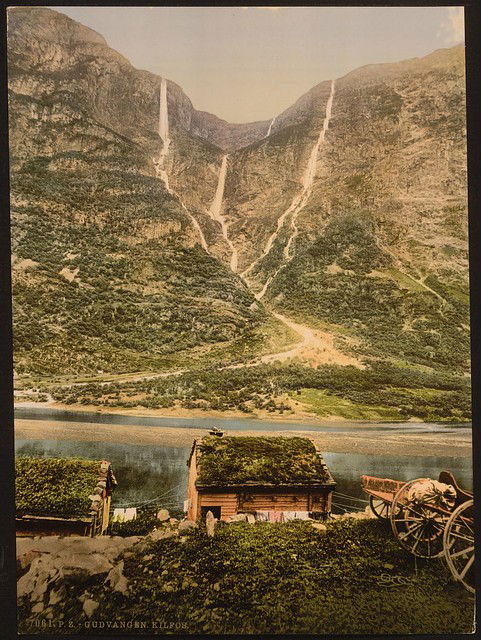
Gudvangen, Kilfos, Sognefjord, Norway, ca. 1890
Overcast. An old loghouse with a balding thatched roof along a mountain path. Goats linger about, munching at the anemic grass that grows around the building. A wooden sign, which might have once hung high but is now resting oblique against the wall beside the loghouse's door, reads: "Pilgrims Welcome" in ancient hand-painted letters.
A woman, dressed in so many layers of drab coats that she looks twice her bulk, shuffles up the muddy path under the low gray sky. A heavy bag flung over her shoulder. She looks at the fading sign and enters.
An hour or so later, a man pulling a wobbly two-wheeled cart approaches from the opposite end of the path. The cart is empty except for a sprinkling of frayed twigs, half-dried leaves, and dirt. A blooming thicket of wiry hairs between the wide bulbous nose and the thin lips, no hair on chin or scalp. He halts to look silently at a white goat, then picks up his cart again and flips it against the wall to the side of the loghouse's door. He enters.
Inside, a rude room cluttered with half a dozen crooked chairs and the desolate bunk frame of a bed. All exists in semi-darkness, because only two small windows open to the bleak-gray outside. A slim fire lengthens in the fireplace at the center of the room. The sitting woman, her hair quivering strawlike in color and rigidity over the hearth, looks up and welcomes the new visitor.
"Good day," she says.
The man nods frowningly and looks at the four patchy coats thrown on the back of a chair. "To you," he says.
"Pilgrim, mister?" she asks.
"Aye, second time, too," he answers. "Heading back down."
"Eh, you ahead of me then. I'm climbing and I wish I was going down like you."
"'Tis a tiresome path, aye." He begins stirring the logs in the fire, blows in their gaps.
The woman looks at the man's blooming mustache for a moment, then asks, "Where you from though?"
"River Valleys up north. Talk about a hike."
"I know them River Valleys. You have the oceans there, don't ye? Never met anyone from there I don't reckon."
"Well now you have and congratulations to you," the man says as he sits on one of the chairs.
"I guess I have."
The two gaze at the fire for some time. The man takes an old piece of bread out of his pocket and begins chewing at one of its corners.
"I'm from them Green Plains down down south," she says quietly, as if to herself.
"That so?"
"I am too. You been?"
"Can't say I have," he answers, the hairy thicket brushing every bite of bread as if to prepare it for deglutition. The man looks at the fire, then tilts his head as a goat's bleat seeps through the loghouse's wood. "They sure got funny beasts 'round here," he says into the fire, which is now mature and licking high towards the ceiling.
"Goats always be funny," the woman replies. "Goat voices used to make me and me sisters laugh every time when we was little."
"Well, these ones make me laugh now and I ain't little no more."
The woman stands up and removes two more coats, speaking as she does so. "You know what I think is good? Cows. Cows is good."
"Cows? I ain't seen no cows 'round here. Not this time or the other time."
"Not here. Just cows, wherever they be. Cows be real good. Majestic, that's the word Teacher used to used."
The man looks into the woman's eyes for the first time since arriving. His eyebrows, overgrown but ever overshadowed by the mustache, raised high. "What's majestic about cows now?"
For a moment, the woman's thoughts go back to her youth, when she had a favorite cow belonging to her father. Its mane was a deep brown like rich earth, and its golden horns were very long and erect, curving handsomely along their shafts and then briskly near the tips like the august handles of a great lyre. All bovines in her country look like that, but her father's beast seemed to her like the most beautiful of all. "I reckon it's them horns," she says. "Yeah, all considered it's the horns that's majestic."
"Ha!" chortles the man. His mind wanders back to his farm, up north in the River Valleys, where he tends to a whole herd of cows with his extended family. All cows in his region are rather small and squat, with furs speckled with dirty white, black, and brown in uneven and shifting proportions, and their horns are short and curled into pathetic spirals. "Well, now," he says. "Wouldn't call them majestic. Always thought them funny as hell, you know. Funnier than goats, at least. But the goats 'round here are even funnier."
"Cows ain't funny. Cows is good and beautiful and majestic, too. I like cows," says the woman.
"Oh, I like cows too. I just find them funny, is all. But I like them all right. Good beasts, good beasts."
The woman looks at him intently, her eyes again on the natural brush sprouting from his nose. "Ye folks of the River Valleys strange, that's for sure." Then, catching herself, "no offense meant, mister. I just thought you use strange words. Funny this, funny that, you know. Not to say ye bad folks. I'm sure ye fine folks all the same."
"Less fine than you think, ha! But the ones with queer words are you people of the Green Plains, calling cows majestic and all. Talk about strange!"
"That was Teacher who said that. It's not all people of the Valleys who go around saying majestic this, majestic that. I just like the word, is all."
"Sounds queer to me all the same. Majestic cows, ha!"
The woman lurches back to her feet, stretches her back with a whimper, and says, "I better get going on up. Who knows when it goes dark in these mountains."
The man looks up at her as she begins to apply her coats in a seemingly predetermined sequence. "It goes dark when it goes dark, as everywhere else."
"I bet it does, too."
She walks out of the semidark room, her fabric bulk scraping against both edges of the door, and leaves the loghouse.
The man looks at the fire for a long time, rests a dry log on the embers. Then his shoulders begin to shake slightly up and down, and continue shaking for a good while. Then he says, "Ha! Majestic cows!" ●
Cover image:
Gudvangen, Kilfos, Sognefjord, Norway, ca. 1890
 Framings and ModelsMindLanguage