Marco Giancotti,
July 31, 2026
Cover image:
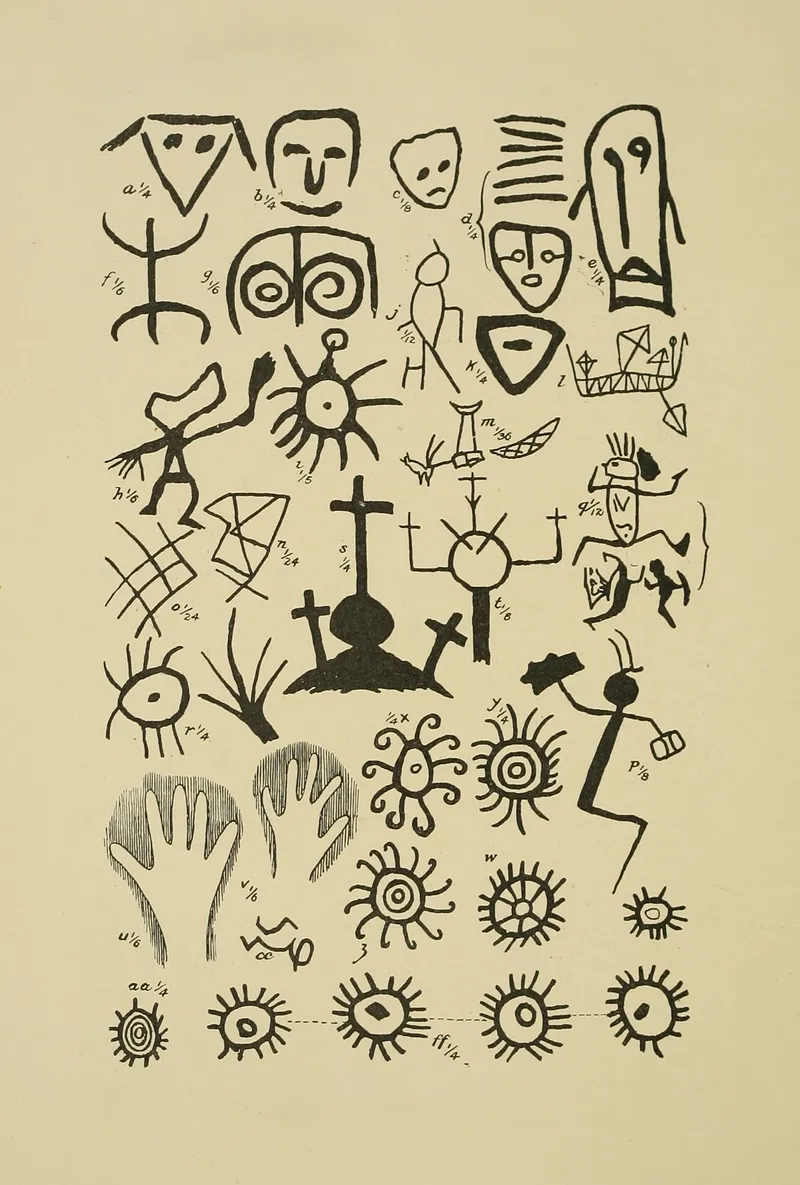
Petroglyphs in Kei Islands (1894), Garrick Mallery
Words have always had a way with me. They find me if and when it suits their fancy. If they do find me, they usually find me between thirty minutes and thirty days after they would have been just perfect to tell someone.
That's why I've always been more of a text person—the words that come to me may not be timely, but text rarely needs to be anyway. Read, think, write: this is the kind of conversation I like the most. It is my weakness, my Achilles' heel even, because my alphabetical bias means I miss out on much of the richness of spoken dialog. Nonverbal channels, subtle facial cues, and eloquent pauses are off limits in my world of just words.
It's true, the written has its privileges. First and foremost, it is blessed with a sublime, lithic stability of character. Its surface can be rough, its verbs smooth, its sentences accumulate into great cliffs of ideas, but its shape will always be firm and consistent. Text is always only text—line upon line of static letters, spaces, punctuation, the occasional sprinkling of numbers and other symbols, and nothing else. This predictability cradles you, and it allows you to forget it exists. Your retinas take in strings of squiggles, but your mind visits places. The stillness of written words is the secret to their transparency. But ask yourself: is this really a good thing? Is transparency so desirable in language as to justify the predictability of form? Ask anyone in the street and they'll tell you that predictability is boring, and that boredom is the enemy of this age. They'll also tell you that it's not good to escape reality, because reality can't be escaped. The sweet escapist nectar of text, its infinite stability is at the same time a blessing and a curse, a devil's kiss, a cage made of gold—it calls to me, it soothes what reason ever inhabits me, it takes me away and I go, I usually go along with it but perhaps I should fight—I should break free of its limitations, I want to master it, transcend it, go beyond it, fully understand it! But how to do that, if first I cannot answer the simple question: what is text? Visual effect: The text is rendered in a weight gradient: thin and light at the top, growing progressively heavier toward the bottom.
I t ' s t r u e , t h e w r i t t e n h a s i t s p r i v i l e g e s . F i r s t a n d f o r e m o s t , i t i s b l e s s e d w i t h a s u b l i m e , l i t h i c s t a b i l i t y o f c h a r a c t e r . I t s s u r f a c e c a n b e r o u g h , i t s v e r b s s m o o t h , i t s s e n t e n c e s a c c u m u l a t e i n t o g r e a t c l i f f s o f i d e a s , b u t i t s s h a p e w i l l a l w a y s b e f i r m a n d c o n s i s t e n t . T e x t i s a l w a y s o n l y t e x t — l i n e u p o n l i n e o f s t a t i c l e t t e r s , s p a c e s , p u n c t u a t i o n , t h e o c c a s i o n a l s p r i n k l i n g o f n u m b e r s a n d o t h e r s y m b o l s , a n d n o t h i n g e l s e . T h i s p r e d i c t a b i l i t y c r a d l e s y o u , a n d i t a l l o w s y o u t o f o r g e t i t e x i s t s . Y o u r r e t i n a s t a k e i n s t r i n g s o f s q u i g g l e s , b u t y o u r m i n d v i s i t s p l a c e s . T h e s t i l l n e s s o f w r i t t e n w o r d s i s t h e s e c r e t t o t h e i r t r a n s p a r e n c y . B u t a s k y o u r s e l f : i s t h i s r e a l l y a g o o d t h i n g ? I s t r a n s p a r e n c y s o d e s i r a b l e i n l a n g u a g e a s t o j u s t i f y t h e p r e d i c t a b i l i t y o f f o r m ? A s k a n y o n e i n t h e s t r e e t a n d t h e y ' l l t e l l y o u t h a t p r e d i c t a b i l i t y i s b o r i n g , a n d t h a t b o r e d o m i s t h e e n e m y o f t h i s a g e . T h e y ' l l a l s o t e l l y o u t h a t i t ' s n o t g o o d t o e s c a p e r e a l i t y , b e c a u s e r e a l i t y c a n ' t b e e s c a p e d . T h e s w e e t e s c a p i s t n e c t a r o f t e x t , i t s i n f i n i t e s t a b i l i t y i s a t t h e s a m e t i m e a b l e s s i n g a n d a c u r s e , a d e v i l ' s k i s s , a c a g e m a d e o f g o l d — i t c a l l s t o m e , i t s o o t h e s w h a t r e a s o n e v e r i n h a b i t s m e , i t t a k e s m e a w a y a n d I g o , I u s u a l l y g o a l o n g w i t h i t b u t p e r h a p s I s h o u l d f i g h t — I s h o u l d b r e a k f r e e o f i t s l i m i t a t i o n s , I w a n t t o m a s t e r i t , t r a n s c e n d i t , g o b e y o n d i t , f u l l y u n d e r s t a n d i t ! B u t h o w t o d o t h a t , i f f i r s t I c a n n o t a n s w e r t h e s i m p l e q u e s t i o n : w h a t i s t e x t ?
One might say that text is pure language, but only a dialectical system is worthy of that name. There is nothing dialectical about text: it won't even react to you. What can you do to it? Destroy it you can, burn it only if made of paper, and that's about it. Speaking to a sans-serif word won't yield a response. Caressing a sentence made of ink won't give back any warmth. Clicking on a paragraph is a futile exercise—go on, try it for yourself: taste loneliness once again. Advocates will tell you that it is precisely this inertness that allows text to offer exactly the same experience to every reader. Text is one, readers are multitude. As if that were a boon! Not that people haven't attempted to make text adaptive—they called them choose-your-own-adventure books, they were a hack rather than a solution, and they are now all but dead. Text does not care about you, text does not respond to you. Visual effect: Hovering the cursor illuminates nearby characters, making them bolder. Clicking and dragging paints a shifting nacre trail of iridescent colour across the text, which fades over several seconds.
O n e m i g h t s a y t h a t t e x t i s p u r e l a n g u a g e , b u t o n l y a d i a l e c t i c a l s y s t e m i s w o r t h y o f t h a t n a m e . T h e r e i s n o t h i n g d i a l e c t i c a l a b o u t t e x t : i t w o n ' t e v e n r e a c t t o y o u . W h a t c a n y o u d o t o i t ? D e s t r o y i t y o u c a n , b u r n i t o n l y i f m a d e o f p a p e r , a n d t h a t ' s a b o u t i t . S p e a k i n g t o a s a n s - s e r i f w o r d w o n ' t y i e l d a r e s p o n s e . C a r e s s i n g a s e n t e n c e m a d e o f i n k w o n ' t g i v e b a c k a n y w a r m t h . C l i c k i n g o n a p a r a g r a p h i s a f u t i l e e x e r c i s e — g o o n , t r y i t f o r y o u r s e l f : t a s t e l o n e l i n e s s o n c e a g a i n . A d v o c a t e s w i l l t e l l y o u t h a t i t i s p r e c i s e l y t h i s i n e r t n e s s t h a t a l l o w s t e x t t o o f f e r e x a c t l y t h e s a m e e x p e r i e n c e t o e v e r y r e a d e r . T e x t i s o n e , r e a d e r s a r e m u l t i t u d e . A s i f t h a t w e r e a b o o n ! N o t t h a t p e o p l e h a v e n ' t a t t e m p t e d t o m a k e t e x t a d a p t i v e — t h e y c a l l e d t h e m c h o o s e - y o u r - o w n - a d v e n t u r e b o o k s , t h e y w e r e a h a c k r a t h e r t h a n a s o l u t i o n , a n d t h e y a r e n o w a l l b u t d e a d . T e x t d o e s n o t c a r e a b o u t y o u , t e x t d o e s n o t r e s p o n d t o y o u .
Is text an inert object? Like a sidewalk puddle or an asteroid belt? If that were the case, I would be wrong to yearn for it to answer me. I could then at least hope to use it as a doorstop, or as a high-brow bowtie. Alas, that is a dead end, too. You can see it, sure, and you can touch its featureless surface, but text will not obey the laws of physics. It has no energy, no mass, no electric charge. The letters are its atoms, and no quantum formula can predict them. Written words are not solid, nor are they waves: they are not things of nature. Visual effect: Clicking sends an expanding ring of weight outward from the click point; letters the ring passes through briefly bold before settling back.
I s t e x t a n i n e r t o b j e c t ? L i k e a s i d e w a l k p u d d l e o r a n a s t e r o i d b e l t ? I f t h a t w e r e t h e c a s e , I w o u l d b e w r o n g t o y e a r n f o r i t t o a n s w e r m e . I c o u l d t h e n a t l e a s t h o p e t o u s e i t a s a d o o r s t o p , o r a s a h i g h - b r o w b o w t i e . A l a s , t h a t i s a d e a d e n d , t o o . Y o u c a n s e e i t , s u r e , a n d y o u c a n t o u c h i t s f e a t u r e l e s s s u r f a c e , b u t t e x t w i l l n o t o b e y t h e l a w s o f p h y s i c s . I t h a s n o e n e r g y , n o m a s s , n o e l e c t r i c c h a r g e . T h e l e t t e r s a r e i t s a t o m s , a n d n o q u a n t u m f o r m u l a c a n p r e d i c t t h e m . W r i t t e n w o r d s a r e n o t s o l i d , n o r a r e t h e y w a v e s : t h e y a r e n o t t h i n g s o f n a t u r e .
If not natural, is text at least mechanical? After all, it is the artifact of human hands. In this hypothesis our words—when expressed in two spatial dimensions—would be a form of clockwork, computer programs of a sort, with parts that slot into each other and produce a designed effect. There is something to this idea. While there are no cogwheels or wires in human writing, it seems uncontroversial that it is an information-conduit. It is assembled by trained individuals according to human-made rules and multiple implied inter-connections; its mechanics are well-studied and mostly-understood by the experts; it is usually created with a function in mind, and deployed into the world in the hope it won't malfunction; in a sense, you could even say that people design and engineer it to perform a predefined job. At first glance, then, it seems as if the matter was settled, but this is yet another illusion—text is made of information, but it does not compute it. It sits there on the page, and its output is forever identical to its input. This fact alone demonstrates that, although it can be produced by a machine, a machine it is not. Visual effect: Clicking seeds a Conway's Game of Life simulation across the character grid. Living cells appear bold; dead cells stay thin. The simulation runs until it reaches stasis, then waits for another click.
I f n o t n a t u r a l , i s t e x t a t l e a s t m e c h a n i c a l ? A f t e r a l l , i t i s t h e a r t i f a c t o f h u m a n h a n d s . I n t h i s h y p o t h e s i s o u r w o r d s — w h e n e x p r e s s e d i n t w o s p a t i a l d i m e n s i o n s — w o u l d b e a f o r m o f c l o c k w o r k , c o m p u t e r p r o g r a m s o f a s o r t , w i t h p a r t s t h a t s l o t i n t o e a c h o t h e r a n d p r o d u c e a d e s i g n e d e f f e c t . T h e r e i s s o m e t h i n g t o t h i s i d e a . W h i l e t h e r e a r e n o c o g w h e e l s o r w i r e s i n h u m a n w r i t i n g , i t s e e m s u n c o n t r o v e r s i a l t h a t i t i s a n i n f o r m a t i o n - c o n d u i t . I t i s a s s e m b l e d b y t r a i n e d i n d i v i d u a l s a c c o r d i n g t o h u m a n - m a d e r u l e s a n d m u l t i p l e i m p l i e d i n t e r - c o n n e c t i o n s ; i t s m e c h a n i c s a r e w e l l - s t u d i e d a n d m o s t l y - u n d e r s t o o d b y t h e e x p e r t s ; i t i s u s u a l l y c r e a t e d w i t h a f u n c t i o n i n m i n d , a n d d e p l o y e d i n t o t h e w o r l d i n t h e h o p e i t w o n ' t m a l f u n c t i o n ; i n a s e n s e , y o u c o u l d e v e n s a y t h a t p e o p l e d e s i g n a n d e n g i n e e r i t t o p e r f o r m a p r e d e f i n e d j o b . A t f i r s t g l a n c e , t h e n , i t s e e m s a s i f t h e m a t t e r w a s s e t t l e d , b u t t h i s i s y e t a n o t h e r i l l u s i o n — t e x t i s m a d e o f i n f o r m a t i o n , b u t i t d o e s n o t c o m p u t e i t . I t s i t s t h e r e o n t h e p a g e , a n d i t s o u t p u t i s f o r e v e r i d e n t i c a l t o i t s i n p u t . T h i s f a c t a l o n e d e m o n s t r a t e s t h a t , a l t h o u g h i t c a n b e p r o d u c e d b y a m a c h i n e , a m a c h i n e i t i s n o t .
I do not know what text is. I've made no progress with the answer. Perhaps there is no reason that can defend my preference for writing over speaking. It's my guilty, irrational pleasure—my cowardice—my misanthropy? Perhaps the thing I like the most about it is that it is very much unlike a living person. It does not breathe. I can rip and incinerate the page, I can throw the screen under a bridge, but the text is unharmed. I can't hurt the words, especially not after they've entered my mind. I can't even scratch them. This is comforting: the perfect friend. Visual effect: The text breathes: all characters slowly grow bolder on inhale and thin on exhale, in a six-second cycle. Dragging across the text leaves a fading pink scratch mark.
I d o n o t k n o w w h a t t e x t i s . I ' v e m a d e n o p r o g r e s s w i t h t h e a n s w e r . P e r h a p s t h e r e i s n o r e a s o n t h a t c a n d e f e n d m y p r e f e r e n c e f o r w r i t i n g o v e r s p e a k i n g . I t ' s m y g u i l t y , i r r a t i o n a l p l e a s u r e — m y c o w a r d i c e — m y m i s a n t h r o p y ? P e r h a p s t h e t h i n g I l i k e t h e m o s t a b o u t i t i s t h a t i t i s v e r y m u c h u n l i k e a l i v i n g p e r s o n . I t d o e s n o t b r e a t h e . I c a n r i p a n d i n c i n e r a t e t h e p a g e , I c a n t h r o w t h e s c r e e n u n d e r a b r i d g e , b u t t h e t e x t i s u n h a r m e d . I c a n ' t h u r t t h e w o r d s , e s p e c i a l l y n o t a f t e r t h e y ' v e e n t e r e d m y m i n d . I c a n ' t e v e n s c r a t c h t h e m . T h i s i s c o m f o r t i n g : t h e p e r f e c t f r i e n d .
I surrender. The written word has mastered me, and not the other way around. If rational thought fails me, I will resort to faith in this God of Strings. I exist at its whims, I breathe it in and out of my creative bronchi and bronchioles, worship the golden cage. Indeed, words have always had a way with me. And if they constrain what I can express, then so be it. Trap me, then, and I won't say it's an unfair condition. Perhaps a picture is worth a thousand words, but I happen to have a thousand and one. The painter will retort: no, that is still not enough. No number of words will avail you the power of impressing, deep in a starving visual cortex, the pride of a lion's mane. To which I rejoin: can any arrangement of pigments convey the exhilarating fluency of Tennyson's verses or the interior history of Faulkner's characters? Can a tune carry an hour-long thought process to fruition? Is it bondage when everyone gets to pick their cage? Visual effect: Clicking cycles through 3 images rendered entirely in character color: pride of a lion's mane, Mona Lisa's hypnotic gaze, emotion of an aurora. Each image scrolls continuously across the text.
I s u r r e n d e r . T h e w r i t t e n w o r d h a s m a s t e r e d m e , a n d n o t t h e o t h e r w a y a r o u n d . I f r a t i o n a l t h o u g h t f a i l s m e , I w i l l r e s o r t t o f a i t h i n t h i s G o d o f S t r i n g s . I e x i s t a t i t s w h i m s , I b r e a t h e i t i n a n d o u t o f m y c r e a t i v e b r o n c h i a n d b r o n c h i o l e s , w o r s h i p t h e g o l d e n c a g e . I n d e e d , w o r d s h a v e a l w a y s h a d a w a y w i t h m e . A n d i f t h e y c o n s t r a i n w h a t I c a n e x p r e s s , t h e n s o b e i t . T r a p m e , t h e n , a n d I w o n ' t s a y i t ' s a n u n f a i r c o n d i t i o n . P e r h a p s a p i c t u r e i s w o r t h a t h o u s a n d w o r d s , b u t I h a p p e n t o h a v e a t h o u s a n d a n d o n e . T h e p a i n t e r w i l l r e t o r t : n o , t h a t i s s t i l l n o t e n o u g h . N o n u m b e r o f w o r d s w i l l a v a i l y o u t h e p o w e r o f i m p r e s s i n g , d e e p i n a s t a r v i n g v i s u a l c o r t e x , t h e pride of a lion's mane . T o w h i c h I r e j o i n : c a n a n y a r r a n g e m e n t o f p i g m e n t s c o n v e y t h e e x h i l a r a t i n g f l u e n c y o f T e n n y s o n ' s v e r s e s o r t h e i n t e r i o r h i s t o r y o f F a u l k n e r ' s c h a r a c t e r s ? C a n a t u n e c a r r y a n h o u r - l o n g t h o u g h t p r o c e s s t o f r u i t i o n ? I s i t b o n d a g e w h e n e v e r y o n e g e t s t o p i c k t h e i r c a g e ?
Weakness, comfort, cowardice, now arrogance. This maelstrom of idiosyncratic words has dragged me through quite a few circles of a Dantean hell. Except, at its bottom is not a half-frozen archdevil but a version of Beatrice they call Humility, for my Stockholm syndrome is stocky enough to squash my ego at every keystroke. Each thing I write is an inauspicious attempt at something greater, usually not a triumphant one. My true fear, I have to finally admit, is not to be unable to convey some multimodal sensory experience, but to fail to say in words what I could say in words. Only I know of all the dreams and sensibilities that dwell and have dwelt in the cracks and recesses of my psyche, and they resist my efforts to cajole them into sequences of spaces and letters—they seem to want to straddle the lines, forever defying my ability to express them, no matter how much extra time the medium of writing affords me. And so every piece of my writing ends with a circle: a final, heavy period to yet another botched confession, a bullet hole in my hubris, a pirate's sign of doom. Perhaps I have chosen the wrong profession? ● Visual effect: Clicking reveals a hidden scrolling message rendered in character weight: “just kidding, I love doing this!”.
W e a k n e s s , c o m f o r t , c o w a r d i c e , n o w a r r o g a n c e . T h i s m a e l s t r o m o f i d i o s y n c r a t i c w o r d s h a s d r a g g e d m e t h r o u g h q u i t e a f e w c i r c l e s o f a D a n t e a n h e l l . E x c e p t , a t i t s b o t t o m i s n o t a h a l f - f r o z e n a r c h d e v i l b u t a v e r s i o n o f B e a t r i c e t h e y c a l l H u m i l i t y , f o r m y S t o c k h o l m s y n d r o m e i s s t o c k y e n o u g h t o s q u a s h m y e g o a t e v e r y k e y s t r o k e . E a c h t h i n g I w r i t e i s a n i n a u s p i c i o u s a t t e m p t a t s o m e t h i n g g r e a t e r , u s u a l l y n o t a t r i u m p h a n t o n e . M y t r u e f e a r , I h a v e t o f i n a l l y a d m i t , i s n o t t o b e u n a b l e t o c o n v e y s o m e m u l t i m o d a l s e n s o r y e x p e r i e n c e , b u t t o f a i l t o s a y i n w o r d s w h a t I c o u l d s a y i n w o r d s . O n l y I k n o w o f a l l t h e d r e a m s a n d s e n s i b i l i t i e s t h a t d w e l l a n d h a v e d w e l t i n t h e c r a c k s a n d r e c e s s e s o f m y p s y c h e , a n d t h e y r e s i s t m y e f f o r t s t o c a j o l e t h e m i n t o s e q u e n c e s o f s p a c e s a n d l e t t e r s — t h e y s e e m t o w a n t t o s t r a d d l e t h e l i n e s , f o r e v e r d e f y i n g m y a b i l i t y t o e x p r e s s t h e m , n o m a t t e r h o w m u c h e x t r a t i m e t h e m e d i u m o f w r i t i n g a f f o r d s m e . A n d s o e v e r y p i e c e o f m y w r i t i n g e n d s w i t h a c i r c l e : a f i n a l , h e a v y p e r i o d t o y e t a n o t h e r b o t c h e d c o n f e s s i o n , a b u l l e t h o l e i n m y h u b r i s , a p i r a t e ' s s i g n o f d o o m . P e r h a p s I h a v e c h o s e n t h e w r o n g p r o f e s s i o n ? ●
Image credits:
Lion: Alexas_Fotos, Unsplash
Mona Lisa: Leonardo Da Vinci
Aurora: Jonny Gios, Unsplash
Cover image:
Petroglyphs in Kei Islands (1894), Garrick Mallery
 MindLanguage