A Map, a Toolbox, a Convergence
Some things emerge
Marco Giancotti,
Marco Giancotti,
Cover image:
The Aether Mug Atlas
Thinking tools in this post:
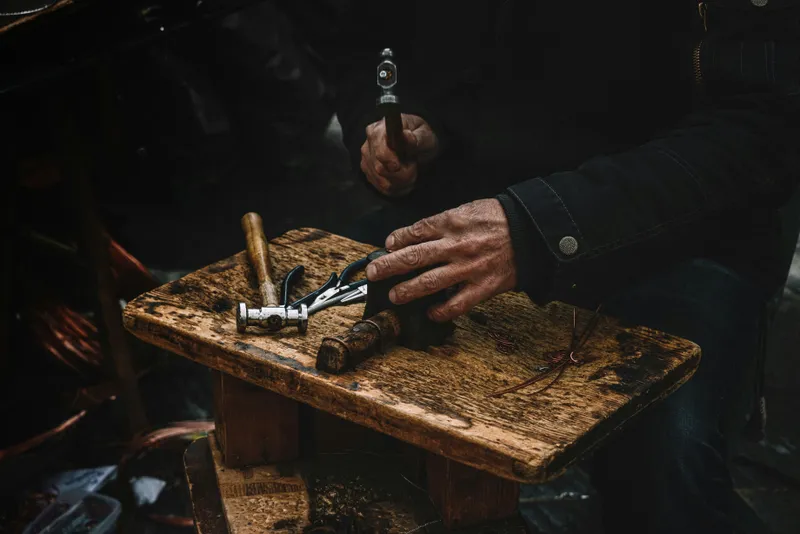
I don't know about you, but what awes me when I watch an artisan at work is their tools and how they use them. "Use" may not even be the right word when it comes to consummate craftspeople: the tools become their appendages; they seem to disappear into them, making those people something more than people—a powerful expansion of the boundaries that define them.
The work I do could be called thinking-tool artisan, so I strive to achieve the same mastery of my tools as the luthier achieves with their chisels and the blacksmith with their hammers. But I also run this blog, which is equivalent to opening up my artisan's workshop for everyone to see, poke around in, and give my tools a try.
So today I'm upgrading my workshop: it's now roomier, tidier, and easier to explore. If you're in a hurry, here is the long and short of it. Explanations follow for those who linger.
- I present to you the Aether Mug Atlas, a semantic world that turns the connections between blog posts into paths you can journey along.
- I also present to you the Aether Mug Thinking Toolbox, an inventory of all the thinking tools I have ever featured or used in my online writing.
- As of today, Plankton Valhalla, my essay site, has been absorbed into Aether Mug: same content, one website.
A Map
Most blogs are written like rivers: each post is transient and kind of throwaway. From the very start, I have meant this blog to be rather like a single, growing product, each part of it designed to interact with and strengthen all the others. Another way to put it is that I think of this blog as a graph—a network with myriad connections both explicit (hyperlinks) and implicit (semantic similarity) that make it a single, complex whole.
But the front page of Aether Mug has never made that clear. It looks like your typical post feed, where the newest post is the one you're encouraged to begin with, and then you passively follow the train chronologically in a straight line. I've always wanted to dispel that impression.
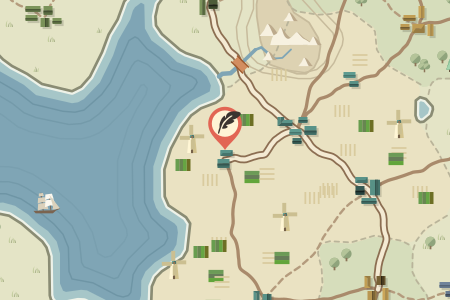
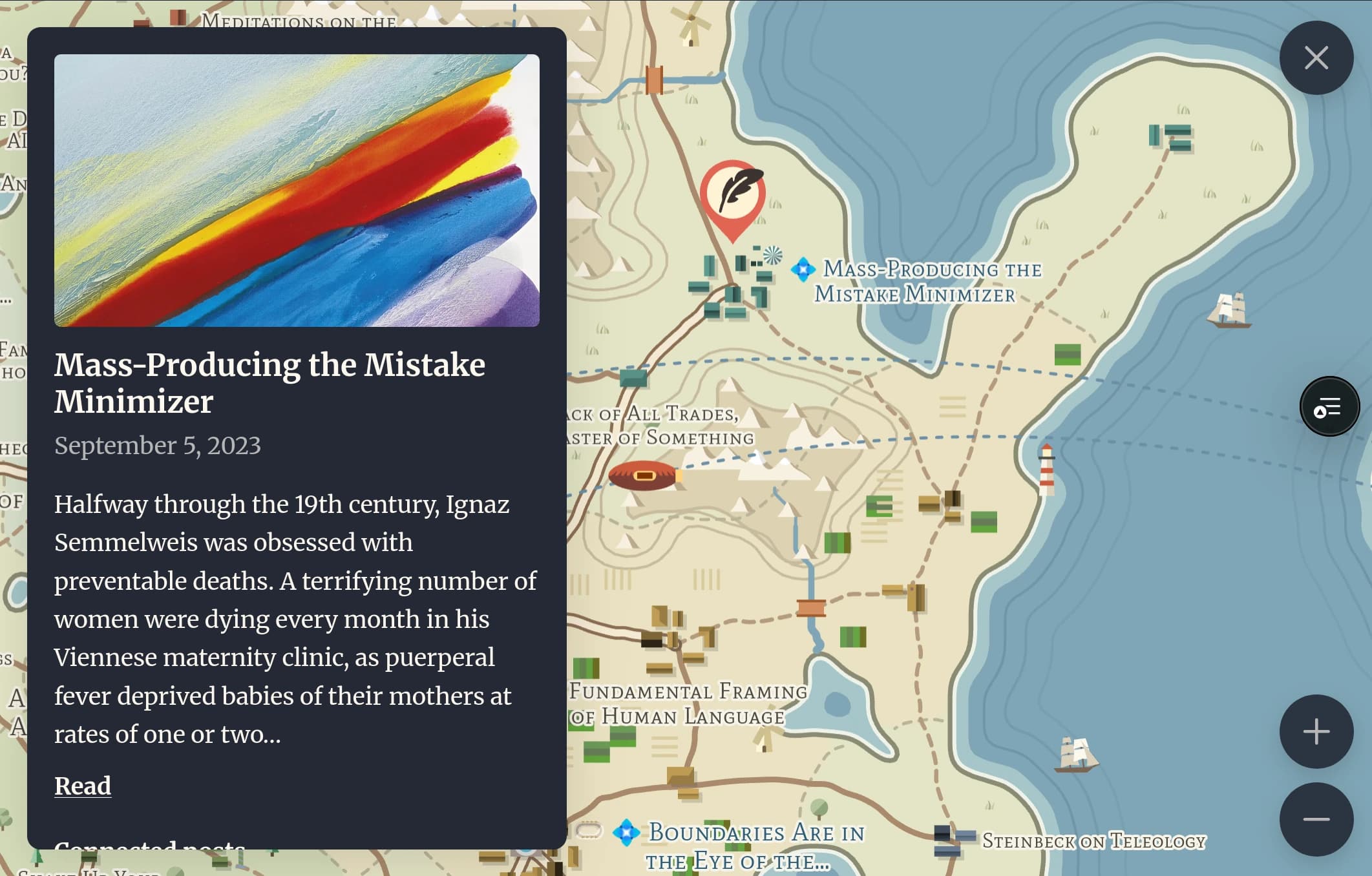
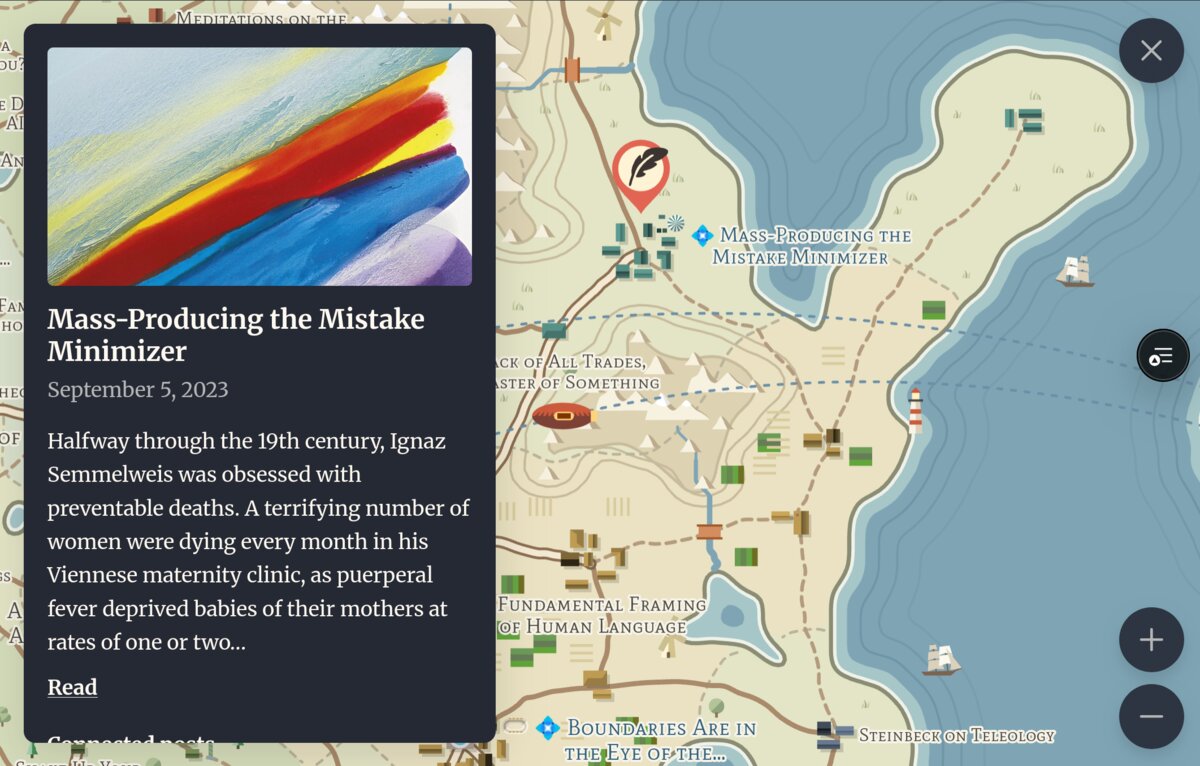
The new Aether Mug Atlas is a different take on what the face of a blog like this could look like. Try it out now in a new tab: you'll find a world with many roads, but no predefined path. Each city is a blog post, cities are bigger for more central posts (those with more incoming links), and fireworks celebrate the latest entry. There is no recommended starting point or destination, no right order in which to move around. This is an invitation to forge your own path, ignoring chronology and cutting through the site's contents guided only by your curiosity. It's another way to do the kind of "cross-section reading" I wrote about for the Foldable Tractatus.
I drew all the art myself, and an LLM built the code to visualize the graph, move things around, and procedurally generate the territory. I hope you enjoy it.
A Toolbox
With all this talk of "crafting" "tools" "for thinking", you might be wondering what I mean in practice. I hear cries of show me this workshop, then! and let us peruse these so-called tools!
Wonder and cry no more: every blog post now has a list of the thinking tools it employs, and a new Thinking Toolbox page shows the whole list in one place. Principles, analogies, frameworks, raw concepts—all kinds of mind-expanding ideas are now at your fingertips, in the form of an index.
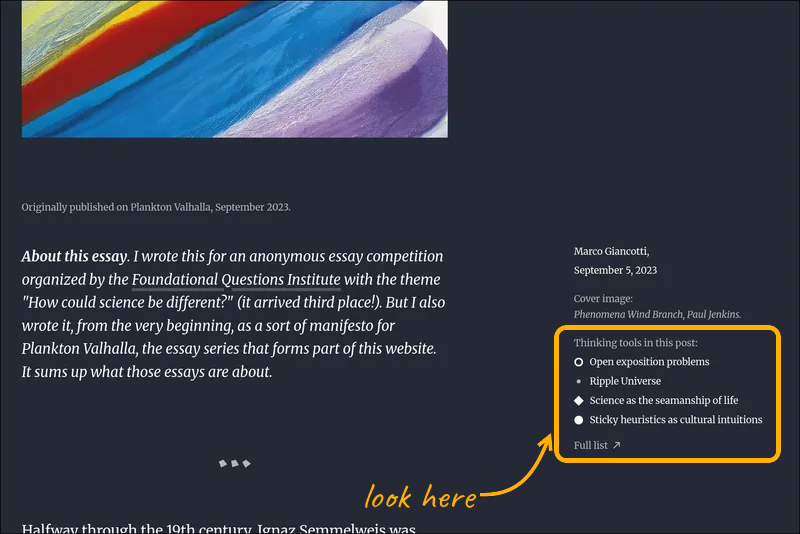
Some of those tools have surfaced only once on AeMug; others make regular appearances across multiple posts. Many I borrowed as-is, even more I borrowed and repackaged, and a few are (I think) my own original ideas. With every new post, the list will keep growing.
Did you think I was just throwing words around? Take these!
A Convergence
After several years of running two websites in parallel, I'm now consolidating them into one here, at aethermug.com. The other site, Plankton Valhalla, was dedicated to essays: longer, published on an irregular schedule, and written for a broader audience. Starting today, those 13 essays form a series on Aether Mug, which you can find on the front page by filtering for "Essays". All old planktonvalhalla.com links should keep working, auto-redirecting to this domain. The essays are already snugly integrated into the Atlas and the Toolbox I announced above.
A couple more practical points for subscribers.
The two mailing lists are now one. All subscribers to Plankton Valhalla are now subscribed to Aether Mug, but they won't get non-essay posts (except this one) unless they explicitly opt in on their subscriber page (there's a link to that at the end of every email). I won't send weekly emails to people who didn't ask for them. Pre-existing Aether Mug subscribers will receive new essays from the Plankton Valhalla series: they're so few and far between that I doubt they'll overwhelm you. You can opt out in the same way, of course.
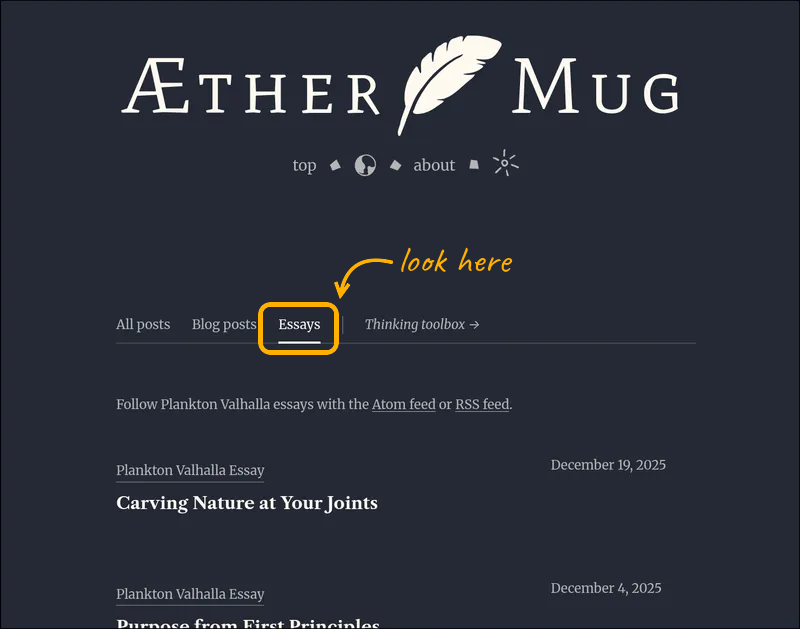
As for the Atom/RSS feeds (for those who use them), the main AeMug feed will include new essays. If you only want the essays and not the blog posts, the separate Atom feed and RSS feed for the old Plankton Valhalla site will keep working.
Some Things Emerge
I don't often do announcement-only posts like this, because people subscribe to a blog for the ideas and stories the author has to share, not for administrative stuff. We all read enough admin stuff outside of blogs. But today's updates all have something in common: they are a way for me to design for emergence. Each blog post and essay adds something of its own to the whole, but something more might emerge when you pay attention to the spaces between. Maybe the surplus beyond the sum of the parts is the most interesting result of a work like this. ●
Cover image:
The Aether Mug Atlas
Thinking tools in this post:
 Announcements
Comments
Loading comments...