Presenting the Foldable Tractatus
An interactive Wittgensteinian tool for thought
Marco Giancotti,

Marco Giancotti,
Thinking tools in this post:
I made a thing: the Foldable Tractatus, a free and open-source web app designed to make reading Wittgenstein's famous first book only hard (as opposed to really hard without it). I'm quite proud of this!
First, you can check it out now. Then read below why I decided to make this multi-level meta-experiment that no one asked for.
A few months ago I had the incredibly brave idea of reading Ludwig Wittgenstein's Tractatus Logico-Philosophicus. It's famous, it's short, and Wittgenstein's awesome, so why not?
In retrospect, I was braver than I could afford.
I knew the book was going to be dense, but boy, was it hard to go through. In part it's because of the large array of technical terms scattered all over it, in part because it's a sequence of assertions with little or no justification and zero concrete examples. These things I can't really complain about, because the author is trying to convey very abstract, fine points while preserving the underrated virtue of conciseness: his aim is to, you know, just... solve the entirety of philosophy, for ever and for everyone, so that philosophers can finally become elementary-school teachers like him and begin contributing to society—all in just 75 pages, where others would have indulged in hundreds of pages of obtuse circling around. I probably wouldn't have read this book had it been hundreds of pages long, so Wittgenstein's commitment to compression is something I can only praise.
The real problem was the format. I read the Tractatus on a Kobo ebook reader, and it just didn't support the style of reading that this book needs. Sure, my Kobo allowed me to add annotations and auto-synced all my highlights to my Readwise account, which was neat, but it also made jumping quickly to other points in a book slow and cumbersome. In a paper book, you can add bookmarks and (gasp) dog-ear pages that you want to get back to. Finding them again is then almost muscle memory. And the Tractatus needs a lot of jumping around. The friction of my reading device made me give up on most of that cross-reading, and it badly hurt my understanding.
But the Tractatus is a stranger book than most, and soon I started doubting whether even a paper version would have been convenient enough. You see, this book is written like a tree. It's structurally very unbooklike.
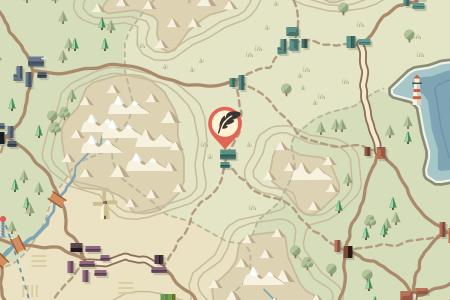
Normal books are sequences of chapters, each of which is a sequence of paragraphs, each of which is a sequence of sentences. At any point in a standard book, you know exactly where you are: you're after all the parts you've already read and before the ones you haven't read yet. This seems obvious until you read the Tractatus. The Tractatus is not like that.
Rather than a book-length succession of ideas building on each other, it is a set of only seven short statements that can be read in under a minute. If you understand them on the first try, congratulations: you've finished the book! Most people can't make head or tail of those seven statements, though, so each of them comes with its own small set of statements expanding on it. Many of those sub-statements are difficult enough to need their own expansion into sub-sub-statements, and so on recursively, several levels deep. What is, on the surface, a single paragraph of seven assertions, is fractally expanded into five hundred and twenty-five points at different depths of detail, snowflake-like.
I love this! This is all up my alley: it is intended as an interactive, navigable tree-graph of ideas, and the reader can choose to dive deeper on some areas than others, jump around, pick and choose their path from one branch to the next. I wish more books were written like this.
But, again: would paper do justice to such an unconventional reading approach? I don't think so at all. Even with the physical affordances for skimming back and forth intuitively, you would need to keep track of an unreasonable number of bookmarks, and a very sophisticated way to mark different pages by topic—sometimes multiple different marks per page.
Also, suppose you wanted to focus on only one of several deep themes in the book, like his "picture theory" of language. This is touched upon in several different branches of the tree, and there is no final summary chapter to bring it all together. The book is its own summary, by design. In theory, you could use sticky labels of a specific color—red, say—to mark all points in the book related to the picture theory on a first read, then re-read it from the start by skipping from one red label to the next, cutting a "cross section" through the text. It can be done, but that would mean a lot of tedious work during both readings.
I managed to finish reading the ebook version, but I can't say I understood it in depth. I felt like I had missed many cross-branch connections, and no single big picture congealed in my mind. This very sub-par experience left me wondering: what would be the perfect medium to read this book (and any other books like it)?
The Foldable Tractatus is the answer I found.
Given the inherent interactivity that Wittgenstein's book requires, a digital format—a responsive web app, to be precise—was the obvious fit. But this is not just another upload of the book as-is: this Tractatus is foldable, like a map!
When you open the Foldable Tractatus, you're welcomed by a brief explanation, followed by the full content of the book. But the book starts in its fully-folded state, i.e. it only shows you the seven-statement root of the conceptual tree (or maybe I should call it a forest of seven trees).
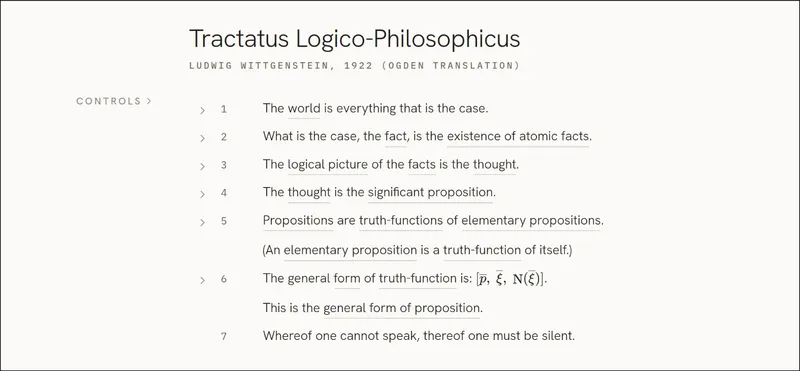
A set of controls then allows you to expand any statement to reveal its direct children; it lets you "pin" specific statements that you want to get back to, and to add annotations with your own thoughts and clarifications. You can also "fold all" statements again, leaving only the statements you pinned (along with the ancestors they expound upon), resulting in a custom "cross-section" of the book, a big-picture view that lets you see the branches and the forest at the same time.
This is the core functionality that I think one needs to properly navigate this complex work the way Ludwig Wittgenstein seemed to conceive it: as a single grand idea with many ramifications. Even with just this small set of features, I think the reading experience on the Foldable Tractatus removes most of the friction that both ink and e-ink formats used to create.
All other functionality is extra cherries on top. Here is a quick roundup:
- The app comes with pre-made "threads", i.e. sets of pinned statements highlighting popular cross-sections of the book: "picture theory", "saying and showing", and "the limits of my world".
- You can also save your own custom threads, pinning/unpinning any of the statements according to your needs.
- Since the information about which statements are currently pinned is encoded in the URL, you can bookmark any number of them in your browser, so that you can return to different cross-sections at any time, or share them with others.
- If you also want to share or bookmark your annotations (the notes you attached to statements), there is a button for that too.
- You can click any technical term anywhere in the text to instantly highlight all other occurrences of the same term and its variants. Then you can optionally pin them all in one click: instant new thread you can read, save, and share.
- A search box allows you to do the same with any other word or combination of words. Want to read only statements in which he says "transcend"? That version of the book is a couple of seconds away.
- You can export a given thread (set of pinned statements), along with any annotations you wrote for them, as a PDF or as a Markdown text file, which is great for printing or importing into knowledge tools like Obsidian.
- For the productivity nerds: you can do most of the actions above with just a keyboard, without using a mouse!
If you've tried reading the Tractatus Logico-Philosophicus before and found it too obscure, or if you shied away from reading it due to its reputation, this might be the time to give it another try, my friend. Annotate it to death, read it while focusing only on relevant subsets, and preserve your work over days and weeks. The navigation and state-preservation features of the Foldable Tractatus make it easier than ever to cut through the confusion and even work on it with others. There is no login or registration, and your data is private (except the links you share yourself).
Not only did I have a lot of fun making this tool, but it serves a fourfold purpose.
First, I believe it's the best reader experience for this specific book that you'll find on the internet.
Second, it's a design experiment: can this simple interaction model open up new writing possibilities, with people writing in the same tree-like structure? I might adapt it for one or more future blog posts of mine, to see how it feels to write fractally.
Third, I have open-sourced the web app so that anyone can modify and improve it as they like. This is the first OSS project I publish.
And fourth, this is also my chosen case study for how to build something very specific with the aid of AI, based on the Anatomy of Augmented Thought framework. Theory is fine, but the best way to learn how to properly use a tool is to see it in action. I use LLMs for most of my coding projects, but most of them are either proprietary (owned by the company I work for) or too personalized and complex to be pedagogically useful. This web app project is both simple enough and public: perfect to show how it's done (spoilers: it's far from a one-shot product, which is exactly the point). I'll write about it soon. If you want to be notified when that happens, consider subscribing to the Aether Mug newsletter.
But enough explaining. Whereof one cannot speak, thereof one must be silent. Go try it for yourself. ●
Thinking tools in this post:
 MindTechnology
Comments
Loading comments...