Darwin the Fun-Loving Young Fellow
In His Own Words (Episode 1)
Marco Giancotti,

Marco Giancotti,
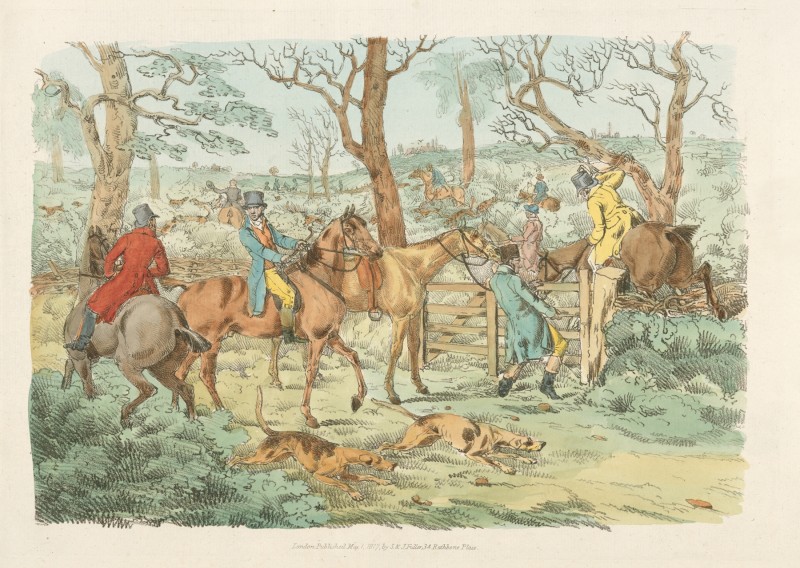
Cover image:
Sportsmen within an enclosure, Henry Thomas Alken
This is the first episode in the series of curated quote collections "Darwin in His Own Words.
- Darwin the Fun-Loving Young Fellow
- Darwin the Voyager
- Darwin the Man of His Times
- Darwin the Witness
- Darwin El Naturalista
I recently read a book with the nicely vintage title of Narrative of the Surveying Voyages of His Majesty's Ships Adventure and Beagle, describing their Examination of the Southern Shores of South America, and the Beagle's Circumnavigation of the Globe - Volume III, and I want to share its joys with you. It's truly a wonderful book.
As you may have already guessed, I'm talking about Charles Darwin's narration of his 5-year journey around the world between 1831 and 1836 aboard the ship Beagle. It's on all biology textbooks as "the time Darwin went to the Galapagos, saw some strange birds, and got the idea for the theory of evolution." But while this is factually true—the "Voyage of the Beagle" did plant the seeds of one of the deepest revolutions in scientific history—limiting your knowledge of it to just that fact would mean badly underselling it. The story of this voyage is exciting and interesting in its own right, and in many ways.
The Voyage, as I'll call the book from now on, reads like the perfect prequel: grand, exciting, and full of subtle foreshadowing. But even without knowing anything—or caring—about what happened in the following decades, this travelogue paints many fascinating pictures: of a mysterious continent's nature, of times and peoples very different from our own, and of some interesting protagonists. Most of all, it paints a picture of the naturalist Charles Darwin as little more than a boy. He was twenty-two when the ship set sail, and it's fair to say that he learned most of what he later became famous for on those fateful whirlwind years of travel.
I'm not going to tell the story of the voyage chronologically here, though. My aim is only to extract a few of those pictures, and maybe to convince you to read the book yourself. I will do this by sharing a wide and curated collection of direct quotations from the book (and other books about it) across several posts, because I believe it's always nicer and more authentic to hear things in the original words. But first, a little context.
How It All Came About
In 1831, Captain Robert FitzRoy, commander of Her Majesty's Ship Beagle, was given the mission of surveying the continent of South America to make accurate measurements of its geography and features. He had many practical things to attend to before sailing, but one seemingly superfluous thought nagged at him: in his previous voyage, he had regretted visiting places with interesting and exotic natural elements without a properly trained naturalist to understand and record them. He decided that in Beagle's new mission he would not be unprepared again.

Anxious that no opportunity of collecting useful information, during the voyage, should be lost; I proposed to the Hydrographer [Captain Francis Beaufort] that some well-educated and scientific person should be sought for who would willingly share such accommodations as I had to offer, in order to profit by the opportunity of visiting distant countries yet little known. Captain Beaufort approved of the suggestion, and wrote to Professor Peacock, of Cambridge [professor of mathematics], who consulted with a friend, Professor Henslow, and he named Mr. Charles Darwin, grandson of Dr. Darwin the poet, as a young man of promising ability, extremely fond of geology, and indeed all branches of natural history.
Who was this "young man of promising ability"? The truth is, he wasn't very much at all then—which makes it an even bigger surprise that he was chosen for the trip.
Charles Darwin, in 1831, was a rich and somewhat spoiled boy studying to become a clergyman. In his youth he had shown an interest in nature, collecting minerals and insects, engaging in birdwatching and helping his older brother with simple chemistry and crystallography experiments. But that fascination seemed to take the back seat when, around the age of fifteen, he got sucked into the fashionable rich pastime of the time: hunting and shooting with a gun. He became so engrossed in it that his father once scolded him, saying "You care for nothing but shooting, dogs, and rat-catching, and you will be a disgrace to yourself and all your family."
That was the beginning of a period in which Charles' "promising ability" did not shine through. He was sent to medical school, but he was too squeamish and wasn't really interested in the subject. In his autobiography he later recalled about those years,
I became convinced from various small circumstances that my Father would leave me property enough to subsist on with some comfort ... my belief was sufficient to check any strenuous effort to learn medicine.
In other words, he realized that he was rich and didn't really need to work at all. His hunting pastime wasn't going to undermine anything after all.
His father, who was a medical doctor, was not happy about it, but he accepted that Charles would probably not follow in his footsteps. So he changed the plans for his son's career: he would become an Anglican parson. In 1828 Charles was sent to Christ's College in Cambridge to begin the new theological curriculum.
Things did not start on the right foot at Cambridge, either.
Although, as we shall presently see, there were some redeeming features in my life at Cambridge, my time was sadly wasted there, and worse than wasted. From my passion for shooting and for hunting, and, when this failed, for riding across country, I got into a sporting set, including some dissipated low-minded young men. We used often to dine together in the evening, ... and we sometimes drank too much, with jolly singing and playing at cards afterwards.
— Autobiography
Still, there were indeed "redeeming features" during his stay there—just not the kind his father would have liked. His youthful interest in nature had endured, and he now had professors and like-minded students to pursue it in much more depth. He became interested in geology and entomology, and he found a new hobby:
No pursuit at Cambridge was followed with nearly so much eagerness or gave me so much pleasure as collecting beetles. It was the mere passion for collecting, for I did not dissect them, and rarely compared their external characters with published descriptions, but got them named anyhow. I will give a proof of my zeal: one day, on tearing off some old bark, I saw two rare beetles, and seized one in each hand; then I saw a third and new kind, which I could not bear to lose, so that I popped the one which I held in my right hand into my mouth. Alas! it ejected some intensely acrid fluid, which burnt my tongue so that I was forced to spit the beetle out, which was lost, as was the third one.
— Autobiography
Young Charles also became friends with professor John Stevens Henslow, as well as other prominent naturalists who hung out in the Cambridge 'hood in that period. Those acquaintances later proved to be very redeeming indeed.
In that same period, Charles read Alexander von Humboldt's best-selling book series Personal Narrative, which recounted the amazing South American journey of the superstar-scientist (really, Humboldt was perhaps the most famous person in the world in his prime, on par with Napoleon—but you can read Andrea Wulf's excellent The Invention of Nature to learn more about his story).
The funny thing is that Darwin was not very ambitious. The notion of going himself to the New Continent never seemed to occur to him. What he latched onto was the more modest idea of a field trip with his friends to the Canarian island of Tenerife, highly praised by Humboldt for its natural beauty. Tenerife was much closer to England, and Charles became obsessed with this seemingly-achievable "Canary Scheme":
My head is running about the Tropics: in the morning I go and gaze at Palm trees in the hot-house and come home and read Humboldt: my enthusiasm is so great that I cannot hardly sit still on my chair. Henslow & other Dons give us great credit for our plan: Henslow promises to cram me in geology. I will never be easy till I see the peak of Teneriffe and the great Dragon tree... I am working regularly at Spanish ... I have written myself into a Tropical glow.
— Letter to his sister Caroline
And elsewhere, in May 1831:
As for my Canary scheme, it is rash of you to ask questions; my other friends most sincerely wish me there, I plague them so with talking about tropical scenery, &c.
— Letter to William Darwin Fox
Fast-forwarding a little: his leisure trip plans never really materialized, but he got to accompany a professor in a geological survey in Wales that summer. Nothing very exciting, but he did learn some practical skills there. More importantly, on his return home Charles found a letter addressed to him from his friend Prof. Henslow inviting him to join Captain FitzRoy aboard the Beagle. And, as they say, the rest is history (and a lot of science, too).
Although his Origin of Species was more impactful and universally known, his narrative of the Voyage was very successful and loved by his contemporaries. Towards the end of his life, after achieving his enormous fame as the father of evolutionary theory, he would still write fondly that "the success of this, my first literary child, always tickles my vanity more than that of any of my other books. Even to this day it sells steadily in England and the United States, and has been translated for the second time into German, and into French and other languages. This success of a book of travels, especially of a scientific one, so many years after its first publication, is surprising."
Frankly, I did not expect to be so captivated by this book. I can confidently say that I never highlighted so many passages in a single volume. To be sure, it's written in a convoluted and antiquated English and it's filled to the brim with descriptions and musings about scientific facts that are now mostly outdated or obsolete. But it's just so wholesome, so sincere a retelling to ever bore you (and you can skip the boring parts!). The story and the characters that transpire from it make it all more than worth it.
And that's about all the story-telling I'm going to do. Now for the "pictures" I promised: this is the first of a series of short posts showcasing my favorite passages from the Voyage, but not in any chronological order. It's a sort of prismatic experiment: instead of trying to describe Charles Darwin directly, in each episode I will show a different face, or a different set of interesting scenes that he experienced. I will share about his face as a voyager, as a man of his times, as a witness of cultures and events, and so on. Each is only one side, a limited "2D view" of the man, but, by reading them all, I hope you'll be able to form your own 3D image of him in your mind.
Now for the first episode.
Darwin the Fun-Loving Young Fellow
When you think about Charles Darwin, you might imagine this man:

You may also think him a rather dull, serious, and stuck-up Victorian gentleman. I already mentioned how this was not the case in his teens—he was a playful boy and did not like studying per se—but I think it is my duty to begin this series by dispelling that prejudice more thoroughly once and for all. You may also think his participation in the naval survey was strictly about work, boring work. This is also not true, as I'll hope to show you.
At the time of boarding the Beagle, Darwin looked roughly halfway between this:

and this:

One of the first fun Beagle moments on record happened less than two months after their departure from England. It was a time-honored seafaring tradition to celebrate when the ship crosses the line of the Equator. The celebration was done in honor of the pagan god of the sea, Neptune.
The effect produced on the young naturalist's mind was unmistakably remarkable. His first impression was that the ship's crew from Captain downwards had gone off their heads. 'What fools these sailors make of themselves,' he said as he descended the companion ladder to wait below till he was admitted.
The Captain received his godship and Amphitrite his wife with becoming solemnity; Neptune was surrounded by a set of the most ultra-demonical looking beings that could be imagined, stripped to the waist, their naked arms and legs bedaubed with every conceivable colour which the ship's stores could turn out, the orbits of their eyes exaggerated with broad circles of red and yellow pigments. Those demons danced a sort of nautical war dance exulting on the fate awaiting their victims below.
Putting his head down the after Companion, the Capt called out 'Darwin look up here'! Up came the young naturalist, in wonderment but yet prepared for any extravagance in the world that seamen could produce. A gaze for a moment at the scene on deck was sufficient, he was convinced he was amongst madmen, and giving one yell disappeared again down the ladder. He was of course the first to be called by the official secretary, and Neptune received him with grace and courtesy ... Of course Mr Darwin readily entered into the fun, and submitted to a few buckets of water thrown over him and the Captain as they sat together by one of the youngsters, as if by accident.
— Recollection by Philip Gidley King in The Beagle Record, edited by Richard Darwin Keynes

By "entered into the fun", King means that Charles' face was painted with tar and his head was shaved, before having the cold water dumped on him. Sounds like the perfect initiation rite for a rich and formally-educated boy joining a band of seventy rowdy sailors.
Technically, Darwin was on that ship for work. In truth, the work mostly consisted in doing precisely the kind of things that had been his hobbies back home, where his real duty was to theology and becoming a country parish. I doubt any of it felt like work to him. He seemed to be consumed by a burning curiosity for nature. This made him do... things.
For example:
In the evening the weather was quite tropical, the thermometer standing at 79°. Numbers of fireflies were hovering about, and the musquitoes were very troublesome. I exposed my hand for five minutes, and it was soon black with them; I do not suppose there could have been less than fifty, all busy sucking.
— Voyage of the Beagle (all quotes below from the same book unless stated otherwise)
Sure, let's allow a hundred mosquitoes to suck me dry, just for the heck of it!
Also, he was not afraid of tasting things:
I believe it is well ascertained that the bladder of the frog acts as a reservoir for the moisture necessary to its existence: such seems to be the case with the tortoise. For some time after a visit to the springs, their urinary bladders are distended with fluid, which is said gradually to decrease in volume, and to become less pure. The inhabitants, when walking in the lower district, and overcome with thirst, often take advantage of this circumstance, and drink the contents of the bladder if full: in one I saw killed, the fluid was quite limpid, and had only a very slightly bitter taste.
I'll let you judge for yourself if he should be called "fearless", "overzealous", or something else still.
But more than subjecting his own body to all sorts of gross trials, Charles liked to play pranks on animals. All for the advancement of science, of course.
Mucking around with Galapagos tortoises:
The inhabitants believe that these animals are absolutely deaf; certainly they do not overhear a person walking close behind them. I was always amused when overtaking one of these great monsters, as it was quietly pacing along, to see how suddenly, the instant I passed, it would draw in its head and legs, and uttering a deep hiss fall to the ground with a heavy sound, as if struck dead. I frequently got on their backs, and then giving a few raps on the hinder part of their shells, they would rise up and walk away;—but I found it very difficult to keep my balance.
"Plaguing" aquatic iguanas:
If this Amblyrhynchus is held and plagued with a stick, it will bite it very severely; but I caught many by the tail, and they never tried to bite me. If two are placed on the ground and held together, they will fight, and bite each other till blood is drawn.
Testing precisely how easy certain birds are to catch:
All of them often approached sufficiently near to be killed with a switch, and sometimes, as I myself tried, with a cap or hat. A gun is here almost superfluous; for with the muzzle I pushed a hawk off the branch of a tree. One day, whilst lying down, a mocking-thrush alighted on the edge of a pitcher, made of the shell of a tortoise, which I held in my hand, and began very quietly to sip the water; it allowed me to lift it from the ground whilst seated on the vessel: I often tried, and very nearly succeeded, in catching these birds by their legs.
Having staring conversations with very bothered land iguanas:
This animal, when making its burrow, works alternately the opposite sides of its body. One front leg for a short time scratches up the soil, and throws it towards the hind foot, which is well placed so as to heave it beyond the mouth of the hole. That side of the body being tired, the other takes up the task, and so on alternately. I watched one for a long time, till half its body was buried; I then walked up and pulled it by the tail; at this it was greatly astonished, and soon shuffled up to see what was the matter; and then stared me in the face, as much as to say, "What made you pull my tail?"
Yeah. Darwin had a lot of fun.
Tormenting animals wasn't his only occupation, of course. He was a keen observer of everything, from scientific facts to the local cultures (both covered in later episodes). He looked at things and people without animosity or bitterness, and the humor of things did not escape him. His narration of specific events is often veiled with irony.
For instance, he was amused by the reaction of some locals to his being an Anglican:
In the evening we reached a comfortable farm-house, where there were several very pretty señoritas. They were much horrified at my having entered one of their churches out of mere curiosity. They asked me, "Why do you not become a Christian—for our religion is certain?" I assured them I was a sort of Christian; but they would not hear of it—appealing to my own words, "Do not your padres, your very bishops, marry?" The absurdity of a bishop having a wife particularly struck them: they scarcely knew whether to be most amused or horror-struck at such an enormity.
One day, while on an exploration of the Andes with some guides, Charles noted that they were at such a high altitude that water would boil at well below the usual temperature. "Hence the potatoes, after remaining for some hours in the boiling water, were nearly as hard as ever. The pot was left on the fire all night, and next morning it was boiled again, but yet the potatoes were not cooked."
He noted (I imagine with a smile) how his local guides explained the matter:
I found out this by overhearing my two companions discussing the cause, they had come to the simple conclusion "that the cursed pot (which was a new one) did not choose to boil potatoes."
And the log for the next day begins: "March 22nd.—After eating our potato-less breakfast, we travelled across..."
I hope the little snippets above convinced you of the playful and good-hearted nature of young Charles Darwin. I feel it is important to understand this in order to take him down from his high pedestal in the scientific pantheon and understand him more closely. He wasn't a superhero, and he wasn't visited by a sudden stroke of genius. In part, the contributions he brought to biology and to human thought were the result of decades of patient and tedious work piecing together many small observations of plants and animals. But they were also the product of the particular temperament of the man. I believe that his playfulness, his occasional foolhardiness, and his almost childish will to pursue his interests at all costs were a major factor in his success.
But, most of all, it is his way of connecting with people that might have had the largest influence.
One way to peek into his relationships is to look at what people called him: at home, his family called him "Bobby" or "Charley"; on board the Beagle, the seamen called him "the Philosopher", or "Philos" for short; and (although it isn't meant to be endearing) I like how he was known in South America:
On arriving at a post-house we were told by the owner that if we had not a regular passport we must pass on, for there were so many robbers he would trust no one. When he read, however, my passport, which began with “El Naturalista Don Carlos,” his respect and civility were as unbounded as his suspicions had been before.
Despite his lifelong shyness and the introversion of his youth, Charles Darwin had a way with people. By the time he arrived in Cambridge, he was a very likeable figure. James Taylor, author of a book about the Beagle and his people, writes that "In contrast to his childhood personality Darwin by this time was an amiable and affable student and had a remarkable capacity to develop and maintain friends." Historian of science John van Wyhe confirms that "Charles Darwin was a kind, good-humoured, pleasant man, unassuming and profoundly modest."
It's not a stretch to say that his Voyage, the insights he gleaned from it, and the publication of the Origin of Species might never have happened had he been a pompous and obnoxious rich kid. The friendships he made during those "wasted years" in Cambridge—first and foremost that with Prof. Henslow—were key to his selection. Even after his introduction to the Beagle's captain, his selection was all but guaranteed:
Later, on becoming very intimate with Fitz Roy, I heard that I had run a very narrow risk of being rejected, on account of the shape of my nose! He... was convinced that he could judge a man's character by the outline of his features; and he doubted whether any one with my nose could possess sufficient energy and determination for the voyage. But I think he was afterwards well satisfied that my nose spoke falsely.
FitzRoy was a kind and generous person, but he tended to be stubborn with some of his convictions. Young Charles impressed him enough with his charms to make the mariner forget his faith in physiognomy. The two went on to become very close friends during their travels, and together they changed the world. ●
Next: In His Own Words Ep. 2 - Darwin the Voyager
Cover image:
Sportsmen within an enclosure, Henry Thomas Alken
 PeopleScience
Comments
Loading comments...