Darwin the Man of His Times
In His Own Words (Episode 3)
Marco Giancotti,

Marco Giancotti,
Cover image:
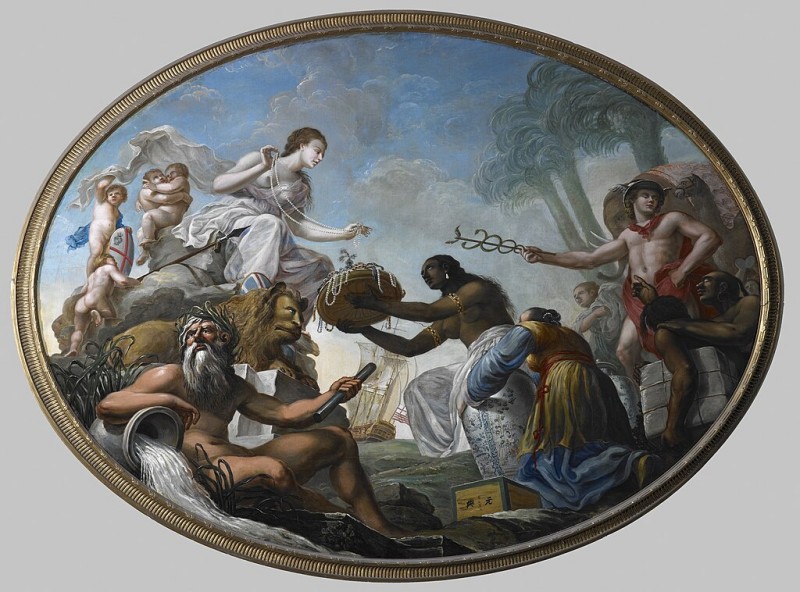
The East Offering its Riches to Britannia, painted by Spiridione Roma for the boardroom of the British East India Company (CC0, via Wikimedia Commons)
This is the third episode in the series of curated quote collections "Darwin in His Own Words".
- Darwin the Fun-Loving Young Fellow
- Darwin the Voyager
- Darwin the Man of His Times
- Darwin the Witness
- Darwin El Naturalista
If you've read the previous two posts, you might have formed the impression that Charles Darwin's voyage aboard the HMS Beagle was all adventure and levity. In this episode, I want to temper that impression a little. After all, if you want a three-dimensional picture of someone, you need some dark spots to create contrast.
TL;DR: Darwin in many ways represented the best English society of the 1830's had to offer—smart, good-hearted, well-educated, and a fervent science-lover—but he was very much not free of the worse features of that same culture.
The period of the late 18th and early 19th century was a time of deep contradictions—that is, only a little more so than most other times. The Enlightenment had brought forth the birth of modern science and some new moral values that are still foundational today. Political upheavals were paving the way for the spread of democracy. Technology was accelerating fast and transforming society. All of these things were good at a high level, but terribly messy if you look only a little bit closer. I'm not going to write a history lesson here. Let's just say that, in that period, people had begun to see and tackle the deepest systemic problems of their times, but they were not yet ready yet to fully grasp the reach of those problems, nor to commit to complete solutions.
Two prominent examples were the American Declaration of Independence (1776) and the French Declaration of the Rights of Man (1789): fantastic intellectual advancements implemented rather poorly and contradictorily. Both proclaimed the equality of all people, but the former was written by slaveholders, the latter denied poor people citizenship, and both failed to give women equal rights.
Darwin's voyage happened half a century after that, but the situation wasn't much better then. From today's perspective, he had a strange mixture of novel insights and antiquated thinking, and this showed up in almost everything he said. For example, he was ahead of his time when it came to (what would later be called) the field of ecology. Inspired by his idol and precursor Alexander von Humboldt, he was able to see Nature as a dynamic, deeply interconnected web of delicate relations—something you can't say of most of his conteporaries.
He understood the risks of invasive species, and saw natural resources as finite and endangered by human interference.
A few years since this country [Australia] abounded with wild animals; but now the emu is banished to a long distance, and the kangaroo is become scarce; to both the English greyhound has been highly destructive. It may be long before these animals are altogether exterminated, but their doom is fixed.
— Voyage of the Beagle (all quotes below from the same book unless otherwise stated)
(Fortunately he was wrong on both accounts, but many other Australian species weren't so lucky.)
At the same time, he was disarmingly passive about all that.
It is said that the common Norway rat, in the short space of two years, annihilated in this northern end of the island the New Zealand species. In many places I noticed several sorts of weeds, which, like the rats, I was forced to own as countrymen. A leek has overrun whole districts, and will prove very troublesome, but it was imported as a favour by a French vessel. The common dock is also widely disseminated, and will, I fear, for ever remain a proof of the rascality of an Englishman who sold the seeds for those of the tobacco plant.
The "fear" and "doom" he wrote about were apparently not enough to make him lift a finger to protect those ecologies. Darwin showed concern for endangered species, because he valued their variety and beauty, but he was never a conservationist.
I found the same kind of paradox all over the pages of his Voyage, often in much worse forms. This is interesting, because it reveals complexities in today's value systems that I hadn't even considered before. After reading that book I feel like I understand a bit better why it took us centuries to arrive at today's still-imperfect ideas about human rights, environmentalism, and morality in general.
Before diving deeper into the murkier side of this, let's dip our toes. One thing I thought was amusing about Charles Darwin's attitude as a writer is that he felt authorized to judge everything rather peremptorily. The things he liked, like the jungles and mountains of South America, he praised profusely (see Episode 2). Other things, he condemned with an air of objectivity.
New Zealand, for example, did not impress him:
In the afternoon we stood out of the Bay of Islands, on our course to Sydney. I believe we were all glad to leave New Zealand. It is not a pleasant place.
Australia fared only marginally better:
Farewell, Australia! you are a rising child, and doubtless some day will reign a great princess in the South; but you are too great and ambitious for affection, yet not great enough for respect. I leave your shores without sorrow or regret.
This judgmental stance was very conscious. In this following passage, he pulls off a funny contortion: at once humble—he admits his own fallibility—and self-entitled to judge whole populations:
From the varying accounts which I had read before reaching these [Polinesian] islands, I was very anxious to form, from my own observation, a judgment of their moral state,—although such judgment would necessarily be very imperfect. First impressions at all times very much depend on one's previously acquired ideas.
I cringed while reading his many comparisons between people of different regions, as if they were species of finches:
Looking at the New Zealander, one naturally compares him with the Tahitian; both belonging to the same family of mankind. The comparison, however, tells heavily against the New Zealander. He may, perhaps be superior in energy, but in every other respect his character is of a much lower order. One glance at their respective expressions brings conviction to the mind that one is a savage, the other a civilised man.
All of this reeks of the entrenched (pre-) Victorian British worldview, where it is natural and appropriate for the "more civilized" to look down on the "savages" of "lower order", as if a moral ladder like that were as clear as daylight.
You should be warmed up enough now. It's time to bring forth the heavy artillery.
The Good: Abolitionism
Darwin came from a family with a tradition of anti-slavery sentiment. Both his grandparents had been prominent figures in the British movement for the abolition of slavery, and Charles himself was quite outspoken about it. You can find statements like this peppered all over the Voyage:
On the 19th of August we finally left the shores of Brazil. I thank God, I shall never again visit a slave-country. To this day, if I hear a distant scream, it recalls with painful vividness my feelings, when passing a house near Pernambuco, I heard the most pitiable moans, and could not but suspect that some poor slave was being tortured, yet knew that I was as powerless as a child even to remonstrate.
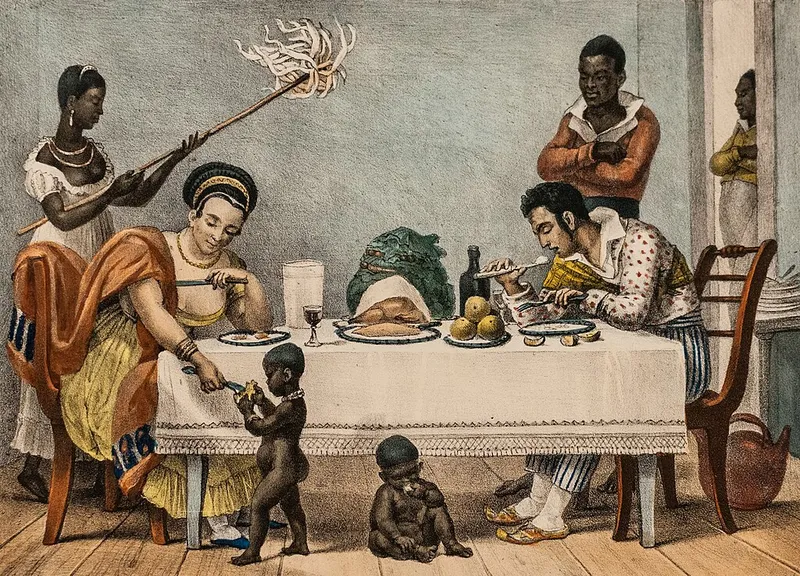
Another time, in Australia:
There are many serious drawbacks to the comforts of a [Sydney] family, the chief of which, perhaps, is being surrounded by convict servants. How thoroughly odious to every feeling, to be waited on by a man who the day before, perhaps, was flogged, from your representation, for some trifling misdemeanour.
The topic of slavery was the cause of occasional rifts and disputes between Darwin and the captain of the Beagle, Robert FitzRoy—who were otherwise good friends. Contrary to Darwin's liberalism, FitzRoy was a conservative Tory, and saw slavery as a necessary evil. In their first serious quarrel, FitzRoy
defended and praised slavery, which I abominated, and told me that he had just visited a great slave-owner, who had called up many of his slaves and asked them... whether they wished to be free, and all answered "No." I then asked him, perhaps with a sneer, whether he thought that the answer of slaves in the presence of their master was worth anything? This made him excessively angry, and he said that as I doubted his word we could not live any longer together. I thought that I should have been compelled to leave the ship; ... But after a few hours Fitz-Roy showed his usual magnanimity by sending an officer to me with an apology and a request that I would continue to live with him.
— Autobiography
During his Beagle voyage, Darwin collected a huge number of animal specimens. In order to preserve them for later study, he stuffed them and periodically shipped them back to England, where his colleagues could examine and store them. He had learned the skills to quickly and accurately stuff animals in his teenage years, when he took private lessons in bird taxidermy from a man called John Edmonstone, someone he considered a "very pleasant and intelligent man". Edmonstone was a Black man from Guyana, and had been a slave in a timber plantation since his birth until around the age of 27. During this time, a visiting naturalist had taught him the science of preserving bird skins from decay, and this became his profession when he was finally freed in 1817. We can't know the details, but one thing is clear: Darwin got the first strong evidence for evolution years after he had returned to England, when an ornithologist re-examined his collection of stuffed finches from the Galapagos islands. In this sense, Edmonstone's teachings were instrumental for the development of the theory. I mention this because it shows that Darwin literally put his money where his mouth was, and he didn't forget or try to hide it.
Darwin was also dispirited by the way his countrymen were usurping the lands and resources of the indigenous peoples, although his denunciation of this theft was not as strong as his anti-slavery stance. In Australia, for example, he wrote that
The aborigines are always anxious to borrow the dogs from the farmhouses: the use of them, the offal when an animal is killed, and some milk from the cows, are the peace-offerings of the settlers, who push farther and farther towards the interior. The thoughtless aboriginal, blinded by these trifling advantages, is delighted at the approach of the white man, who seems predestined to inherit the country of his children.
Here the waters begin to get a little murky. The sentiment in this excerpt is mostly relatable: white men were indeed taking advantage of the locals to take over their territories. My snag is with the term "thoughtless aboriginal". Had he written "unsuspecting", for example, it would have been accurate. But "thoughtless" implies that the locals had the necessary information and context to uncover the ploy, and simply failed to do so. I don't believe that is true. Together with that last "predestined" sentence—as if there was nothing to be done about the matter—this passage shows a (rather soft version of a) pattern that pops up all over the Voyage. (We'll get there.)
The Bad: Arrogance of the Civilized
The ownership of slaves was finally banned in most of the British Empire in 1833, while the Beagle was midway through its circumnavigation of the globe. We owe that milestone to the activism and political pressure of people like Darwin's family, and for this they deserve our respect and gratitude. It took the courage of people like Darwin to advocate and fight for those causes at a time when so much was at stake (financially) for so many.
This makes it all the more interesting to read the Voyage closely, because—at least for me—it reveals a moral contrast that comes off as very unpleasant today. I probably should have expected this, but I didn't. The thing is, all this talk of the right to freedom and appreciating the qualities of all people still came safely embedded in a deeply flawed framing that today we would definitely call racist.

The implicit assumption in all of Darwin's writing goes something like this: rich Westerners are the pinnacle of human achievement, which we call "civilization", and the populations who are less civilized are inherently inferior. Seen in this context, Darwin's progressive stance wasn't an assertion of the equality of all people, but a much weaker form: all people have the potential to be equal to the Westerners if they were educated and civilized in the British way. Ignorance was somehow morally degrading. Even when advocating for magnanimity and protection, this was a condescending stance.
My pleasure in reading the Voyage is sometimes soured by reading passages like this:
Landing at midday, we saw a family of pure Indian extraction. ... This party could muster but little Spanish, and talked to each other in their own tongue. It is a pleasant thing to see the aborigines advanced to the same degree of civilisation, however low that may be, which their white conquerors have attained.
To be clear, this wasn't only Darwin's attitude. It was the dominant attitude pervading the way of thinking of everyone in Darwin's slice of society. As a matter of fact, that mindset was so entrenched, that it might have been the main cause of that whole voyage. The story is quite crazy.
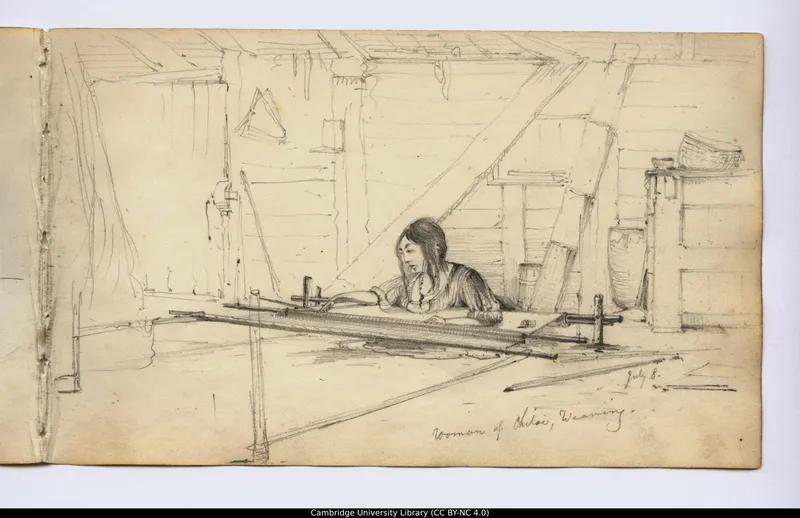
On paper, the Beagle's mission was to take a large number of accurate measurements of South America's geography and other physical and natural features. In truth, however, the voyage happened because Captain FitzRoy really wanted to go back to Tierra del Fuego. The Lords Commissioners of the Admiralty of the British Navy weren't particularly eager to send FitzRoy on a new mission like that. It took a lot of negotiating and cajoling on the captain's part, using the wealth and political influence of his rich family to force their hand. He wanted to go to Tierra del Fuego so badly that he went so far as contracting a merchant ship with money from his own pocket. That was a waste of money, though, because soon after that he was finally appointed to command the Beagle, and the voyage happened as it did.
Why was FitzRoy so adamant about returning to that forsaken place at the edge of the world? He wanted to take "his Fuegians"—natives of Tierra del Fuego he had taken to England with him in his previous voyage—back home.
The affair had begun one year earlier, in 1830, when the Beagle was in Patagonia for its first expedition (no Darwin that time). One morning, the ship's crew found that one of their whaleboats had been stolen by the indigenous people they called the Fuegians. Hoping to convince them to give the boat back, the Englishmen retaliated by taking hostages from the Fuegians. They captured two young men, a teenage boy, and a 9-year-old girl. Then, when all their attempts to recover the boat failed, FitzRoy decided that he would keep the captive Fuegians anyway. It would be an interesting experiment, he thought, to see how much they could be "civilized" back in Britain.
In plain words, the captain kidnapped four innocent kids and took them with him to the other side of the world for three years. In his mind, though, he was doing them a favor. In London, they were taught the English language and manners, paraded in front of the King, and converted to Christianity. The last part of the "experiment" was the most important: once properly civilized (reasoned FitzRoy), the Fuegians should be taken back to their original tribes, where they could spread the magic and make life better for everyone. By teaching English and the "plainer truths of Christianity" to their peers, the repatriated Fuegians would not only contribute to advancing their way of life, but would make it easier for future voyagers to communicate with and understand the locals. What could possibly go wrong?
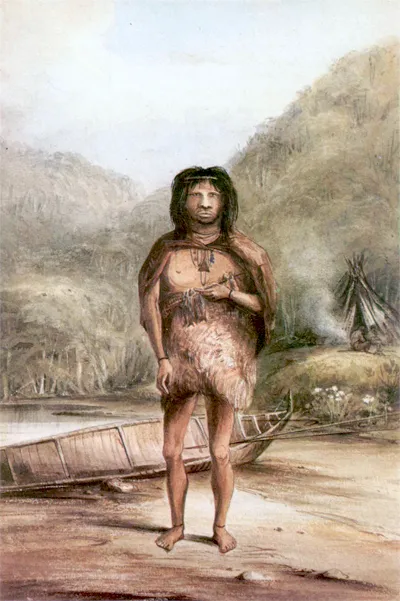
Here's how it went: one of the captives died of smallpox very early on. As for the other three, called York, Jemmy, and Fuegia, Darwin writes:
It was quite melancholy leaving the three Fuegians with their savage countrymen; but it was a great comfort that they had no personal fears. York, being a powerful resolute man, was pretty sure to get on well, together with his wife Fuegia. Poor Jemmy looked rather disconsolate, and would then, I have little doubt, have been glad to have returned with us. His own brother had stolen many things from him; and as he remarked, "What fashion call that:" he abused his countrymen, "all bad men, no sabe (know) nothing" and, though I never heard him swear before, "damned fools." Our three Fuegians, though they had been only three years with civilised men, would, I am sure, have been glad to have retained their new habits; but this was obviously impossible. I fear it is more than doubtful whether their visit [to Britain] will have been of any use to them.
The Ugly: Contradictions All the Way Down
The matter would be easy to dismiss as antiquated bigotry if all instances were so black and white. But evil rarely comes in its pure form. A lesson I learned reading this book is that a bad framing can lead to some pretty powerful reality distortions like this. When FitzRoy defended slavery in his arguments with Darwin, they both held the same flawed worldview of the primacy of civilization, and simply interpreted it in different ways: Darwin inferred that helping people improve is always preferable to enslaving them, while the captain concluded that slaves should be grateful to the teachings and protection of their masters.
The reality distortion comes up in most remarks that Darwin, the good guy of the situation, made about these topics. In the same breath, he is able to bring together kindness and prejudice.
So about the slave-owning lifestyle in Brazil he could write things like this:
As long as the idea of slavery could be banished, there was something exceedingly fascinating in this simple and patriarchal style of living: it was such a perfect retirement and independence from the rest of the world.
After witnessing the massacre of indigenous tribes at the hands of the colonizers, he is livid about it:
Every one here is fully convinced that this is the most just war, because it is against barbarians. Who would believe in this age that such atrocities could be committed in a Christian civilised country? The children of the Indians are saved, to be sold or given away as servants, or rather slaves for as long a time as the owners can make them believe themselves slaves;
...but still he can't help closing the matter with "but I believe in their treatment there is little to complain of."
In Rio, he complains of "very nearly being an eye-witness to one of those atrocious acts which can only take place in a slave country": a slaveowner had decided to sell away his slave women and children, separating them from their men. The plan was canceled, but not out of the goodness of the owner's heart.
Indeed, I do not believe the inhumanity of separating thirty families, who had lived together for many years, even occurred to the owner. Yet I will pledge myself, that in humanity and good feeling he was superior to the common run of men. It may be said there exists no limit to the blindness of interest and selfish habit.
His ability to compartmentalize things is impressive. This last quote is about Tasmania, then called Van Diemen's Land:
All the aborigines have been removed to an island in Bass's Straits, so that Van Diemen's Land enjoys the great advantage of being free from a native population. This most cruel step seems to have been quite unavoidable, as the only means of stopping a fearful succession of robberies, burnings, and murders, committed by the blacks; and which sooner or later would have ended in their utter destruction. I fear there is no doubt that this train of evil and its consequences originated in the infamous conduct of some of our countrymen.
To him, the forced deportation of natives from their own land is cruel but "unavoidable". This is perhaps the most telling quote, because it shows just how hard he was banging against the boundaries in his mind. He hates that such things are happening, he wishes they didn't have to, but it simply doesn't occur to him that stopping colonization is the answer. It is not part of the calculus of his mind.
Conclusions
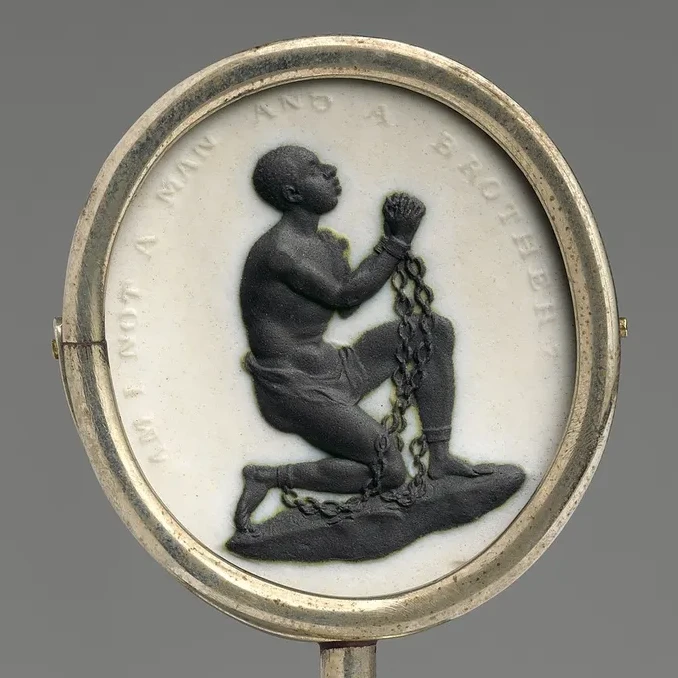
Why bring all of this up? Isn't it unfair to call out Darwin for racism and imperialism, out of so many worse offenders in his and later times?
Yes, it is a little unfair, and that's the point. I am a fan of Darwin—I mean, I'm here writing a whole series about his first book—and I think he was genuinely a kind, honest, and well-meaning guy. He was also humble and open-minded, very much ready to admit his weaknesses and mistakes, and to entertain new ideas for improvement. Those virtues are what allowed him to follow through with this multi-decade project to write the Origin of Species. And, precisely because he was so good, it is useful to take a close look at the ways his thinking failed.
Charles Darwin is the perfect example of how rationality fails at the edge: his fault, and the cause of all those discriminatory and conceited remarks, was not a problem with his thinking ability, but with his most basic assumptions. He was standing on the shoulders of the wrong giants, and had to work from what he could see from there.
Those excerpts where he manages to simultaneously express sympathy and condescension towards slaves and indigenous peoples are not hypocrisy, they are contradictions that he was utterly unable to notice.
I'll go out on a limb and say that Darwin might have been able to see those mistakes and feel ashamed about them, if only someone had provided a better framing for him to adopt. I know it's idle speculation, but there were several passages in the Voyage that showed him perfectly capable of appreciating, even looking up to the original ways of the native tribes, even when they were unaffected by the Western teachings. I gave some examples to that effect in the previous episode. Here is another one:
Their [The Aborigines'] countenances were good-humoured and pleasant, and they appeared far from being such utterly degraded beings as they have usually been represented. In their own arts they are admirable. A cap being fixed at thirty yards distance, they transfixed it with a spear, delivered by the throwing-stick with the rapidity of an arrow from the bow of a practised archer. In tracking animals or men they show most wonderful sagacity; and I heard of several of their remarks which manifested considerable acuteness.
His choice of learning a key skill for his work from John Edmonstone, a freed slave, and his later openness in owning that choice, is another hint that he didn't have a strong cognitive dissonance on these matters.
But that "better framing" was not available at his time. It would take more than 100 difficult years to overthrow the paternalist worldview of the Europeans with any degree of success.
Simply "canceling" Darwin today for his other warty statements and forgetting about it would mean missing an important lesson. The Voyage provides a useful cultural snapshot of that shifting intellectual period: in the middle of a transition to better ideals, but before they could reach the more profound ideas of universal human rights and true equality.
But, more than that, I am humbled by these examples—the whole lot, good, bad, and ugly included. If a man as great as Charles Darwin could have such formidable blind spots, if he could fail to see the deep flaws in his own assumptions, what am I missing when I think about today's issues? Why would I ever stop trying to think better, to improve my mental framings and models, and to question what I and everyone around me has always taken for granted? ●
Next: In His Own Words Ep. 4 - Darwin the Witness
Cover image:
The East Offering its Riches to Britannia, painted by Spiridione Roma for the boardroom of the British East India Company (CC0, via Wikimedia Commons)
 PeopleScience
Comments
Loading comments...