AeMug Chat #1 / Aether Mug Evolves
I'll be posting less often and more in depth
Marco Giancotti,

Marco Giancotti,
Cover image:
Kinder am Lagerfeuer, Raimund Ritter von Wichera
Thinking tools in this post:
In this post I'm trying something different. Instead of writing about my ideas, I'm asking you a question—a tough, Aether-Mug-style question!—for you to discuss with other readers in the comments section below.
Several people have told me that they don't know of any other places on the internet to read and talk about these topics. I can very much relate, and it's part of why I started AeMug in the first place.
It would be remiss of me not to allow you to connect with other people who are interested in [whatever you want to call this mix of interests].
If you're eager, you can skip the Announcements section below and jump straight to the question and comments.
A Couple of Announcements
Recently I asked you how often and how deeply you want me to post, and you answered.
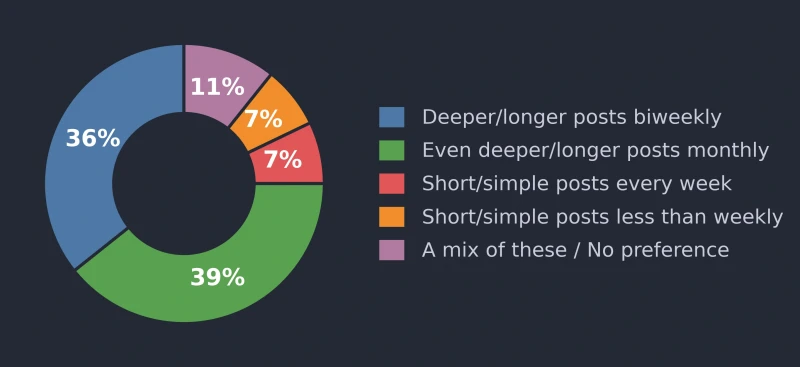
About 75% of respondents asked for longer/deeper posts and more than 80% asked for a lower posting frequency. Over a third wanted monthly posts.
These results blew my mind!
I've been pushing myself to keep a weekly pace as much as possible, and mostly succeeded. But that came at a cost, because I've been (metaphorically) "living hand to mouth" with my posts, writing each new one just before publishing it. This limited how much time I could spend on each post. I have a huge and growing pile of cool post ideas that I always shy away from because I couldn't possibly finish them in a week.
You're telling me that the common don't think and write advice doesn't apply as strictly as I had feared. This is excellent news. I will take your votes as permission to relax that constraint and bite into meatier subjects.

Here is what I'll do:
First, I will switch to publishing every two weeks.
Second, while I'm at it, I'll spend the next 2-3 months building a "post buffer" of ready-to-publish pieces, so that in the future I'll have the peace of mind of tackling longer, more research-heavy ideas. This means that, for a while, I'll be spending more time than usual on AeMug, but you'll see less content than usual. Please bear with me!
This is where these "chat" posts come in: if I see a good response (even a few brave commenters are enough!) to this post, I'll make more in the coming months to keep the pulse going.
As always, I invite you to also reply to this newsletter's emails to share your thoughts.
Q: How Do Mental Holes Work?
The Stanford Encyclopedia of Philosophy has a whole page about holes.
Should we consider a hole to "be a thing" in the same sense that street lamps and airliners are things? The philosophers are split on this.
My question is not a philosophical one, though. I'm interested in how the human mind actually treats concepts like holes, regardless of whether that treatment is philosophically sound or not. It's a question about psychology.
In case you're dying to know, here is my current take on holes: holes are "things"—black boxes—in our mental framings exactly like everything else. Since they're black boxes, we usually don't worry about their deep, internal workings, and are perfectly content using them in our mental models based on some properties we take to be intrinsic: like most physical objects, they are countable, perceivable, localized, bounded, and structured, and they come in variants (hollows, cavities, tunnels, etc.); unlike most other black boxes, they are also immaterial, parasitic, fillable, etc.
In other words, holes have their own laws of virtual physics that we use to make predictions—e.g. "stepping in that hole would be dangerous," or "I'll wait for the gaps between pops to get longer and then take the popcorn off the heat."
In this sense, holes are exactly like every other concept in our minds. Mental framings are maximally democratic.
The problem is about their boundaries. Our minds don't seem to have any issues with holes in everyday life, but something is weird here. As the philosophers remind us, it's not so clear what the boundary of a hole should be. If your answer is "it's the boundary of the object around it" you're talking about another black box, not the hole. The dough of the doughnut, not the hole. If you say that the boundary is where the space inside the hole ends, okay, but you can then remove the stuff around it and the same space will still be there. Does it become a hole within a hole?
To put the philosophical implication another way: you need to draw the shores in order to depict a recognizable lake.
Yet the mind seems to handle this strange kind of overlapping, "subordinate" boundary just fine. So here are my psychological questions for you:
- Is the mind missing something important by pretending holes have normal boundaries like everything else?
- Is this naïvete the cause of problems sometimes, in our daily lives?
- Are there more examples, other than holes, where this strange boundary phenomenon happens?
- Is this a case in which the "boundary" concept (itself a black box) breaks down and needs to be replaced with a better framing?
I honestly don't know the answers. Leave a comment, reply to others, see what emerges from the collective mind! ●
(I will moderate the comments to keep the atmosphere constructive and pleasant.)
Cover image:
Kinder am Lagerfeuer, Raimund Ritter von Wichera
Thinking tools in this post:
 Announcements
Comments
Loading comments...