Backgrounding My Way to Japan
How to learn truth from fiction
Marco Giancotti,
Marco Giancotti,
Cover image:
A Kanbari-nyūdō ghost, from Konjaku Gazu Zoku Hyakki by Toriyama Sekien
When I first set foot on Japanese land, in October 2011, it felt strange in an unexpected way. The country itself is of course "different" by Western standards, but I already knew that. The truly strange part for me was that it didn't feel nearly as strange as I thought it would: there were no major surprises or "whoa" moments (though there were many small ones!); I experienced no culture shock at any point in the months and years that followed; and I could understand the language, spoken and written, without problems from day one. It felt like coming back to a home I'd never seen before, but that was nonetheless very familiar to me. It felt wonderful, and it helped me quickly integrate into the local culture and lifestyle without much trouble.
Fifteen years later, I still feel that same sense of being at home in Tokyo—a charmingly strange home, but a welcoming one nonetheless. At the same time, I have lost track of how many times I witnessed the deep disappointment, anger, and sometimes depression of expat friends and acquaintances who came to Japan with high expectations, only to be forced to go back to their countries sooner than planned because the place, it turned out, didn't suit them. It's always doubly sad, first because I miss them after they leave, and second because I think their suffering was not entirely necessary.
Was I just lucky to be born with a more Japan-compatible temperament than those friends? A little, maybe. But I also think I accidentally stumbled, early on, upon a learning approach that helped me enormously in making my experience a happy and smooth one. I always knew I must have done something right unconsciously, but only recently do I feel I understand what that something was.
By the time I first came to Japan, I had been studying Japanese intensely for five full years, so it's not that surprising that I knew many facts about the country. But the way I studied seems to have mattered, and here I want to put into words exactly why it could produce that deep déjà vu effect.
The reason is this: I learned 99% of what I knew then from works of fiction.
My years of self-study consisted almost entirely of watching movies, doramas, and anime, as well as reading manga and novels in Japanese. I never took a course or lesson in the language. Except for one quick pass through the excellent Japanese guide by Tae Kim to build a basic framing of the grammar and Remembering the Kanji to memorize the basic logograms, I didn't use any textbooks or pedagogic materials either. There weren't many Japanese speakers in my city at the time, and while I did have a few Japanese friends there, I only got to hang out with them a couple of precious hours per month at best. Stories were my true teachers.
The obvious benefit of this is that I didn't need to "motivate myself" to study, because it was fun all along. But fiction is full of perils for the eager learner: it is not made to teach the kind of stuff that a foreigner needs to learn. Stories are full of lies by design. Read naively, they're likely to do more harm than good to a student. Some people go so far as to actively discourage learning from invented stories—in Japanese or any other language—on the grounds that their vocabulary is not the one used in real life, that literary prose differs from normal speech, and that the settings and situations are unrealistic, among other similar objections.
It sounds like trying to learn anatomy from a cubist painting. What gives?
In retrospect, I see that I avoided those traps, and was able to learn mostly accurate cultural and linguistic notions about Japan, by using a thinking tool I'll call backgrounding (I've briefly mentioned it in a previous post). In short, this consists in knowing how to focus your attention on the non-abnormal parts of a story. The advice to never learn from fiction is wrong, but you do need proper backgrounding to avoid the pitfalls. The lies are there, you just need to discount them.
I suspect that most language/culture learners who consume enough fiction in their second language eventually learn to background effectively. Unfortunately, few people seem to use fiction at all for learning. Instead, I see most people absolutely murdering their own motivation by forcing themselves to slog through sterile textbooks, baby-step speech lessons, and "business-speak" crash courses. If those things genuinely 🎇 spark joy 🎇 within you, and you can't get enough of them, then by all means knock yourself out, subject yourself to them. If, on the other hand, you're like me and find them somewhat less fun and exciting than your favorite forms of entertainment—the kind you'd consume anyway in your native tongue—then skip all that and actually consume your favorite forms of entertainment in your second language, by applying backgrounding.
In addition to being much more fun and sustainable, learning through fiction is arguably far more cost-effective, because it teaches you both the culture and the language at the same time—two things that can't be fully understood separately.
To grasp backgrounding (a term I made up), you first need to know about a concept from literary criticism called foregrounding. In poetry and prose, foregrounding is the stylistic device of having specific words and passages stand out by making them unusual or strange. This can be done in many ways. Poets use techniques like rhyme, alliteration, and parallelism to this effect, as well as calculated deviations from the standard meter and rhythm. When Keats writes in To Autumn,
Season of mists and mellow fruitfulness,
Close bosom-friend of the maturing sun;
the first line stands out for its unusual concentration of the sounds "M" and "S", which lend it an intensity and flavor that goes beyond the meaning of the words themselves (read it out loud to feel it).
Or when Dickens begins his novel with "It was the best of times, it was the worst of times...", the intentional contradiction brings into relief the turbulence and unresolved dichotomies of the period in which the story is set: from the very start, the reader's attention is captured with a slight surprise.
The general idea behind foregrounding applies to almost any form of communication. If I apply italics or bold letters to a word (I've done that several times already in this post), I'm intentionally foregrounding that word because I want it to hit harder than the others. With spoken language, foregrounding is what you're doing every time you raise your voice or pronounce something more slowly and deliberately.
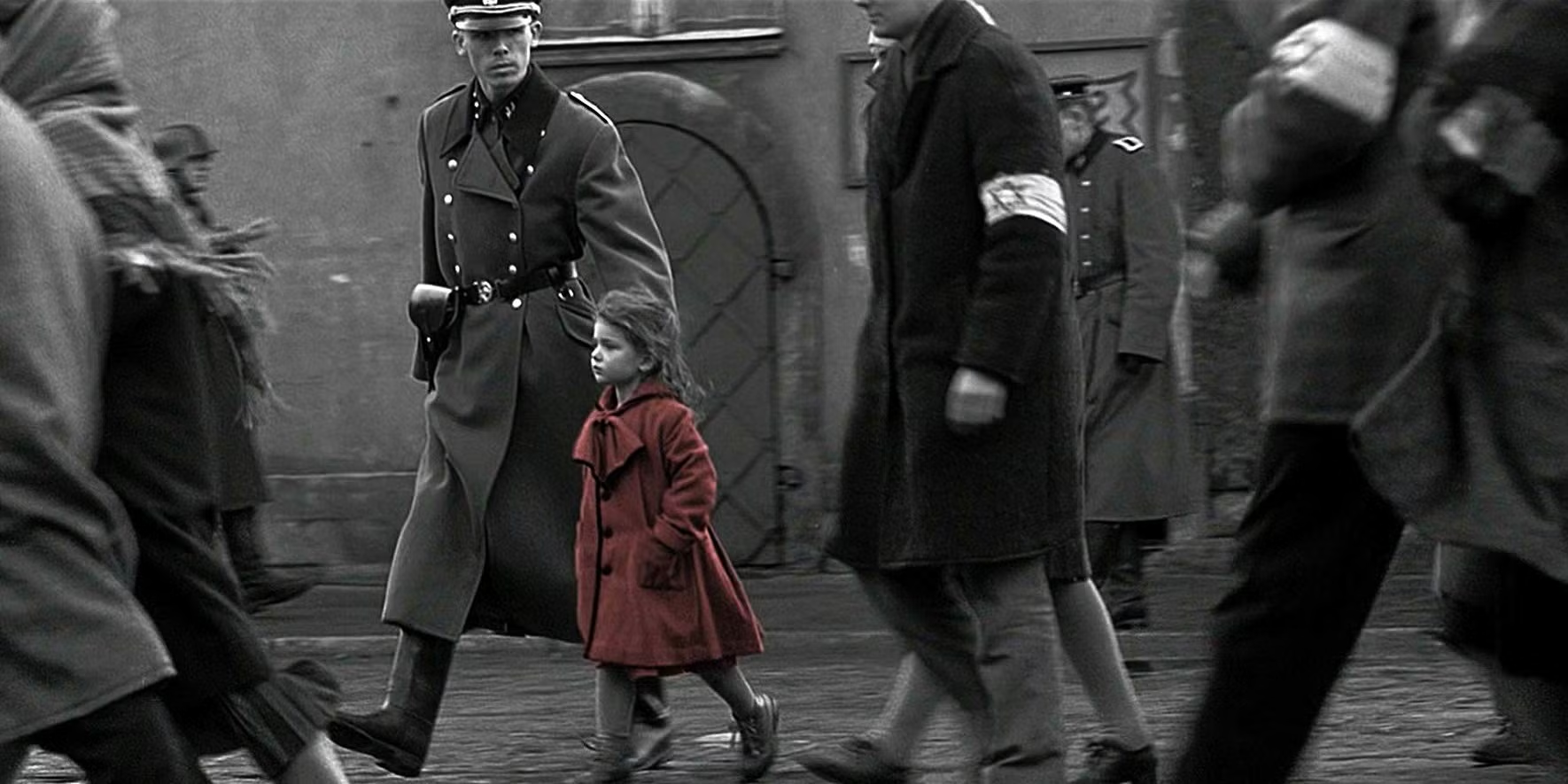
This looser sense of "foregrounding" is also at the root of all storytelling: the author is almost forced to use various methods to make it clear who and what the story is about, and which events are more important. Failing to do so would leave the reader confused, unsure what the point of reading the story was.
This is where backgrounding comes into play. It's a way to exploit the structure of foregrounding in fiction to extract truth. While foregrounding is a stylistic tool, backgrounding is a tool for cultural and linguistic learning.
To have something in the foreground, you need a background for it to stand against. That background needs to be discreet, unobtrusive, and non-flashy; otherwise it would rise to the foreground itself.
The foreground is the breaking of a rule, the background is the rule being broken.
The foreground is interesting, the background is dull.
The foreground is special, the background is normal.
(I have just foregrounded the above three sentences by making them their own short paragraphs with parallel elements. If it felt like being hammered, it did its job.)
In a story, this means that, usually, the key information the author wants you to take in is in the foreground, and you're meant to overlook—take for granted—the background stuff. But when you're a learner from a foreign country, you need to flip the author's intent upside down! A couple of examples, one for culture-learning and one for language acquisition, ought to help.
First, culture is the mass-synchronization of framings, and those framings are the entire definition of what constitutes normality among the people who share them. They must go into the background of any story written for that culture: look there to find the cultural truth in fiction.
The first time I consciously noticed this was when I watched a scene in a Japanese show (the title slips my mind) in which two lifelong friends were reunited after years of painful distance. The moment they recognized each other, their eyes lit up, they called out each other's names, and ran towards each other in tears. This scene was heavily foregrounded: the camera zoomed in on each face to catch every microexpression, passionate violins took over the soundtrack, and their running may even have been dramatically slowed down. The director's intent was clear: this reunion is a big deal, and I want you to be enthralled by its emotion.
What bothered me when I watched this scene was that the two friends immediately started talking lovingly to each other, catching up on the unbearably long time they had been apart—but they never hugged! They literally stopped running one step away from each other!

I expected them to hug intensely, squeeze each other's backs, press forehead to forehead. Instead, they didn't even attempt to touch, and it was immediately obvious, from their other actions and words, that this was not because the two lacked affection or intimacy. I could tell, because the non-hugging was left in the background, a fleeting and barely noticeable detail. This told me that, in Japanese culture, not hugging in such a personal situation is not surprising at all. It must be a natural, boring consequence of the virtual physics of that culture—the collectively shared framing. Years later, when I moved to Japan, I found that inference to have been exactly right (incidentally, this is related to why I only got to meet my Japanese friends in Italy so rarely: even meeting once a week is reserved only for the closest of friends).
Second, what does backgrounding look like when it comes to language? At its core, all language acquisition comes down to learning to spot and avoid weird word choices.
When you're just getting started, all word choices look like uniformly strange gibberish. Then you learn some patterns, the recognizable and predictable bits fade into the background, and only the parts you still don't understand remain surprising to you. In the intermediate stages you're forced to use word combinations that feel at least a little strange to you, because you can't reliably tell them apart from the non-strange words. You know you've reached fluency in a language when your sense of what's strange in it matches that of native speakers: that leftover strangeness is "wrong" by definition and, if you can notice it, you can avoid it.
But if fiction intentionally introduces its own strangeness and surprises, how do you tell that apart from real language strangeness? Which word choices and sentence patterns are good candidates for what's definitionally "wrong" in the language, and which are strange only for artistic effect?
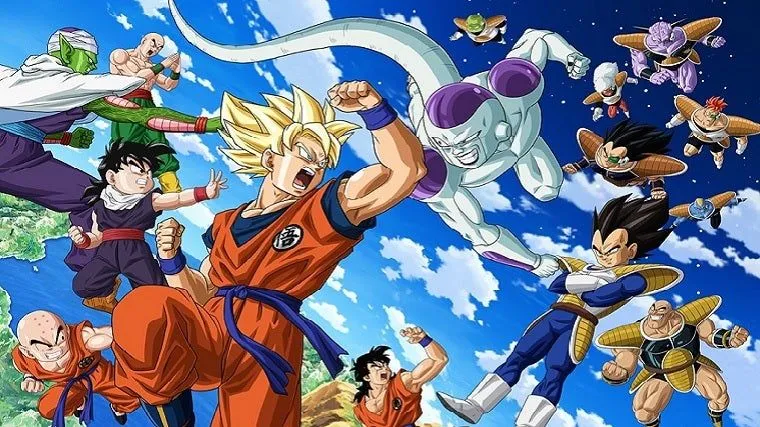
For Japanese, this problem is acute in manga comic books, especially in the subgenre called shonen (for "boy"). These tend to be some of the wackiest, most over-the-top, and sometimes silliest stories on the planet. Their characters are highly caricatured heroes and villains, and this bedlam of excesses extends to the ways they speak. When people recommend against learning Japanese from fiction, they usually have shonen manga at the front of their minds.
A case in point: heroes and villains almost always use flamboyant ways to say "I" and "you". As you may know, the Japanese language is peculiar for the large number of variants of its pronouns. There is one for every occasion, and shonen manga tend to have some very... unique occasions.
At least a couple of generations of Japanese kids grew up reading comics like Dragonball, a shonen manga by Akira Toriyama. The series' beloved protagonist, Son Goku, uses these pronouns:
- To say "I": ora (オラ)
- To say "you": omē (おめえ)
His most iconic frenemy, Vegeta, instead prefers:
- To say "I": ore (オレ)
- To say "you": kisama (きさま), mostly
If you decide to learn Japanese from Dragonball, you're in for a lot of fun. You'll also have to dodge some funky language bullets here. Except for Vegeta's ore (standard for Japanese men) you should never use any of these pronouns in real life!
Goku's ora and omē are never used by anyone today, period. They are a choice the author made to give the main character his own quirky, rough way of speaking. Vegeta's kisama does occur in real-world Japan occasionally, but only when people want to turn the insult dial up to its maximum level—which is to say almost never. Call someone kisama only when you want to pick a fight.
But what if you don't have someone to tell you which of those words are strange, like I did just now? Background it on your own. Assume from the start that the foreground characters' manner of speaking is idiosyncratic and non-transferable. Enjoy it as something that is supposed to be strange, then learn from what's left.
This page from a volume of Dragonball exemplifies the distinction I'm talking about.
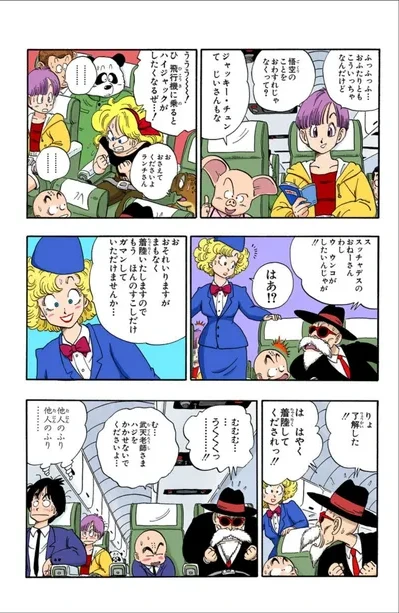
The page features six recurring characters and three "extras" that only ever appear in this one scene. Of the six cast members, this scene particularly foregrounds Lunch, the angry blonde girl, and Master Roshi, the old man. Both of them are rather unusual types (Lunch switches personality every time she sneezes, and Roshi is a nutty hermit), and both speak in proportionally funny ways—not the Japanese you'd want to imitate. On the other hand, the cabin attendant lady (the only extra who speaks) is all background: her clothes are ordinary, her reaction to Roshi's antics is real-world natural, and her Japanese is perfectly standard. Excellent learning material.
To avoid learning from foreground elements, you need to know with some confidence where the foreground ends and where the background begins. If you were already fluent in the culture and tongue of the narrative, the distinction would be irrelevant: you could let the story do its work on you and enjoy the effects of its foregrounding. But as a learner you find the boundary by asking yourself: why does this story even exist?
You don't need to study literary theory to know that every tale needs to justify itself—a story can do perfectly well without a clear goal, moral, or discernible message, but it won't work if the reader can't even figure out the reason why someone would want to tell it (AKA its tellability). In the universe of all good and passable stories, the presence of tellability might be the only trait they all have in common.
Your task is to figure out the raison d'être of every story you consume, because that constrains what it's likely to foreground.
- Is it being told because it recounts unusual circumstances or interesting coincidences exposing a hidden facet of human nature?
- Is it because the characters involved are special or unique?
- If the story looks ordinary in all parts, is it justified by the unforeseen consequences it had later on, thus demonstrating how small things can contain the seeds of great ones (e.g. story-shaped biographies)?
These are only a few possibilities among many. Sometimes there is nothing inherently special in the events and people depicted, but the way the story is narrated makes it deeply interesting, affecting, or relatable—think of James Joyce's Ulysses: a handful of otherwise mundane, forgettable, and inconclusive scenes narrated in a way that changed literature forever. Pinpointing the tellability of a story is an art rather than a science, and an easy one to learn.
The easiest trick, when available, is to look at the story's genre. A comedy's tellability is, at least in part, to entertain you and tickle your sense of humor; look at the non-funny parts to find the normal, i.e. the parts safest for you to learn from. Action stories instead tend to justify themselves with the thrills and adrenaline they inject into you; the safe, slow-paced, and relaxed parts are probably background.
Sci-Fi and fantasy stories typically exist to bring you into interesting imaginary worlds, so they warrant a closer look. In these genres, even things that would usually be part of the background are foregrounded. When the whole premise of a tale is the whimsy or novelty of the cultures it explores, what can you take away from it about the culture of its target audience?
In my experience, what usually remains in the background here are the most entrenched framings of that culture and (what the author believes to be) the more basic human universals. This is easier to spot when you look at older works in the genre, where the underlying values and ideals stick out for their quaintness and anachronism: female scientists are almost non-existent in Verne's works, and the only truly happy place in Middle-earth is the un-industrialized, rural land of the hobbits.
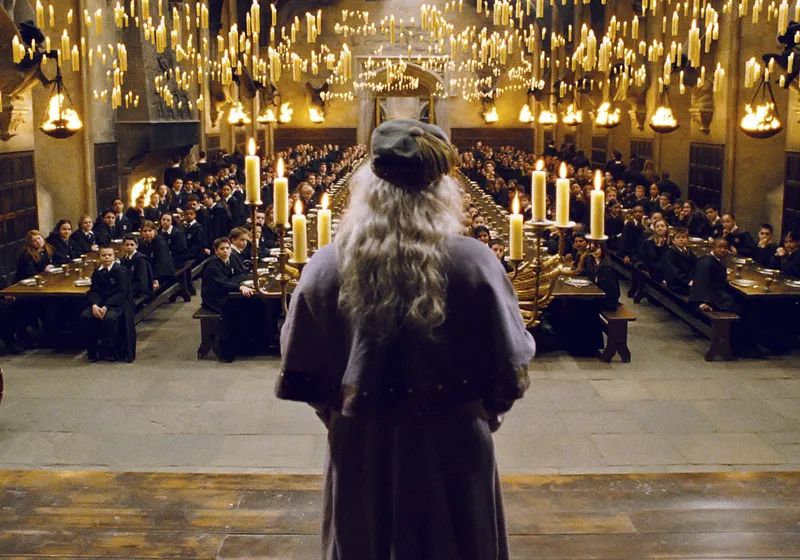
Language is less affected by the intentional fancifulness of fantasy and science fiction: even when a story seems full of invented words, it must follow conventional grammar and word choices the vast majority of the time, or risk being incomprehensible, extremely tiring to consume, or both.
Even when a story's genre makes its foreground/background commitments clear, even when it is firmly set in a realistic-looking contemporary rendition of a real culture, the technique of backgrounding is far from exact. Every individual work is a subjective interpretation, a curation of elements, a set of more or less unconscious stereotypes. Cultures have varied subcultures within them, and any seemingly ordinary element might be an inside joke or a reference in disguise. Backgrounding works well only statistically: you need to read, watch, and listen to many stories, of many types and shapes, to triangulate the underlying truth and average out the idiosyncrasies that even the backgrounds contain.
I see it as a sort of economy of scale: no single work of fiction is safe to learn much from on its own, but the backgrounds of ten, thirty, a hundred of them will give you surprisingly solid material. This is good news for any prospective learner, because it means you can read whatever you want, without fear of your learning being embarrassingly skewed.
Are you so picky that the only kind of content that keeps you engaged is superhero fan-fiction, or psychothrillers, or furry erotica? I'm here to tell you that you can do serious learning with it. Forget about textbooks and courses: you can acquire most of what you need about a real-world society's customs and tongues by only consuming lots of whatever genres you like, as long as they're made for people in that society. Of course, quantity is not the whole point: you must also learn to notice what the author doesn't need you to notice. Then maybe even a very foreign country, like Japan was for me, will become as welcoming as a home away from home. ●
Cover image:
A Kanbari-nyūdō ghost, from Konjaku Gazu Zoku Hyakki by Toriyama Sekien
 Framings and ModelsMindLanguage
Comments
Loading comments...