Please Don't Shame the AI Writers
A case for an uncomfortable middle ground
Marco Giancotti,

Marco Giancotti,
Cover image:
Homer playing the violin, in the company of a pupil, follower of Pier Francesco Mola
Thinking tools in this post:
As someone who writes often and at length about the relativity of boundaries and the complex interrelation of everything with everything else, I find most black-and-white opinions, most expressions of certainty, and most refusals to listen to differing points of view distasteful.
If the way I perceive the world depends on the framings I and others have built in my mind, and if there is no such thing as a right or wrong framing without stating a context, then certainty should be the rarest of mental phenomena—a cognitive chimera I'd rather avoid even when applicable, in case it decides to swallow me up. This is the first of Bertrand Russell's Ten Commandments.
This worldview, or worldview-openness, frequently leads me to be that guy in a conversation who places himself in the middle, accepts some part of each side's arguments but neither side's fully, proposes conciliatory tweaks to the basic assumptions and suggests leaving some questions tentatively unanswered. I'm that guy who throws "most", "tend", "often", and "perhaps" around a lot.
Most people don't like that guy.
Some think it's a sign of weakness not to take a clear, sharp stance on a hot topic. Others even find it immoral. Many take my unwillingness to fully side with them as a declaration of war, and promptly categorize me with their enemies. The majority simply chooses to ignore me, either because the shades of gray I offer are confusing, or because they're too busy keeping their eyes on the ball kicked by their official counterparts.
This is understandable. Asking someone to consider exceptions and counterarguments to their rock-solid convictions sounds very much like playing devil's advocate, and who wants to be in Satan's camp?
Besides, I do more than nitpick. I believe that most long-lasting disagreements are caused by the implicit mismatch of goals rather than logic, so I often end up suggesting that people declare and/or compromise on their respective aims to find common ground. That can be annoying. On top of that, my approach slows things down considerably, and no one's got time for that, right?
My behavior is almost a kind of self-ostracism. It would be far easier and more pleasant to simply embrace the dark side (or the light one, depending on who you ask; either's fine) and be warmly welcomed into the proud ranks of whichever side I think is even slightly less wrong. I do the middle-ground thing because it usually teaches me much more, and because it offers others a big upside and a small downside (if they do change their minds, it's usually for the better). Sometimes it turns out that there is no useful middle ground, but that case is much rarer than people think.
Now, that was quite a preamble! I felt it was necessary, because boy is the topic of AI slop touchy nowadays! I want to propose an approach to that debate that tends to freak people out, but I think it's important precisely for that reason.
I want to ask for a moratorium, in certain cases, on AI-written text.
Everyone hates slop, and for good reasons: it's everywhere, it's extremely repetitive in its choice of words and sentence structure, and it's very often abused by content farms, salespeople, and whoever succumbs to the allure of automated engagement.
AI slop is bad. The stop must slop. I mean, you get the point. There isn't a real debate here, because the slop producers have no interest in discussing the matter. Nothing to tickle my middle-ground instinct. I happily join the slop-haters.
But a real debate does exist very close to this topic: should well-meaning people be allowed to use LLMs to put their thoughts into words? This is not a question of "AI slop" proper: we're not talking, here, about people selling anything or unilaterally flooding others with content-free content. We're talking about folks who want to share their ideas, reports on their activities, and other real, personal outputs but, for one reason or another, feel that doing it with an LLM would yield better results.
The camps, here, are pretty well-defined. The YES side can't see what the problem even is: the LLM is merely presenting the work they (humans) did, the ideas they wrote in the prompts, only much faster and/or better than they would otherwise. The NO side has learned that LLM-speech patterns are a very good predictor of time-wasting slop, and sees a full ban (or, more feasibly, a cancellation) as the only solution.
They talk past each other:
YES: It's just like putting makeup on my text. People have no problem with makeup.
NO: If you can't be bothered to write it yourself, why should I bother reading it?
Y: Focus on the content, not the word choices. Don't be shallow.
N: The word choices are too distracting to read more than one or two sentences.
Y: I'm bad at writing/I hate writing/my specialty is X, not report-writing, and I have the right to spend most of my time on the tasks I'm best at.
N: The skill of presenting to others is a core aspect of the work of anyone who wants to share ideas: get your act together.
I read these things, and I feel tickled from head to foot: neither party is even trying to understand the other!
It seems obvious to me that the YES people are using AI way too naively, without much reflection beyond "convenient be good!" or "I'm free to do what I want! AMERICA!" I can't bring myself to agree with them: I consistently choose to write all of my posts, notes, and personal messages the slow and inefficient finger-pressing way. The one time I did post something through an LLM was an open experiment, with my own analysis of the experience concluding that "LLMs can't write a good blog post, under my definition, yet. Surely not from scratch, and apparently not even when given a human-crafted seed."
But I do let AI write a lot of code in my stead. I have also found it satisfactory for some work artifacts: the first drafts of a new internal policy, IT incident reports, summaries of meeting decisions, things like that. Until very recently, I couldn't put my finger on a simple heuristic, but it was clear to me that there were (at least) two categories of AI-generated text: those where AI sucks irredeemably and those where it is good enough if carefully steered, reviewed, and hand-corrected. This second category seems to have grown in the past year of AI advances. For these reasons, I can't bring myself to fully agree with the NO group either—the ones asking for a blanket ban on all AI-generated words.

So I did something unusual and attempted to engage with the topic on social media. I chose to talk with the NO group first, because they're the ones trying to bootstrap a new moral rule, and once a moral rule spreads in a population it's very hard to go back.
I expected the usual kind of defensiveness, and I got plenty of it. Most people, as usual, simply ignored my reasoned comments, which I posed as open questions rather than strong assertions (people still tend to interpret my questions as loaded or rhetorical, which no amount of care in formulation on my part seems to prevent). Some avoided addressing my arguments and appealed to their expertise as if only they could know what writing means; then, when gently pressed for reasons, they left the conversation saying that they're "not trying to change anyone's minds". One of them did the old trick from third grade of replying "No." and then immediately blocking me, ensuring that their word was final and, therefore, right.
Those behaviors are discouraging, but nothing new to me. When I realized that the simple act of posing those difficult questions was annoying someone, I apologized and let them be. But after doing this a few times, something else bothered me: I could find no one willing to engage earnestly. This, in my experience, is much rarer, and it started getting under my skin.
Maybe my judgment was blinded by AI psychosis? Maybe the hints of a possible nuance I noticed were nothing more than mirages everyone else saw through? My human tendency to synchronize with the majority clashed with the intuitions I've honed over decades. I actually felt a bit bad about it.
Then Charity Majors published a post titled Confessions of an Unrepentant Slop Snob. It's about the thought process that went into writing a new set of AI guidelines for Majors' company (honeycomb.io), and what I read encouraged me. They saw the same divide I saw! They hated AI slop like me and everyone else—but they also recognized that sometimes AI outputs are quite acceptable. They went further than me, though, and proposed a framework to understand this.
The axis they chose is Personal-Functional: at one extreme is text where "the value is that it comes from a specific person who thought or felt it", which makes no sense unless it is written fully by a human; at the other is text whose value "is about the idea being communicated, not the person who said it." I'll call this the Honeycomb Slop Framework.
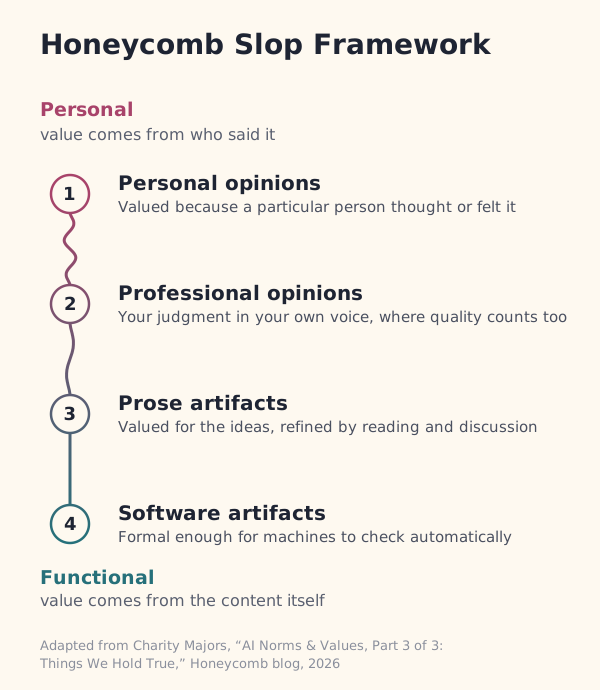
Majors intentionally avoided making this into two sharp categories. All gradations are possible, though they identify four notable steps. Personal thoughts/feelings are squarely on the human side. Professional, role-centered communication is one step in the functional direction, so the framework allows for some AI use, albeit with care and with a solid core of human input. All sorts of work artifacts, like plans, design docs, and records, are mostly functional, while code is fully functional and AI-assignable. This maps well to my own experience and brings clarity to this muddled topic.
The blog post reaches a very sane conclusion:
This means that humans who want to use it for interpersonal interactions will need to work hard to compensate for the loss of trust it engenders. It can be done — it’s not impossible. But it will not work to simply deny this effect and shove AI-generated happy birthdays and performance reviews down everyone’s throats. Not in 2026.
I was not going crazy after all! There is a path to some nuance here. I feel much better now, and I have Charity Majors to thank. I hope this kind of thinking spreads and sparks some much-needed debate.
I think we should go further: Majors declares that they are among those who auto-trash any blog post or newsletter that is clearly written by AI, because "AI slop isn’t a perfect proxy, but it’s a decent weeder."
I sympathize, and this is sound Bayesian inference: most "content-free content" nowadays is written by AI, and not many people who actually have something to say use AI to say it, so it is optimal to conclude that something that looks AI-written is indeed AI slop. It works very well as a weeder, so I can't blame people for doing that. I find myself doing it instinctively, too.
But the part that worries me is not people applying their own filters; it's people trying to popularize a stigma against anyone who shares AI-written text, period. They want to actively shame people for doing this. Again, I'm not trying to argue that such public humiliation must never happen; I just want people to slow down and make very sure that this is a good idea before it's too late.
Here are my grounds for caution.
AI is a new tool. No one really understands how it can do what it can do, and very few people have even an inkling of how to use it effectively. Most still think that a single prompt is all you need to achieve virtually anything—you just need to put the words in the right order. I call it the Magic Wand Illusion and wrote a long analysis of the many facets of this problem. I looked in depth at what kind of thinking should and shouldn't be delegated, which tasks can or can't benefit from AI use, and other very "grayscale" questions like that. My conclusion was this: using an LLM well for anything, including writing, is hard work and requires a skillset—metacognition—that many people don't exercise much. Even in the field of software engineering, where people are most bullish and enthusiastic about using AI for everything, we are still learning how to do it well, and the pitfalls abound.
Then, could it be that we just haven't yet learned to harness LLMs well for writing? Could it be that we are yet to discover the methods and skills to make AI produce pleasant, meaningful text and faithfully carry the human intents and ideas forward, in a way that brings net benefits for all involved?
To earn the right to answer that, one would have to try really hard to do it.
I didn't try hard, so I can't answer yet. It could be that no amount of human effort can win against the "dehumanizing" powers of language models. It could be that even a human who spends 60 minutes guiding a model to write a text that would otherwise have taken 62 is doomed to produce repulsive nonsense. Maybe banning every single paragraph with signs of Claudese or GPT-ese is the way to go.

But we simply don't know yet, because we haven't given it enough time. Suppose, for a minute, that there is a way to write well and meaningfully and beautifully with the aid of AI. No one has figured that out yet, but it's possible. If it were possible, then it would be great for the writers, and also good for the readers, who would gain access to more meaningful writing from more people, including those who, until now, could not share their ideas for lack of confidence and/or writing skills.
When you start learning to play the violin, there is an initial period in which all you can produce is horrible screeches that send everyone running. Maybe we're in the screeching stage of AI writing. If you stick with your violin, you eventually learn to make more palatable sounds. If a similar improvement is conceivable with LLMs, we need people to experiment until they figure out how to do it right. That is not possible if a blanket ban is applied.
The optimal Bayesian update mentioned above hinges on this sentence: "not many people who actually have something to say use AI to say it." If many, or all, people with something meaningful to say did use AI to say it, the weeding filter would break down: the signal-to-noise ratio online would go back to pre-AI levels, which were already pretty bad but required deeper judgment to sift through than Pangram can provide.
We need to let people try, and we need those who try to work hard and carefully at it, always keeping in mind how their outputs might hurt, annoy, and sow distrust. Each of us is free to choose to engage with AI-written text or not, but shouting at and blaming its users regardless of its contents is not a constructive way forward.
Besides, even if it turns out that AI writing is simply irredeemable after all, the process of trying to make it work would let us explore and better understand some previously unassailable questions, like:
- How to effectively extract meaning from a sea of noise?
- How to distinguish what has meaning for me from what has meaning for others?
- What makes a message "personal"? Is the effort you put into writing the thing that matters, or is that just a proxy for something deeper, like attention and care? And can that deeper thing be proxied effectively in a different way with AI?
Time for me to withdraw from the ring and report back to my horned master. ●
Cover image:
Homer playing the violin, in the company of a pupil, follower of Pier Francesco Mola
Thinking tools in this post:
 AIFramings and ModelsMind
Comments
Loading comments...